


















Lesson 6 of 45 · What Is Ethics
Ethics, Law and Etiquette
Compare morality, law and etiquette: what each rule system demands, who enforces it, why legal is not always right, and what civil disobedience teaches.
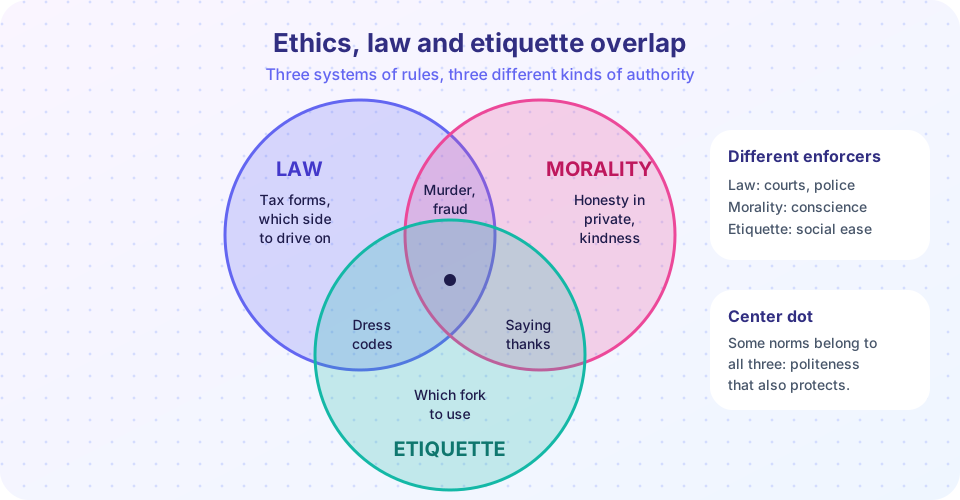
You are at a dinner. Using the wrong fork is a social slip. Parking in a reserved space is against the rules and may bring a fine. Letting a friend down after promising to help is neither a social slip nor a crime, yet it feels wrong. Three different systems of rules are at work: etiquette, law and morality. They overlap and they pull apart, and learning to tell them apart is the first step in thinking about ethics clearly.
This lesson compares them, asks what makes morality special, and examines the cases where law and morality clash, from slavery to civil disobedience.
What you will learn
- The defining features of law, morality and etiquette.
- Why an act can be legal yet wrong, or illegal yet right.
- What research on moral and conventional rules (Elliot Turiel) suggests.
- How thinkers such as Mill, Hart and King discussed the relation between law and morality.
Key terms
Law: rules made and enforced by a political authority, backed by sanctions.
Convention: a custom that exists because people expect each other to follow it.
Etiquette: conventions of politeness and social ease.
Civil disobedience: open, non-violent breaking of a law to protest its injustice, accepting the penalty.
Legal positivism: the view that what counts as law depends on social facts, not on whether it is moral.
Three systems of rules
| Law | Etiquette | Morality | |
|---|---|---|---|
| Source | Legislatures, courts, constitutions | Local custom, habit | Reasons, conscience, shared values |
| Enforcer | Police, courts | Social approval and disapproval | Conscience, guilt, blame |
| Varies by place? | Yes, a lot | Yes, a lot | Disputed: this is the question of relativism |
| Can it be changed by decision? | Yes, by vote or decree | Gradually, by habit | Disputed: we discover or decide it? |
| Typical subject | Contracts, crimes, taxes | Greetings, dress, table manners | Harm, fairness, honesty, loyalty |
Law has the clearest mechanism: a recognized authority makes rules and punishes breaches. Etiquette has no official enforcer. It works through approval, embarrassment and the desire to fit in. Morality is harder to pin down. It does not depend on any authority, yet it can bind us even when nobody is watching.
Legal but wrong, illegal but right
Law and morality overlap heavily. Almost every legal system forbids murder, theft and fraud, and those are also moral wrongs. But the overlap is partial.
Legal but wrong. Many societies once legally permitted slavery. The Fugitive Slave Act of 1850 in the United States required citizens to help return people who had escaped enslavement. Racial segregation was legally required in parts of the US until the 1960s and in apartheid South Africa until the early 1990s. Today these laws are widely judged to have been unjust. Smaller examples are everywhere: betraying a friend's confidence or lying to a partner is rarely illegal and usually wrong.
Illegal but right. Those who helped people escape slavery through the network now called the Underground Railroad broke the law. So did some people who sheltered Jews from Nazi authorities. In each case, many people now judge that the law was wrong, and the lawbreaking was admirable.
This gap is the reason ethics cannot be reduced to law. If "legal" and "right" meant the same, it would make no sense to say that a law is unjust.
What is special about morality?
Developmental psychologist Elliot Turiel (1983) proposed that even young children distinguish moral rules from conventional ones. Moral rules concern harm, fairness and rights. Conventional rules, such as wearing a uniform or standing in line, depend on what authorities and groups have decided. In studies he described, children tended to say that a school rule about gum could be changed if the teacher agreed, but that hitting another child would still be wrong even if the teacher allowed it. The exact findings vary across cultures and ages, and researchers debate where the boundary lies, but the pattern suggests morality has a feature we sense early: it seems to be authority-independent.
Philosophers have found it hard to say exactly how etiquette differs from morality. Philippa Foot (1972) noted that etiquette also uses "must" and "should" ("you should not use your fingers") without being obviously binding on us. What we think of as morality seems to carry more weight: we are more ready to blame a violation, we ask for justification and we feel guilt, not just embarrassment. But there are borderline cases. A custom of greeting people politely is etiquette in one view, yet it can express respect, which is a moral value.
Should law enforce morality?
Another question is how far the law should go. John Stuart Mill argued in On Liberty (1859) that the state may limit a person's freedom only to prevent harm to others. On this "harm principle", conduct that harms only the person who chooses it, such as a private lifestyle, should not be criminalized merely because others find it immoral. Lord Devlin disagreed in the 1950s and 1960s, arguing that a society may protect its shared moral fabric. H. L. A. Hart replied that society should not punish conduct simply because it is disliked. The debate continues in disputes over drug laws, speech and public decency.
Philosophers of law also disagree about whether an unjust law is really law. Legal positivists, such as Hart, say that whether something is law depends on social facts such as who made it and how, not on its moral merit. Natural law thinkers hold that a seriously unjust rule lacks full legal authority. In a letter written from a Birmingham jail in 1963, Martin Luther King Jr. cited Augustine to argue that an unjust law is "no law at all" in the moral sense, and then explained that civil disobedience must be open, non-violent and willing to accept the penalty.
Common misconceptions
"If it is legal, it must be fine." The history of unjust laws shows otherwise. Law is a minimum standard that some societies set badly.
"Etiquette is trivial, so it has nothing to do with ethics." Many conventions express respect, and mistreating someone through rudeness can be a moral failing. The point is only that rules of etiquette are not what ethics is mainly about.
"Morality is just the law plus religion." Morality can criticize both. Many people hold moral views that no law enforces and some that no religion teaches.
Try it
The first demonstration is a scatter plot that places everyday norms along two scales: how much the norm varies between societies, and how much harm or unfairness is at stake. The ratings are illustrative judgments made for this lesson, not measurements. Notice how they spread between "convention" and "core morality".
Press Run (or Ctrl + Enter) to see the result here.
Program input · what you'd type while the program runs
Type the answers before you press Run, one per line. Each time the program reads a line (with input()), it gets the next line from this box.
The second demonstration is a four-quadrant explorer. Click a quadrant to see examples where the law and morality agree or disagree.
Check your understanding
Quick check · 5 questions
of 5 answered You scored / 5 · perfect!
-
1. Which pair of terms best distinguishes law from etiquette?
Law has official enforcers and penalties; etiquette is maintained by social pressure and habit. -
2. Why does the existence of unjust laws matter for ethics?
If legal and right meant the same, it would be meaningless to call a law unjust. -
3. Turiel's work suggested that children tend to treat harm-based rules as
He reported that children distinguish moral rules (still wrong if allowed) from conventions (changeable by authority). -
4. Mill's harm principle holds that the state may limit a person's liberty mainly to
In On Liberty, Mill argues that preventing harm to others is the main justification for interference. -
5. Civil disobedience, as King described it, is
He stressed openness, non-violence and willingness to accept the consequences.
Summary
- Law, etiquette and morality are overlapping but different systems with different sources and enforcers.
- Acts can be legal but wrong or illegal but right, so morality can be used to criticize law.
- Research such as Turiel's suggests children distinguish moral rules from conventions, though the boundary is debated.
- Mill's harm principle, the Hart-Devlin debate and civil disobedience show how seriously the relation of law and morality is debated.
Track your progress
Create a free account to tick off lessons and pick up where you left off on any device.
of Ethics lessons completed