


















Lesson 18 of 45 · Deontology
The Trolley Problem and the Doctrine of Double Effect
Explore the switch, footbridge and loop trolley cases, the doctrine of double effect, doing versus allowing, and what survey data and critics say about them.
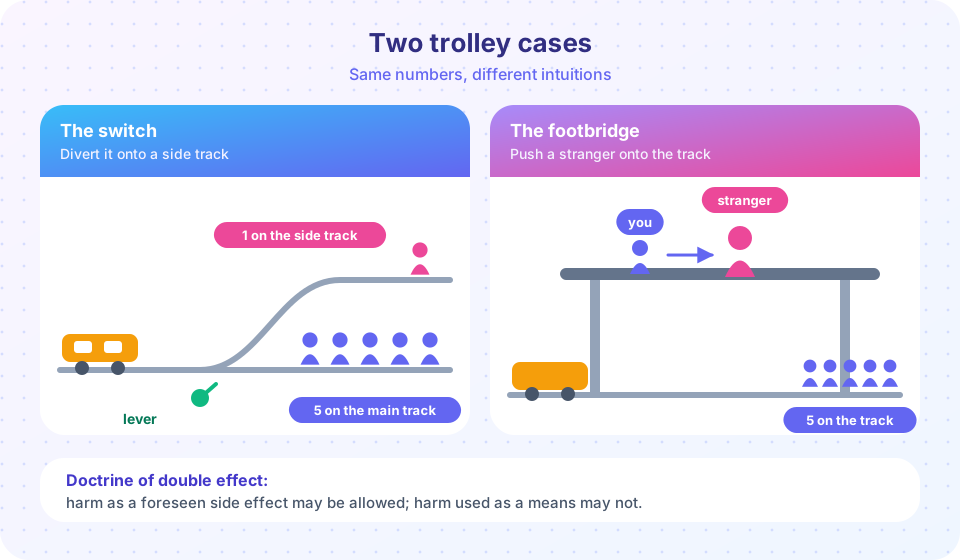
A runaway trolley is heading toward five people who cannot get out of the way. You are standing next to a lever. If you pull it, the trolley will switch to a side track where it will kill one person instead of five. Should you pull the lever?
Most people say yes. Now change the case. You are on a footbridge above the track, beside a large stranger. The only way to stop the trolley is to push the stranger off the bridge, so that his body blocks the trolley. He will die; the five will live. Should you push? Most people say no. Yet the numbers are the same: one dies, five live. What makes the difference? Trying to answer this question has produced a whole research field.
What you will learn
- The origins of the trolley problem and its main variants.
- Distinctions philosophers draw: doing and allowing, intending and foreseeing, means and side effects.
- The doctrine of double effect and its strengths and limits.
- What survey data show, and why trolley cases are criticized.
Key terms
Trolley problem: a family of dilemmas about killing one person to save several.
Doctrine of double effect (DDE): a principle that distinguishes harm intended as a means or end from harm foreseen as a side effect.
Doing versus allowing: the distinction between causing harm and failing to prevent it.
Intending versus foreseeing: aiming at a harm versus knowing it will come about without aiming at it.
Permissible: morally allowed (not required).
Where the problem came from
Philippa Foot introduced the case in a 1967 paper on abortion and the doctrine of double effect. She imagined the driver of a runaway tram who can steer onto a track with one worker instead of five. She used it to compare cases in which harm is a foreseen side effect with cases in which it is intended. Judith Jarvis Thomson later developed the problem in two papers (1976, 1985) and added the bridge and the loop. The name "trolley problem" is hers.
The main cases
- Switch (bystander). Pull a lever to divert the trolley to a track with one person. Most people judge it permissible.
- Footbridge. Push a stranger onto the track to stop the trolley. Most people judge it impermissible.
- Loop. The side track loops back toward the five. The trolley would kill them anyway, except that the one person on the loop is heavy enough to stop it. You pull the lever. Many people judge this permissible, at least more than the footbridge, though less clearly than the plain switch.
- Transplant. A surgeon could kill one healthy patient and use the organs to save five. Almost everyone says no.
In one large online study (Hauser and colleagues, 2007), about nine in ten respondents judged the switch permissible and only about one in ten judged pushing permissible. Later studies, including the Moral Machine experiment (Awad and colleagues, 2018) with about 40 million decisions from people in over 200 countries and territories, found broad patterns, such as a preference for saving more lives, as well as notable variation between regions.
Principles that try to explain the difference
Consequentialism. The cases are the same: one death for five lives. So pushing is just as permissible as pulling. Consequentialists accept the verdict and argue that our resistance to pushing is an emotional reaction, an idea Greene develops, which should not guide us.
Doing versus allowing. Killing is worse than letting die. But in both cases you do something that results in a death, so this distinction does not explain the contrast.
The doctrine of double effect. The doctrine goes back to Thomas Aquinas's discussion of self-defense. In its modern form it says that causing a harm can be permissible if (1) the act itself is not wrong, (2) the bad effect is not intended, whether as a means or as an end, (3) the good effect is not produced by means of the bad effect, and (4) the good outweighs the bad. In the switch case, the death of the one is a foreseen side effect: you would be delighted if the person escaped. In the footbridge case the stranger's body is the means by which the trolley is stopped: the harm is intended. The doctrine therefore says switch yes, footbridge no.
A classic application separates strategic bombing (hitting a military target while foreseeing civilian deaths as a side effect) from terror bombing (killing civilians in order to demoralize the enemy). Another is in medicine: giving strong pain relief with the foreseen risk of hastening death is often distinguished from giving an overdose in order to cause death. In each pair, the doctrine locates the difference in the agent's intention.
Problems with double effect. The loop case makes trouble: the one person's body is the means of stopping the trolley, so the doctrine forbids pulling the lever, yet many people think it permissible. Critics also argue that it is hard to say what counts as "intended": could you not simply decide to "intend" only the diversion? Defenders reply that the test is whether the harm plays a role in your plan so that, if it failed to occur, the plan would fail. Other philosophers, such as Frances Kamm, propose alternative principles, for example about the causal structure of harm, and others suggest that contact, personal force or the use of a person as a tool matter.
Do trolley cases tell us anything?
Critics raise several worries.
- Unrealistic. Real situations involve uncertainty, institutions and many agents. Why trust intuitions about a fantasy in which you know all the outcomes with certainty?
- Variation. Responses differ across cultures, and wording and order can change answers, as discussed in Chapter 1.
- Artificiality. Some say the cases invite a calculating mindset that distorts ordinary moral thinking. Defenders reply that an unrealistic case can isolate one variable and is no more artificial than a controlled experiment.
- Practical relevance. The problem has returned in discussions of self-driving cars, which must be programmed for collisions. Many ethicists argue that this framing is too narrow, since real safety design aims to reduce the chance of such situations, and public opinion alone should not decide how to value lives.
Common misconceptions
"The trolley problem has a correct answer." Philosophers still disagree. The point is to identify the principles our reactions rely on and test them.
"Pulling the lever means you are a utilitarian." A deontologist who accepts double effect also pulls the lever. The cases separate theories only when combined with a reason.
"Double effect says intentions are all that matter." The doctrine includes proportionality and conditions on the act and on causation, not just intention.
Try it
The first demonstration shows how to read survey results about a trolley case. The proportions are invented values chosen to illustrate the technique, not real data. It computes a 95% confidence interval for each proportion, a range that shows how much sampling alone could move the result. Try changing n, the number of respondents.
Press Run (or Ctrl + Enter) to see the result here.
Program input · what you'd type while the program runs
Type the answers before you press Run, one per line. Each time the program reads a line (with input()), it gets the next line from this box.
The second demonstration is a principle tester. Give your own verdict on each case, then see how many of your verdicts each principle matches. This is a tool for reflective equilibrium (Chapter 1). If your verdicts differ from all the principles, that is interesting too.
Check your understanding
Quick check · 5 questions
of 5 answered You scored / 5 · perfect!
-
1. Who introduced the original tram case in a 1967 paper?
Foot's paper on abortion and the doctrine of double effect introduced the case; Thomson later named and extended the problem. -
2. According to the doctrine of double effect, the footbridge push is wrong mainly because
The stranger's death is the means by which the trolley is stopped, so it is intended. -
3. Which case is hard for the doctrine of double effect?
The loop's victim is a means, yet many people think diverting is permissible. -
4. What is the main reason some philosophers think trolley cases tell us little?
Critics point to artificiality, framing effects and cross-cultural variation. -
5. 'Foreseeing but not intending' a harm describes
DDE separates harms aimed at (means or ends) from foreseen side effects.
Summary
- Trolley cases (switch, footbridge, loop, transplant) isolate what makes killing one to save five permissible or not.
- The doctrine of double effect distinguishes intended harm from foreseen side effects, but the loop case challenges it.
- Consequentialists hold that all the cases are alike in result; deontologists propose principles about means, doing and allowing.
- Intuitions about trolley cases are fragile and culture-sensitive, so they are best used as one piece of evidence.
Next: Chapter 4 Review
Track your progress
Create a free account to tick off lessons and pick up where you left off on any device.
of Ethics lessons completed