


















Lesson 19 of 45 · Deontology
Chapter 4 Review: Deontology
Review chapter 4: deontology, Kant's categorical imperative, Ross's prima facie duties, rights, the trolley problem and double effect, with a ten-question quiz.
Deontology gives a different answer to the question "what makes an act right?" It says that right and wrong are not settled by results alone. There are duties, rights and limits that protect persons. In this chapter you saw this idea in three forms: Kant's test of universal law and his principle of respect for persons, Ross's plural duties weighed by judgment, and the theory of rights as claims that outrank ordinary appeals to the general good. You also saw how the trolley cases and the doctrine of double effect probe the limits.
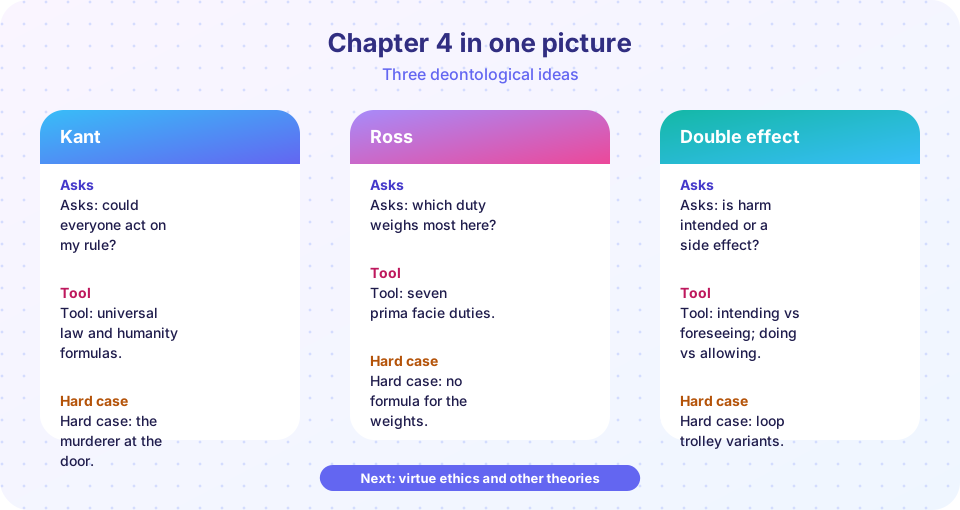
The chapter at a glance
| Lesson | Big idea | Key terms |
|---|---|---|
| Deontology: Duties, Rights and Limits | Some acts are forbidden whatever the results; constraints and options. | Constraint, option, threshold deontology |
| Kant and the Categorical Imperative | Act on maxims you could will as universal law; never treat persons merely as means. | Good will, maxim, categorical imperative, autonomy |
| Duties and Rights | Seven prima facie duties; rights as claims, liberties, powers, immunities. | Prima facie duty, claim right, rights as trumps |
| The Trolley Problem and Double Effect | The difference between intended harm and foreseen side effects. | Doing vs allowing, intending vs foreseeing |
Consequentialism and deontology compared
The two families can often agree about what to do, and they disagree most sharply in "hard" cases where a harm to one person would bring great benefits to others. Some contrasts to keep in mind:
| Question | Consequentialism | Deontology |
|---|---|---|
| What makes an act right? | The goodness of its outcome | Fit with duties, rights and constraints |
| Can good results justify any act? | In principle yes, if the total is best | No: some acts are ruled out |
| Whose view of the agent? | A channel for good results | An agent with their own responsibilities and projects |
| Typical objection | Can justify harming the innocent | Seems to ignore terrible results; unclear how to rank duties |
Many contemporary philosophers try to combine elements, for example by accepting constraints plus a duty of beneficence, or by using rule consequentialism, which reaches deontological-sounding rules from consequentialist foundations.
Try it
The first demonstration is a short program that applies three decision procedures to three scenarios: a maximizer (best outcome), a constraint-respecting chooser (forbids violating a constraint) and a Ross-style weigher (adds up signed duty strengths). The scenarios and numbers are invented to illustrate how the procedures differ. Real deontologists use judgment, not arithmetic.
Press Run (or Ctrl + Enter) to see the result here.
Program input · what you'd type while the program runs
Type the answers before you press Run, one per line. Each time the program reads a line (with input()), it gets the next line from this box.
The second demonstration is a sorting drill. Decide whether each reason for an action is the kind of reason a consequentialist or a deontologist would give.
Check your understanding
Quick check · 10 questions
of 10 answered You scored / 10 · perfect!
-
1. What does a deontological constraint forbid?
Constraints rule some acts out regardless of the outcome. -
2. Kant's shopkeeper who gives correct change only for business reasons shows the difference between
Moral worth requires acting from duty, not just conforming to it. -
3. The false promise fails Kant's universal law test because
This is a contradiction in conception. -
4. Which is a perfect duty according to Kant?
Perfect duties, such as not deceiving, admit no exceptions; helping and self-development are imperfect duties. -
5. Ross's duties are called 'prima facie' because
Prima facie duties are real but defeasible. -
6. Which Hohfeldian right correlates with a duty on someone else?
A claim right imposes a corresponding duty on another person. -
7. Dworkin's phrase 'rights as trumps' means
A right wins over arguments that appeal to the greater benefit of the many. -
8. The doctrine of double effect distinguishes
It is the contrast between harms aimed at and harms merely foreseen. -
9. Which case is the hardest for the doctrine of double effect?
The victim on the loop is a means, yet many people judge diverting permissible. -
10. What is the 'paradox of deontology'?
Critics ask why a theory that cares about victims would keep your hands clean at the cost of more victims.
Summary
- Deontology holds that duties, rights and constraints limit what may be done to persons, whatever the results.
- Kant offers the universal law and humanity formulas; Ross offers weighed prima facie duties; rights theories offer claims that act as trumps or side constraints.
- The trolley problem and the doctrine of double effect probe the distinction between intended harm and side effects.
- Deontology and consequentialism often agree, and their disagreements reveal what each theory must explain.
Track your progress
Create a free account to tick off lessons and pick up where you left off on any device.
of Ethics lessons completed