


















Lesson 28 of 45 · Metaethics
Moral psychology: intuition, reason and evolution
How do people actually make moral judgments? Hume, Kohlberg, Haidt, Greene, evolutionary debunking and the is-ought gap, with evidence, limits and a coding demo.
Metaethics asks what moral claims are. Moral psychology asks what people are doing when they make them. The two meet at an old puzzle: if moral judgment comes mainly from fast feelings, can it still be a matter of reasons? And if evolution shaped those feelings, does that cast doubt on them?
This lesson takes the evidence seriously and keeps the philosophical questions separate from the empirical ones.
What you will learn
- Hume's view of reason and passion, and the is-ought gap.
- Kohlberg's stages and Gilligan's challenge.
- Haidt's social intuitionist model and moral dumbfounding, and Greene's dual-process view.
- The Moral Machine experiment and what cross-cultural data suggest.
- Evolutionary debunking arguments, and why they are controversial.
Key terms
Moral intuition: a quick, seemingly self-evident judgment about right and wrong, arriving without explicit reasoning.
Dual-process theory: the idea that thinking involves a fast, automatic system and a slower, deliberate system.
Moral dumbfounding: holding a moral judgment while being unable to give reasons for it.
Debunking argument: an argument that a belief is unjustified because its origin is unrelated to its truth.
Is-ought gap: descriptive premises alone cannot entail a prescriptive conclusion.
Hume: passion, reason and the gap
In his Treatise of Human Nature (1739–40) David Hume claimed that reason alone cannot move us to act. Reason finds relations of ideas and matters of fact, but a desire or sentiment must supply the push. He wrote that reason is, and ought to be, the slave of the passions. Moral distinctions, he said, come from feelings of approval and disapproval.
In a famous passage he also noticed that authors often move from "is" statements to "ought" statements without comment, and he said this seems "altogether inconceivable" unless a reason is given. This is-ought gap is now a standard point: facts about what people want or what causes harm do not, by themselves, entail what we ought to do. Something has to bridge them, such as a moral principle. The coding demo below makes the gap visible.
Kohlberg and Gilligan
Lawrence Kohlberg (1950s–80s) interviewed children and adults about dilemmas, such as whether a man should steal a drug to save his wife. He proposed six stages in three levels: pre-conventional (punishment and reward), conventional (social roles and law) and post-conventional (principles). On this view moral development is the growth of reasoning, and Kant-like principles sit at the top.
Carol Gilligan objected that the scale favored one style of reasoning (justice, rights) and underplayed another (care, relationships). Later research found smaller sex differences than first claimed. Critics also point out that the stage theory has been tested mostly in Western samples, and that people often reason below their "stage" in daily life.
Haidt: the emotional dog and its rational tail
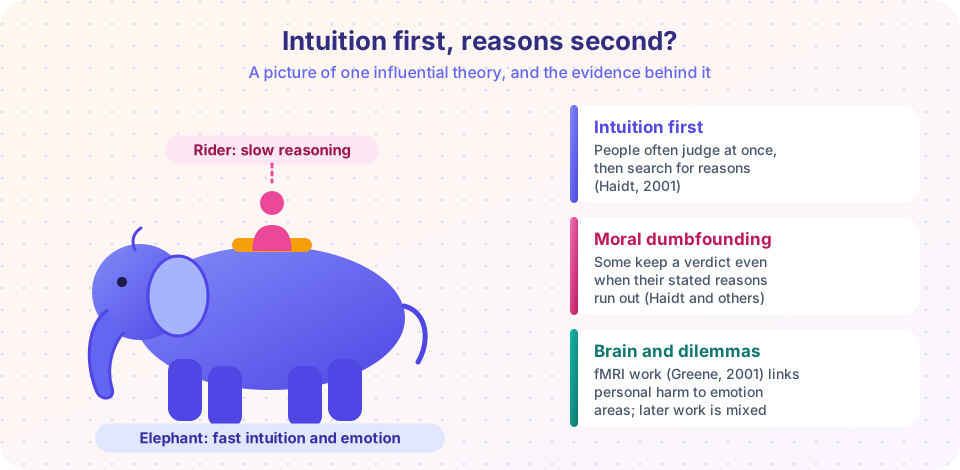
In 2001 Jonathan Haidt proposed the social intuitionist model. Most moral judgments, he argued, begin with a fast intuition. Conscious reasoning mostly comes afterwards, to justify the verdict to ourselves and others, like a lawyer for a client. Social influence (what friends say) matters more than private reasoning.
Evidence includes moral dumbfounding: when participants were given stories about harmless but disturbing acts (such as a consensual act between adults, or an unusual treatment of a dead pet), many kept their judgment of wrongness after their stated reasons had been answered. Haidt reads this as showing that the judgment did not come from the reasons.
Haidt and colleagues also proposed Moral Foundations Theory: people draw on several intuitive foundations (care, fairness, loyalty, authority, sanctity, and later liberty), and the weights differ across cultures and political outlooks.
Limits. Critics reply that people often do change their minds by reasoning, that dumbfounding results depend on how stories are told, and that the "rational tail" claim is overstated. Some "priming" effects reported around this literature (for example, that cleanliness softens moral judgments) failed in later replication attempts. A sensible summary is that intuition is often the first move, but reasoning and conversation can and do revise it.
Greene: two systems in the brain
Joshua Greene and colleagues (2001, Science) scanned people while they considered trolley-type dilemmas. In the footbridge case (pushing a person to save five) brain regions linked to emotion were more active than in the switch case (diverting a trolley). Greene proposed a dual-process account: automatic emotional responses tend to support rule-like judgments ("do not push"), while slower reasoning supports weighing of results. He later suggested that consequentialist judgments depend on controlled thinking and deontological judgments on automatic emotion, and he argued this should reduce our confidence in deontological intuitions. Critics reply that deontology also involves reasoning, that the dilemmas are unrealistic, and that the neuroimaging results are mixed.
The Moral Machine
The Moral Machine experiment (Awad and colleagues, Nature, 2018) asked millions of online participants about unavoidable-crash scenarios for self-driving cars. It collected about 40 million decisions from 233 countries and territories. Across the world people preferred to spare humans over animals, more lives over fewer, and younger over older, but with clear regional differences. The study is a rich description of stated preferences. It does not show what machines should do, and participants chose in an unusual online setting.
Evolution and debunking
Evolutionary biologists suggest that moral emotions such as empathy, guilt and indignation helped our ancestors cooperate. Some philosophers draw a debunking conclusion. Sharon Street (2006) argued that if our evaluative attitudes were shaped by selection to promote survival, they would have no reason to track stance-independent moral truths, so realists face a "Darwinian dilemma". Richard Joyce (2006) argued that evolution explains moral belief without appeal to moral truth, so those beliefs are unjustified.
Replies:
- Evolutionary origins do not by themselves show falsity. Our arithmetic ability also evolved.
- Realists such as David Enoch and Russ Shafer-Landau argue that survival and moral truth might be connected, or that the argument over-generalizes to all normative belief.
- Constructivists and expressivists say debunking threatens only realism, not their views.
Common misconceptions
"Moral psychology tells us what is right." It describes how people judge. The step from "people judge X" to "X is right" is a normative one.
"Intuitions are always unreliable." Some are well-tuned by experience; others reflect bias. The question is which, and why.
"Evolution explains away morality." The argument needs extra premises, and it applies to many beliefs, not only moral ones.
"Famous studies are settled facts." Several classic social-psychology findings have been questioned, so treat single studies with caution.
Try it
Press Run (or Ctrl + Enter) to see the result here.
Program input · what you'd type while the program runs
Type the answers before you press Run, one per line. Each time the program reads a line (with input()), it gets the next line from this box.
Check your understanding
Quick check · 6 questions
of 6 answered You scored / 6 · perfect!
-
1. What is the is-ought gap?
Hume noted that authors move from 'is' to 'ought' without comment; a bridging principle is needed. -
2. Haidt's social intuitionist model says moral judgments
He compared reasoning to a lawyer defending a client; critics think the claim is overstated. -
3. Moral dumbfounding is
Participants often still condemned harmless but disturbing acts after their reasons were answered. -
4. What did the Moral Machine experiment collect?
It gathered stated preferences online; it describes preferences but does not settle what machines should do. -
5. What is an evolutionary debunking argument?
Street and Joyce argued along these lines; replies note the argument may over-generalize. -
6. Why should studies in moral psychology be treated cautiously?
Replication problems and sample limits mean single studies are not final.
Summary
- Hume tied moral judgment to sentiment and noticed the is-ought gap.
- Kohlberg described stages of reasoning; Gilligan added a care voice.
- Haidt emphasizes intuition and Greene dual processes; both claims have limits and critics.
- The Moral Machine shows large cross-cultural data on stated preferences, not normative answers.
- Debunking arguments claim evolution undermines moral belief; replies say the argument over-reaches.
Next: Chapter review
Track your progress
Create a free account to tick off lessons and pick up where you left off on any device.
of Ethics lessons completed