


















Lesson 21 of 45 · Virtue Ethics and Other Theories
Aristotle and the doctrine of the mean
Learn Aristotle's virtue ethics: eudaimonia, habit, the doctrine of the mean, practical wisdom, and the main objections, with worked examples and a model you can run.
Around 340 BCE a philosopher in Athens wrote a set of lecture notes that people still read, argue about and teach: the Nicomachean Ethics. Its author, Aristotle, did not begin by asking "which acts are forbidden?" He began with a simpler question: what is the best life for a human being? His answer, and the way he builds a whole theory of character from it, is the root of virtue ethics.
This lesson follows his argument step by step. You will see why he thinks virtues are habits, why every virtue sits between two vices, and why no formula can replace good judgment.
What you will learn
- What Aristotle means by eudaimonia, usually translated "flourishing" or "living well".
- How the "function argument" links human nature to the good life.
- Why virtues of character are acquired by habit and are a kind of mean.
- What practical wisdom (phronesis) is, and why it matters.
- Three standard objections and how defenders reply.
Key terms
Eudaimonia: a flourishing, well-lived human life; the final goal of action in Aristotle's ethics. Not a mood and not mere pleasure.
Virtue (arete): an excellence of character or intellect; a stable disposition to feel and act well.
The mean: the fitting response between too much and too little, relative to the person and situation.
Phronesis: practical wisdom, the skill of seeing what a situation calls for and acting on it.
Habituation: becoming good by repeatedly doing good things until they become second nature.
The goal of life: eudaimonia
Aristotle observes that we do some things for the sake of others: we study to pass, we pass to get a job, we work for a living. The chain of "for the sake of" cannot go on forever. Something must be wanted for its own sake and for nothing beyond it. People disagree about what that is (pleasure, honor, wealth), but almost everyone would call it happiness. Aristotle's word is eudaimonia.
He then asks what it consists in, and answers with the function argument (Greek ergon). A flute player is good if she plays the flute well. An eye is good if it sees well. What is the characteristic activity of a human being? Not mere growth (plants do that) or perception (animals do that) but the activity of the soul guided by reason. So the good for a human is activity of the soul in accordance with excellence, over a complete life. A swallow does not make a spring, he adds: one good day does not make a flourishing life.
Modern readers often challenge the argument. Does a being have a "function" at all? Even if humans do, why should it be reasoning? Defenders reply that Aristotle is describing the kind of life that suits our nature as social, thinking creatures, and that the claim is open to evidence about what actually fulfils people.
Two kinds of virtue
Aristotle splits excellence into two families:
- Intellectual virtues, such as scientific knowledge and practical wisdom, which are taught.
- Virtues of character, such as courage, generosity and temperance, which are acquired by habit.
You become just by doing just acts, he says, as you become a builder by building. At first you do the right thing because a parent or teacher guides you. Over time the actions shape your feelings: you start to enjoy fairness and dislike cruelty. A truly virtuous person acts knowingly, chooses the act for its own sake, and acts from a firm and settled character, not by accident. Giving back a wallet because you were seen does not show the same character as giving it back because you care.
The doctrine of the mean
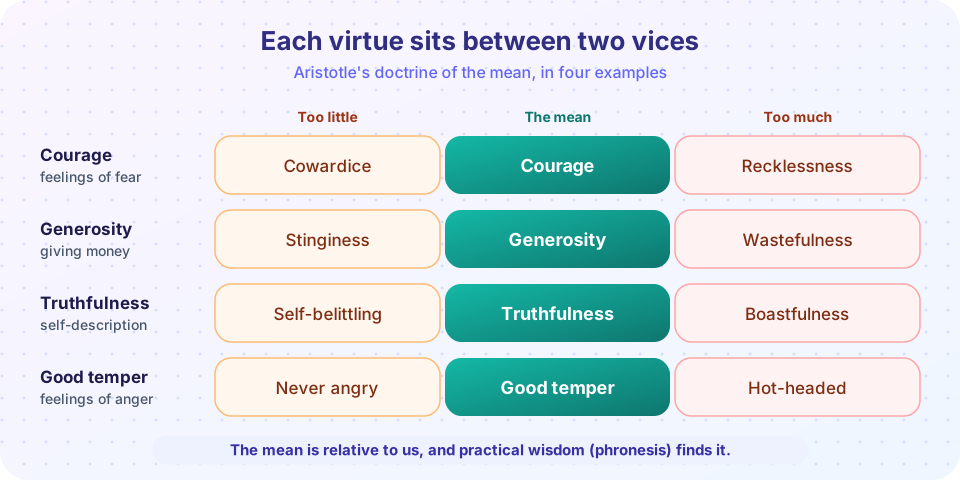
Aristotle describes each virtue of character as a mean between two vices: one of deficiency and one of excess. Courage is the mean regarding fear and confidence, between cowardice and recklessness. Generosity is the mean in giving, between stinginess and wastefulness. His list of examples is long, and some of his pairings are surprising, but the pattern is the same.
Three details prevent common misunderstandings.
- The mean is not an average. It is not "do a little of everything" and it is not mediocrity. For Aristotle the virtuous act is an extreme in the sense of excellence even though it lies between vices. He gives the example of a trainer who knows ten pounds of food is too much and two is too little for an athlete, but will not simply prescribe six; the right amount depends on the person.
- The mean is relative to us. The right amount of fear for a soldier at the front differs from the right amount for a bystander. The right response depends on who you are, who else is involved and what is at stake. You must feel and act at the right time, about the right things, toward the right people, for the right end and in the right way.
- Some acts and feelings have no mean. Aristotle says murder, theft and adultery are wrong as such; there is no right amount of them. The doctrine describes character traits, not every act.
Practical wisdom: the skill that finds the mean
If the mean cannot be calculated, how does a person find it? Through phronesis, practical wisdom. This is the ability to see what matters in a situation, to weigh competing claims and to choose well. It cannot be learned from a book alone because it needs experience. Aristotle says it also cannot exist without the virtues of character, and they cannot be complete without it. This is the "unity of the virtues" idea: a brave act by someone who cannot judge when bravery is called for is not fully virtuous.
This is a very different picture of ethics from a rule list. Experienced nurses, teachers and judges often say that they cannot fully state how they decide. Aristotle would say that is what expertise in living well looks like.
Friendship and the good of others
Virtue ethics is not selfish, though it begins with the agent's flourishing. Aristotle devotes two of the ten books of the Ethics to friendship, and argues that a good life needs friends who share it. Friends of virtue wish each other well for the other's own sake. A flourishing life is therefore tied to the flourishing of others.
Objections and replies
- "It does not tell me what to do." Critics say "do what the virtuous person would do" is empty. Replies: virtue ethics gives guidance through virtue and vice words (be honest, do not be cruel), and through role models. Law-like rules also need judgment to apply.
- "It is circular." The virtuous act is defined by the virtuous person, who is defined by right acts. Defenders reply that the theory grounds both in an independent account of human flourishing.
- "It is elitist and dated." Aristotle defended slavery and held that women were naturally subordinate, and his ideal "great-souled man" was an aristocrat. Most modern virtue ethicists reject these views and argue that the method of virtue and flourishing does not depend on them.
- "Luck decides." Whether you become virtuous depends on your upbringing and circumstances. Aristotle accepts this: flourishing needs some external goods and good fortune. Some find that honest, others unfair.
Common misconceptions
"The mean means moderation in everything." Aristotle praises passionate excellence. Courage demands more than moderate fear; it demands the right amount, which can be intense.
"Eudaimonia means a happy feeling." It means a life lived well, which could not be taken away by a cheerful mood or a bad day.
"Virtue ethics is just self-improvement." Many virtues (justice, generosity, friendship) are about how we treat others, and Aristotle thinks ethics and politics are connected.
Try it
Press Run (or Ctrl + Enter) to see the result here.
Program input · what you'd type while the program runs
Type the answers before you press Run, one per line. Each time the program reads a line (with input()), it gets the next line from this box.
Check your understanding
Quick check · 5 questions
of 5 answered You scored / 5 · perfect!
-
1. What is eudaimonia in Aristotle's ethics?
Eudaimonia is the final goal of action: a life of excellent activity over a complete lifetime, not a passing feeling. -
2. How do virtues of character arise, according to Aristotle?
We become just by doing just acts, brave by doing brave acts, so habit shapes feeling and choice. -
3. In the doctrine of the mean, courage lies between
Courage is the mean regarding fear and confidence, flanked by the deficiency (cowardice) and the excess (recklessness). -
4. Why does Aristotle say the mean is 'relative to us'?
His trainer example shows that the right amount depends on who you are; it is not a fixed arithmetic midpoint. -
5. Which of the following is a standard objection to Aristotelian virtue ethics?
Critics say 'do what the virtuous person would do' can seem too vague; defenders reply that virtue terms and exemplars do give guidance.
Summary
- Aristotle grounds ethics in eudaimonia, a flourishing life, argued from the characteristic function of human beings.
- Virtues of character are stable dispositions formed by habit; the virtuous person acts knowingly, for the act's own sake, from a settled character.
- Each virtue is a mean relative to us between a deficiency and an excess, but some acts have no mean.
- Practical wisdom finds the fitting response and cannot be reduced to a rule.
- Objections about guidance, circularity, elitism and luck have shaped modern versions of the theory.
Track your progress
Create a free account to tick off lessons and pick up where you left off on any device.
of Ethics lessons completed