


















Lesson 12 of 45 · Consequentialism
Well-Being and Welfare: What Is Good for a Person?
Compare hedonism, preference theories and objective-list theories of well-being, the experience machine, adaptive preferences and how QALYs measure welfare.
To maximize well-being you need to know what well-being is. This is harder than it looks. Is a person doing well when they feel good, when they get what they want, or when their life contains things worth having whether or not they feel anything about them? Philosophers call this the question of welfare or prudential value: what makes a life go well for the person living it.
The answer shapes every consequentialist calculation, and also matters to health policy, economics and everyday life. In this lesson you will meet the three standard theories, test them with famous cases, and see how a health system turns one answer into a number.
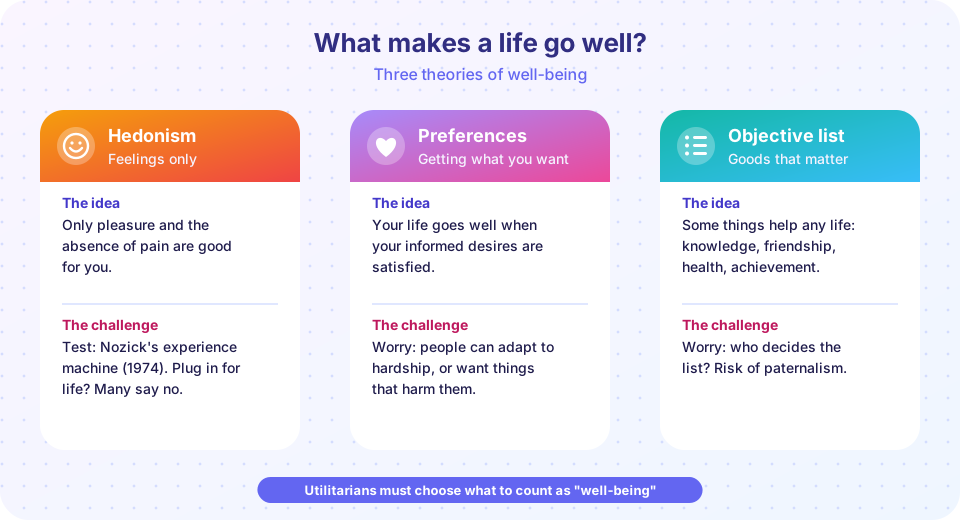
What you will learn
- The three main theories: hedonism, preference theories and objective-list theories.
- Test cases: the experience machine, adaptive preferences and desires about the remote past.
- Why measuring well-being (for example with QALYs) requires philosophical choices.
Key terms
Well-being (welfare): how well a person's life is going for that person.
Hedonism: well-being consists in pleasure and the absence of pain.
Preference (desire) theory: well-being consists in getting what you want, or what you would want if fully informed.
Objective-list theory: some things (such as knowledge, friendship, health) are good for you whether or not you want them or enjoy them.
Adaptive preference: a desire that has shrunk to fit a person's limited circumstances.
Hedonism
Hedonism says that pleasure is the only thing good for you and pain the only thing bad. It is simple, and it fits many everyday judgments: we care about people's pain, and we want pleasant lives for those we love. Classical utilitarians were hedonists.
Its famous test is Robert Nozick's experience machine (1974). You could plug in to a machine that gives you any experiences you choose: writing a great novel, falling in love, making friends. All would feel entirely real, and you would not know you were in the machine. Would you plug in for life? Many people say no. Nozick suggested this shows that we care about actually doing things and being a certain kind of person, not only about the feelings. Critics point out that people may refuse for the wrong reasons, such as a bias toward the familiar status quo. (Experimental work has found that many people become more willing to plug in when the status quo is reversed, for instance when told that their present life is itself a machine and they could unplug.) The case is therefore a strong challenge, but not a knockdown one.
Another worry is hedonic adaptation. In a well-known 1978 study, Brickman, Coates and Janoff-Bulman reported that lottery winners were not much happier than comparison groups and that people with paraplegia were not as unhappy as expected. Later research found adaptation to be real but often incomplete, especially for serious conditions, and found problems with the original sample sizes. The lasting point is that happiness depends on expectations and circumstances, which complicates the task of comparing outcomes by feelings alone.
Preference theories
Preference theories say your life goes well when your desires are satisfied. This respects the fact that people differ: a quiet life suits one person and adventure another, and an outsider need not decide which is better. Because bare desires can be based on false beliefs, most versions use informed desires: what you would want if you knew the relevant facts and thought clearly.
Challenges include:
- Adaptive preferences. A person raised with no chance of education may not want it. Their desires are satisfied, but we may think their life is going worse than it could. Amartya Sen and Jon Elster discussed this pattern, and it matters for development policy.
- Desires about the remote past or future. Derek Parfit imagined a stranger on a train whom you will never meet again and who has a serious illness. You hope she recovers. Does it make your life go better if she does, if you never find out? Preference theories seem to say yes.
- Bad desires. If someone strongly desires something trivial or self-destructive, is satisfying it good for them?
Objective-list theories
Objective-list theories say that certain things are good for people regardless of their desires: for example knowledge, friendship, achievement, health, autonomy and aesthetic appreciation. This view explains why we might think a deceived or uneducated person's life is going worse even if they are content. Martha Nussbaum's capabilities approach is a well-known list-based framework for development: it names central capabilities such as life, bodily health, practical reason and affiliation that every person should be able to achieve.
Critics worry about paternalism: who decides what belongs on the list, and may we override people's own choices? Defenders reply that a short, widely accepted list is not an excuse to dictate how people live, and that autonomy is itself on the list.
Measuring welfare: QALYs
Health systems must choose between treatments, so they need a way to compare. The quality-adjusted life year (QALY) weights each year of life by quality: 1 for full health, 0 for death, and values in between for impaired health. A treatment that gives four extra years at quality 0.5 yields 2 QALYs; one that gives one year at 0.9 yields 0.9. Agencies such as the UK's National Institute for Health and Care Excellence use cost per QALY to compare options.
QALYs show how philosophical choices become practical. The weights come from surveys that ask people to trade off years of life against health states, which is partly preference-based. Critics argue that the scheme can undervalue people with disabilities or chronic conditions, and that it ignores who benefits. Defenders say that any system of rationing must compare, and that making criteria explicit is better than leaving them hidden. Both sides are discussing a very real tension between maximizing total benefit and treating people fairly.
Common misconceptions
"Well-being is the same as money." Income is one resource, not the thing itself. Studies of income and happiness have produced mixed results: Kahneman and Deaton (2010) reported a plateau in emotional well-being at moderate incomes, while a later study by Killingsworth (2021) and a joint reanalysis with Kahneman and Mellers (2023) found that reported happiness keeps rising with income for most people, with a plateau only among the least happy group.
"Hedonism means a life of indulgence." Hedonists can recommend self-discipline, friendship and meaningful work when they lead to more pleasure over a lifetime.
"Objective-list theories are just personal taste." They claim the goods are good for people independently of taste, which is a claim that needs defending.
Try it
The first demonstration is a QALY calculator. The costs, years and quality weights are invented for illustration. Compare treatments by total QALYs and cost per QALY, then change the numbers to see how a small change in the quality weight changes the ranking.
Press Run (or Ctrl + Enter) to see the result here.
Program input · what you'd type while the program runs
Type the answers before you press Run, one per line. Each time the program reads a line (with input()), it gets the next line from this box.
The second demonstration compares what the three theories say about three cases. Choose a case.
Check your understanding
Quick check · 5 questions
of 5 answered You scored / 5 · perfect!
-
1. What was Nozick's experience machine meant to show?
If many people would not plug in, perhaps well-being involves actually doing and being, not only feeling. -
2. Which theory best explains why an uneducated but content person might be worse off than they could be?
An objective list can count knowledge and freedom as goods even if the person does not want them. -
3. An adaptive preference is
Adaptive preferences shrink to fit what a person believes is possible, which is a problem for simple preference theories. -
4. A treatment yields 3 extra years at quality 0.6. How many QALYs is that?
QALYs = years x quality = 3 x 0.6 = 1.8. -
5. A common criticism of objective-list theories is
Critics worry about overriding people's own choices; defenders note that autonomy can be on the list.
Summary
- Hedonism, preference theories and objective-list theories give three answers to what is good for a person.
- Each has a standard test case: the experience machine, adaptive preferences and the problem of paternalism.
- Measures such as QALYs turn philosophical choices into practical numbers and raise questions of fairness.
- A consequentialist must choose a theory of well-being, and the choice matters.
Track your progress
Create a free account to tick off lessons and pick up where you left off on any device.
of Ethics lessons completed