


















Lesson 15 of 45 · Deontology
Deontology: Duties, Rights and Limits
Chapter 4 overview: what deontological ethics says, how it differs from consequentialism, constraints and options, threshold views, and what the chapter's lessons cover.
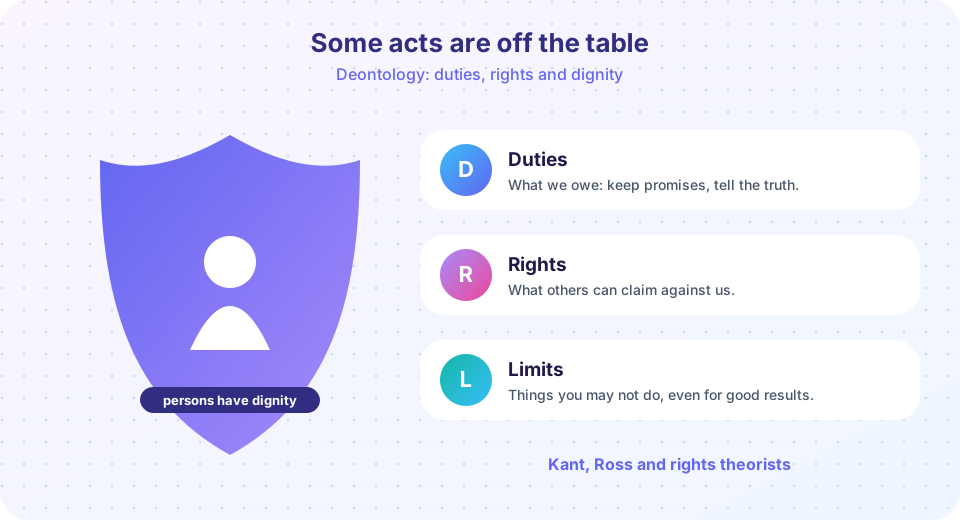
Most people think there are things you must not do to a person, even if doing them would produce a better result overall. You must not frame an innocent person to calm an angry crowd. You must not break a solemn promise just because it pays slightly better. You must not use someone merely as a tool. A moral outlook built around such limits is called deontology, from the Greek deon, "duty."
Where consequentialism asks "what will happen?", deontology asks "what do I owe to this person, and what may I not do?" This chapter looks at its best-known forms: Immanuel Kant's ethics of duty and dignity, W. D. Ross's plural duties, and the theory of rights, followed by the famous trolley cases and the doctrine of double effect.
What you will learn
- The core claims of deontology, and how it differs from consequentialism.
- Constraints and options, the "paradox of deontology" and threshold views.
- A preview of the four lessons in this chapter.
Key terms
Deontology: an approach to ethics in which some acts are required or forbidden regardless of their consequences.
Duty: something one is morally required to do or avoid.
Constraint: a limit on what you may do, such as a ban on killing the innocent, even to achieve good results.
Option: a permission not to maximize the good, such as the freedom to pursue your own projects.
Threshold deontology: the view that constraints hold unless the stakes are catastrophically high.
Core ideas
The right is not reducible to the good. For consequentialists, rightness is a function of how good the outcomes are. Deontologists deny this. Some acts are wrong because of what they are (a lie, a betrayal, a killing of an innocent), not because of what they cause.
Constraints. Deontologists believe that morality includes agent-relative constraints. They are "agent-relative" because they tell you not to do certain things, rather than telling everyone to minimize how many times the thing happens in the world. Compare "do not kill" with "act so as to minimize killings". The two can differ: the first forbids you from killing one person even to stop someone else from killing five.
Options. Most deontologists also believe that you are not required to maximize good at every moment. You may spend a weekend with your family rather than giving it to charity. This makes deontology less demanding than consequentialism.
Persons as ends. Many deontological views are built on the idea that each person has a dignity or worth that cannot be traded off against other people's gains. Kant expressed this as the requirement to treat humanity never merely as a means.
The paradox of deontology
If killing is so bad, why shouldn't you kill one person to stop five other killings? Critics call this the paradox of deontology: a constraint that tells you not to do a bad thing, even to prevent more of the same bad thing, seems to be about keeping your own hands clean, which seems odd if you care about the victims. Defenders answer that constraints protect each person's separateness: the one person has a claim against you that does not disappear because other people have claims against someone else. Thinkers such as Robert Nozick and Frances Kamm have developed this reply, and critics, such as Samuel Scheffler, press the objection.
Some deontologists accept a threshold: constraints hold until the consequences become catastrophic, such as when breaking a promise would avert the destruction of a city. Strict ("absolutist") deontologists reject thresholds. They say a constraint that bends under pressure is not a constraint. The question is where, if anywhere, to place the threshold, and why.
Kinds of deontology
Three deontological ideas
What deontology adds
Next: how the three ideas work in practice.
The chapter in four lessons
- Kant and the Categorical Imperative explains the universal law test, the humanity formula and the idea of acting from duty.
- Duties and Rights covers Ross's seven prima facie duties and the idea of moral rights.
- The Trolley Problem and Double Effect looks at the switch and footbridge cases, doing versus allowing, and intending versus foreseeing.
- Chapter 4 Review summarizes and quizzes you.
Common misconceptions
"Deontologists do not care about consequences." They care a great deal. Most hold that promoting good outcomes is one duty among others, such as beneficence in Ross's list. They deny only that it is the sole basis of right and wrong.
"Deontology is just following rules." Some versions are rule-like, but others (Ross, rights theories) involve weighing and judgment. Kant's own view centers on principles of reason, not a list of commands.
"Deontology and religion are the same." Some deontological views are religious, others, such as Kant's, appeal to reason alone.
Try it
The first demonstration contrasts a pure maximizer with a chooser who respects a constraint, and shows what a threshold does. Each action has an outcome value and may violate a constraint (such as "do not lie"). The values are invented to illustrate the logic, not to say which action is right.
Press Run (or Ctrl + Enter) to see the result here.
Program input · what you'd type while the program runs
Type the answers before you press Run, one per line. Each time the program reads a line (with input()), it gets the next line from this box.
Notice how little the numbers tell you about where a threshold should be. That is a moral question, not a computational one.
The second demonstration is an interactive slider: how many lives would have to be saved before three different views would permit breaking a firm constraint? Move the slider and set the threshold.
Check your understanding
Quick check · 4 questions
of 4 answered You scored / 4 · perfect!
-
1. What does 'deon' mean in Greek?
Deontology is the study of duty. -
2. An agent-relative constraint tells you
Constraints focus on what the agent does, not on minimizing the total. -
3. The paradox of deontology asks
A constraint that forbids preventing five killings by committing one seems to put your clean hands ahead of the victims. -
4. Threshold deontology holds that
It accepts constraints but allows them to be overridden at some very high level of harm.
Summary
- Deontology holds that some acts are required or forbidden regardless of their consequences.
- It features constraints, options and a respect for persons as separate beings.
- The paradox of deontology and threshold views mark a central debate.
- The chapter examines Kant, Ross, rights and the trolley cases.
Track your progress
Create a free account to tick off lessons and pick up where you left off on any device.
of Ethics lessons completed