


















Lesson 3 of 45 · Getting Started
Thought Experiments and Moral Intuitions
How philosophers test moral principles with imagined cases, why intuitions count as evidence, what critics say, and how reflective equilibrium works.
You cannot run a laboratory experiment on whether it is ever right to break a promise. You cannot, for good reasons, push someone in front of a trolley to see what happens. So moral philosophers use another tool: the thought experiment, an imagined case designed to isolate one feature of a situation and ask whether it matters. You consider the case, notice your reaction, and then ask what principle would explain it.
This method is powerful and also controversial. In this lesson you will see how it works, why our gut reactions ("intuitions") count as a kind of evidence, what can go wrong, and how the process of adjusting principles and cases against each other leads to what John Rawls called reflective equilibrium.
What you will learn
- What a thought experiment is, with four famous examples.
- Why moral intuitions are treated as data, and what a "considered judgment" is.
- The main criticisms: framing effects, bias and evolutionary debunking.
- How reflective equilibrium works, step by step.
Key terms
Thought experiment: an imagined scenario used to test a principle or concept.
Moral intuition: an immediate sense that something is right or wrong, without conscious reasoning.
Considered judgment: a moral verdict you hold with confidence, after reflecting calmly and impartially.
Reflective equilibrium: a state in which your principles and your considered judgments support each other.
Counterexample: a case in which a principle gives a verdict that seems clearly wrong.
Four classic thought experiments
The drowning child. Peter Singer (1972) asked you to imagine walking past a shallow pond and seeing a small child drowning. You could wade in and save the child, but your clothes would be ruined. Almost everyone says you must save the child. The case isolates a principle: if you can prevent something very bad at modest cost to yourself, you ought to. The next question, which makes people uncomfortable, is whether the principle also applies to children far away whom donations could help.
The violinist. Judith Jarvis Thomson (1971) imagined waking up connected to a famous violinist who needs your kidneys for nine months. Must you stay connected? The case was designed to ask whether the right to life includes a right to use another person's body. It has been used for and against several positions in the abortion debate, and critics argue about whether the analogy holds.
The experience machine. Robert Nozick (1974) imagined a machine that could give you any experiences you wanted, indistinguishable from reality. Would you plug in for life? Many people say no, which Nozick took to show that we care about more than pleasant feelings. We meet this case again in the lessons on well-being.
The ring of Gyges. In Plato's Republic, a shepherd finds a ring that makes him invisible. Glaucon asks whether anyone would stay just if they could never be caught. The case probes whether morality depends on the fear of punishment.
Notice what these have in common. Each is simple, strips away irrelevant details and ends with a question you can answer in seconds.
Why intuitions count as evidence
In science, observations are data that theories must explain. In ethics, many philosophers treat carefully formed intuitions in a similar way. If a theory says that torturing an innocent child for fun is acceptable, that is a reason to doubt the theory, not a reason to accept torture. Rawls called the verdicts we trust most considered judgments: reached when we are calm, informed, impartial and not personally gaining from the answer.
Not every gut reaction qualifies. A flash of disgust at an unfamiliar custom, or a preference for people like us, is not a considered judgment. The work of ethics is partly to sort strong, stable intuitions from prejudice.
Reflective equilibrium
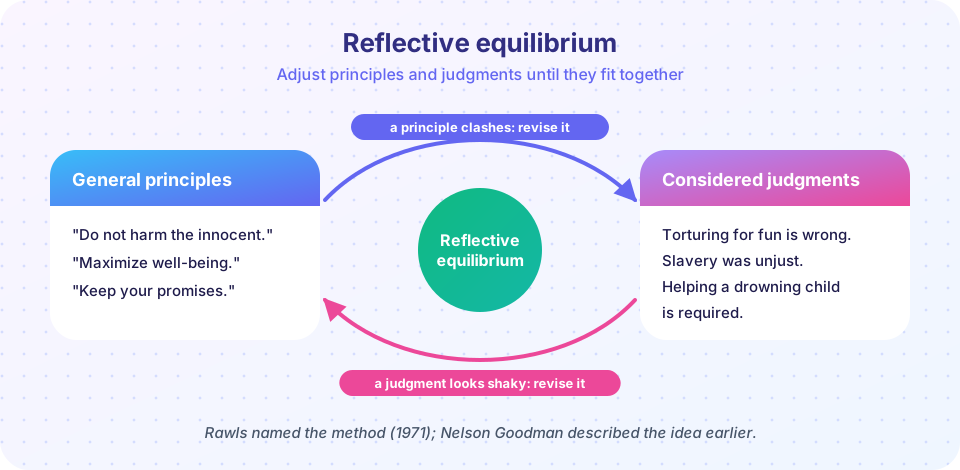
Rawls described a back-and-forth process. You start with some principles and some case judgments.
- Apply a principle to a case and see whether its verdict matches your judgment.
- If it does not, you have a clash. You may revise the principle (add an exception, narrow it) or revise the judgment (perhaps it was a bias).
- Test the new version on further cases.
- Repeat until your principles and judgments fit together.
The result is not a proof. It is a coherent view, and it stays open to revision when new cases or arguments appear. The method is also not unique to ethics: the logician Nelson Goodman described a similar way of justifying rules of inference against accepted practice.
Problems with the method
Critics raise several worries.
- Framing and order effects. Studies of philosophical cases report that wording and order can change people's answers. In a well-known line of work, Petrinovich and O'Neill (1996) found that the way a switch dilemma was described shifted judgments. Effects of this kind suggest some intuitions are fragile.
- Unusual scenarios. Cases with exotic details (machines, invisible rings, trolleys) may exceed what our moral sense evolved to handle.
- Evolution and culture. If our reactions were shaped by natural selection or by culture, why trust them? Some philosophers, such as Joshua Greene and Peter Singer, use such "debunking" arguments to cast doubt on certain intuitions. Others reply that all reasoning has some origin, and the question is whether the intuition survives scrutiny.
- Variation. People differ, so whose intuitions count? Experimental philosophers survey many people to find out which verdicts are widely shared.
The upshot is balance. Intuitions are fallible evidence, to be weighed alongside principles and arguments, and not an unquestionable oracle. A principle that is elegant but implies terrible things deserves suspicion; an intuition that is widely shared but easily explained as bias deserves suspicion too.
How to analyze a thought experiment
Ask yourself:
- What is the case designed to isolate? Name the one feature that differs from a similar case.
- What is my verdict, and how confident am I? Strong and stable, or shaky?
- What principle explains it? Try to state it in a sentence.
- Does the principle fit other cases? Look for counterexamples.
- Could bias explain my reaction? For instance, is the victim someone I identify with?
Common misconceptions
"A thought experiment must be realistic to be useful." Not so. An unrealistic case can still isolate a feature. The danger is relying on details that distort our judgment, not unreality itself.
"Intuitions are just feelings, so they prove nothing." Many are stable, shared and survive reflection. They are not proof, but they are evidence, in the same way that perceptions are evidence in science.
"Reflective equilibrium means you can believe whatever is consistent." Consistency is necessary, not sufficient. The method also requires that you weigh the plausibility of principles and judgments, and test them against new cases and objections.
Try it
This first demonstration is a toy model of reflective equilibrium. It scores three candidate principles against a set of case judgments. The cases and verdicts are illustrative choices made for this lesson, not survey data. See which principle fits best, then see which judgments clash with the others.
Press Run (or Ctrl + Enter) to see the result here.
Program input · what you'd type while the program runs
Type the answers before you press Run, one per line. Each time the program reads a line (with input()), it gets the next line from this box.
Principle A alone clashes with the bridge and organ cases. B and C both fit all six, so these cases cannot tell them apart: you would need a new case where nothing is gained and nobody is used as a means. To reach equilibrium you could revise A (add a constraint, as C does), or revise your judgment about the bridge. Which would you do, and why? Notice that the model only checks fit. It cannot tell you whether the judgments are right.
The second demonstration applies Singer's principle to the drowning child and its "distance" variant. Choose a cost and a distance and read the verdict.
Check your understanding
Quick check · 5 questions
of 5 answered You scored / 5 · perfect!
-
1. What is a thought experiment in ethics?
Thought experiments let philosophers test principles on cases that cannot be, or should not be, carried out in real life. -
2. Which is the best description of a considered judgment?
Rawls used the term for verdicts reached under good conditions: calm, informed and impartial. -
3. Nozick's experience machine was meant to challenge
If most people refuse to plug in, perhaps more than feelings matter to us, which challenges hedonism. -
4. In reflective equilibrium, what should you do when a principle clashes with a judgment?
Either side can give way; the goal is a stable fit, checked against further cases and objections. -
5. Why do some philosophers distrust certain intuitions?
Evidence of framing and debunking arguments show some intuitions need scrutiny; this does not make all of them worthless.
Summary
- Thought experiments isolate a feature of a situation so you can test a principle against it.
- Considered judgments are treated as evidence, but they are fallible and can be fragile or biased.
- Reflective equilibrium adjusts principles and judgments until they cohere, and stays open to revision.
- Always ask what the case isolates, how confident you are and whether bias could explain your reaction.
Next: Chapter 1 Review
Track your progress
Create a free account to tick off lessons and pick up where you left off on any device.
of Ethics lessons completed