


















Lesson 43 of 45 · Projects and Practice
Glossary of ethics
A glossary of more than 40 key terms in ethics, from autonomy and deontology to metaethics, justice and AI ethics, with flashcards and a lookup tool.
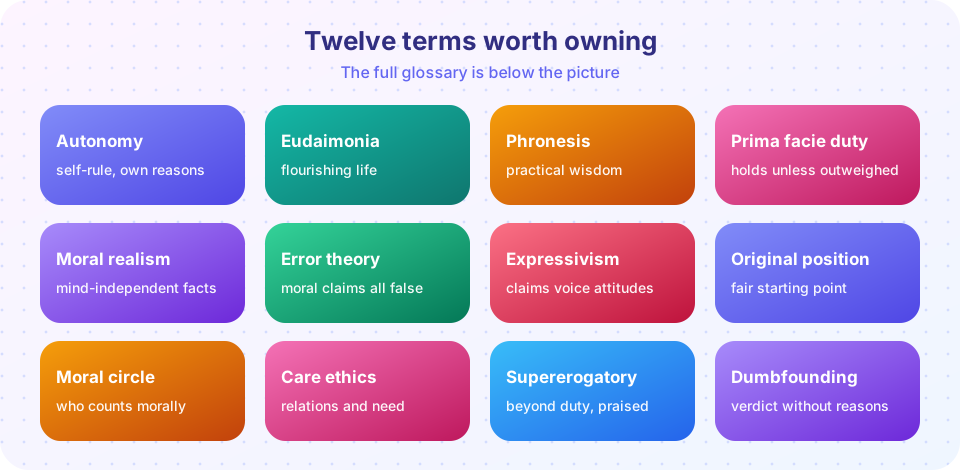
Ethics has its own vocabulary, and many words that sound everyday (duty, virtue, right, fair) have precise meanings in philosophy. This glossary gathers the terms used across the whole course, grouped by theme. Use it to check a definition, to prepare for the quizzes, or to study with the flashcards at the end.
What you will learn
- The meaning of the key terms of normative ethics, metaethics, applied ethics and justice.
- How terms group into families and contrast with each other.
- How to use flashcards to remember them.
Key terms
Glossary tip: learn terms in contrast pairs (cognitivism versus non-cognitivism, positive versus negative duty). A pair is easier to remember than a single word.
Normative theories
| Term | Meaning |
|---|---|
| Consequentialism | The view that the rightness of an act depends on its outcomes. |
| Utilitarianism | A consequentialist theory that says to maximize overall well-being (utility). |
| Deontology | The view that some acts are required or forbidden regardless of outcomes; duties and rights matter. |
| Categorical imperative | Kant's test of moral rules: act only on maxims you could will as universal laws, and treat persons as ends. |
| Prima facie duty | A duty that binds unless outweighed by a stronger one (W. D. Ross). |
| Virtue ethics | The view that ethics is about character and what a virtuous person would do. |
| Eudaimonia | Flourishing; living well over a whole life (Aristotle). |
| Phronesis | Practical wisdom: the skill of finding the fitting response. |
| Doctrine of the mean | Each virtue lies between a vice of deficiency and one of excess, relative to us. |
| Contractualism | The view that morality consists of principles no one could reasonably reject (Scanlon). |
| Social contract | The idea that legitimate rules rest on real or hypothetical agreement. |
| Ethics of care | The view that relationships, dependence and responsive care are central to morality. |
| Moral pluralism | The view that several values or principles matter and cannot all be reduced to one. |
Concepts of moral life
| Term | Meaning |
|---|---|
| Autonomy | Self-rule; the capacity to make informed decisions about one's life. |
| Intrinsic value | Value a thing has in itself, not as a means. |
| Moral status | Whether and how much a being's interests matter for their own sake. |
| Moral circle | The set of beings whose interests we count; argued to have widened over time. |
| Supererogatory | Beyond the call of duty; praiseworthy but not required. |
| Moral luck | The way moral assessment is affected by factors outside our control. |
| Moral residue | Regret that remains after a justified choice involving a real loss. |
| Positive duty / negative duty | A duty to help / a duty not to harm. |
| Demandingness | The worry that a moral theory asks too much of ordinary agents. |
| Partiality | Special concern for family, friends and community. |
| Moral dilemma | A situation in which every option involves a moral cost. |
| Integrity | Acting in line with one's deeper commitments and values. |
Metaethics
| Term | Meaning |
|---|---|
| Metaethics | The study of the meaning, nature and knowledge of moral claims. |
| Cognitivism / non-cognitivism | Moral sentences express beliefs / attitudes. |
| Moral realism | There are moral facts that hold independently of anyone's attitudes. |
| Naturalism / non-naturalism | Moral facts are natural facts / their own irreducible kind. |
| Error theory | Moral claims aim at objective facts but are all false (Mackie). |
| Expressivism | Moral sentences express attitudes or plans (Ayer, Stevenson, Blackburn, Gibbard). |
| Quasi-realism | Expressivism that earns the language of truth (Blackburn). |
| Constructivism | Moral truth is fixed by an idealized procedure of reasoning or agreement. |
| Direction of fit | Whether a mental state should match the world or the world should match it. |
| Frege-Geach problem | The problem of explaining embedded moral sentences in valid arguments. |
| Is-ought gap | Descriptive premises alone cannot entail prescriptive conclusions (Hume). |
| Moral dumbfounding | Holding a moral judgment while being unable to give reasons for it (Haidt). |
| Debunking argument | An argument that a belief is unjustified because its origin is unconnected to its truth. |
Applied ethics
| Term | Meaning |
|---|---|
| Informed consent | Agreement given with competence, information, understanding and freedom. |
| Double effect | A foreseen harm may be permitted as a side effect of a good act under four conditions. |
| Sentience | The capacity to feel, especially to suffer or enjoy. |
| Speciesism | Giving less weight to interests only because of species membership. |
| Land ethic | An act is right if it preserves the integrity, stability and beauty of the biotic community (Leopold). |
| Discount rate | The yearly reduction applied to future costs and benefits. |
| Non-identity problem | Policies change who exists, complicating claims that future people are harmed (Parfit). |
| Algorithmic bias | Systematic, unfair differences in a system's outputs or errors across groups. |
| Proxy | A measurable stand-in for the quantity you really care about. |
| Responsibility gap | The difficulty of assigning accountability for harms by autonomous systems. |
Justice and moral progress
| Term | Meaning |
|---|---|
| Distributive justice | The fair distribution of resources, opportunities and burdens. |
| Original position | Rawls's imagined situation for choosing principles of justice. |
| Veil of ignorance | The rule that choosers do not know their own place or traits. |
| Difference principle | Inequalities are allowed only if they most benefit the least advantaged. |
| Entitlement theory | A distribution is just if it arose from just acquisition and transfer (Nozick). |
| Desert | What a person deserves by effort, contribution or conduct. |
| Luck egalitarianism | Inequalities from brute luck are unjust; those from choice may not be. |
| Prioritarianism | Benefits count for more the worse off the recipient is. |
| Capability approach | Justice concerns what people are actually able to do and be (Sen, Nussbaum). |
| Effective altruism | Using evidence and reasoning to do the most good with limited resources. |
| Moral progress | A change that is an improvement by a defensible standard. |
| Whig history | A reading of history as a steady march toward the present's values. |
Common misconceptions
"A glossary is the same as understanding." Definitions are a start. You understand a term when you can use it in an argument and give an example and a counterexample.
"Terms have one fixed meaning." Philosophers use some words differently (for example, 'utilitarianism' varies in details). Check how a text defines a term.
"Contrast pairs are rivals only." Some pairs (positive and negative duties) coexist in most moral views.
Try it
Press Run (or Ctrl + Enter) to see the result here.
Program input · what you'd type while the program runs
Type the answers before you press Run, one per line. Each time the program reads a line (with input()), it gets the next line from this box.
Check your understanding
Quick check · 4 questions
of 4 answered You scored / 4 · perfect!
-
1. Which pair of terms are contrasting positions on what moral sentences express?
Cognitivism says beliefs; non-cognitivism says attitudes. -
2. Which term means 'beyond the call of duty'?
A supererogatory act is praiseworthy but not required. -
3. What is moral residue?
It reflects that some good choices still cost something of moral importance. -
4. A proxy in AI ethics is
Using cost as a proxy for need is a standard example.
Summary
- The glossary groups terms into normative theories, moral life, metaethics, applied ethics, and justice and progress.
- Contrast pairs make terms easier to remember.
- Use flashcards for recall and examples for understanding.
Next: The cheat sheet
Track your progress
Create a free account to tick off lessons and pick up where you left off on any device.
of Ethics lessons completed