


















Lesson 13 of 45 · Consequentialism
Act and Rule Consequentialism, and the Main Objections
Compare act and rule utilitarianism, then test consequentialism against the utility monster, demandingness, rights and justice, and integrity objections.
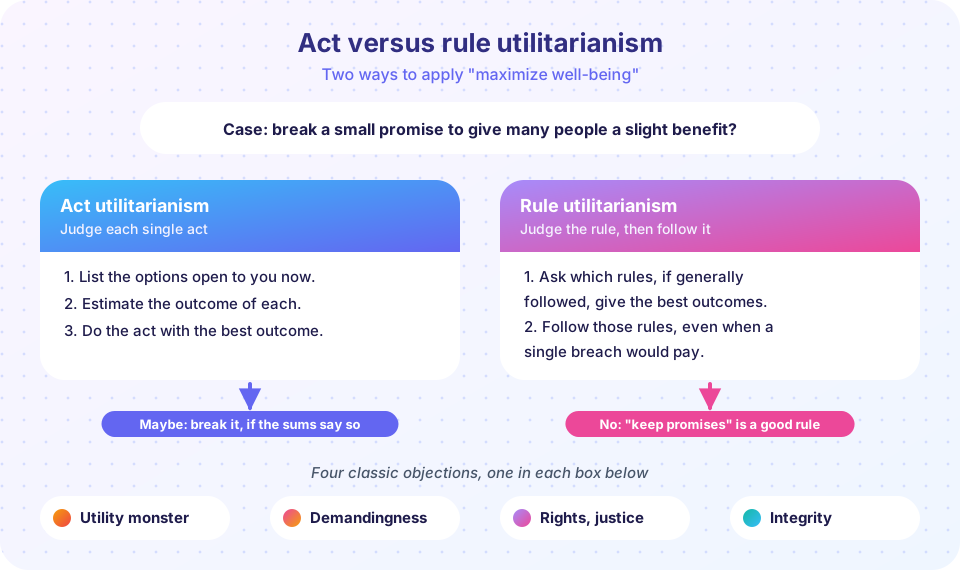
Suppose you have promised to meet a friend, and on the way you meet a stranger who needs help for an hour. Helping would do slightly more good than keeping the promise. Should you break it? An act consequentialist asks which option, this time, gives the best outcome. A rule consequentialist asks which general practice would give the best outcomes, and then follows it. They can give different answers, and each version is built to avoid problems the other faces.
This lesson sets out the two versions, then examines four classic objections to consequentialism. No theory in ethics escapes objections. The point is to see what each one claims, how defenders reply, and what is left to think about.
What you will learn
- How act and rule consequentialism differ and what each gains and loses.
- Four objections: the utility monster, demandingness, rights and justice, and integrity.
- The main replies, including two-level utilitarianism and satisficing.
Key terms
Act consequentialism: an act is right if it has the best consequences of the options available.
Rule consequentialism: an act is right if it follows the rules whose general acceptance would have the best consequences.
Demandingness: the worry that a theory requires too much sacrifice.
Integrity: acting from one's own deep commitments and projects.
Two-level view: use simple rules in daily life, and use calculation to choose and revise the rules.
Act versus rule
Act consequentialism applies the principle of utility to each individual choice. Its strength is flexibility: it can recommend breaking a rule when breaking it truly does more good. Its weakness is that it seems to license things we find outrageous, and that real decision makers are not good at calculating.
Rule consequentialism moves the test up one level. Brad Hooker (2000) puts it roughly like this: an act is wrong if it is forbidden by the code of rules whose general acceptance by nearly everyone would have the best consequences. Because the rules include "keep promises", "do not harm the innocent" and "help those in need", the theory seems closer to commonsense morality.
In the promise case, the act view says to break it if the net result is better; the rule view says to keep it, because a general practice of keeping promises produces trust and coordination that benefit everyone, and a practice of breaking them whenever the sums favored it would destroy that trust.
Rule consequentialism faces a collapse objection, pressed by J. J. C. Smart: if following a rule would produce worse results in a particular case, why follow it? To insist on the rule looks like rule worship. If the rule includes endless exceptions ("keep promises unless breaking them does more good"), the theory collapses into the act view. Rule theorists reply that rules with a few well-defined exceptions can still give different verdicts, and that real people cannot reliably predict the effects of exceptions. They also note that a code has to be learnable and teachable, and that complexity has costs.
R. M. Hare proposed a two-level view: at the "intuitive" level, we use simple rules and dispositions, because they are reliable and stable; at the "critical" level, such as when designing institutions or when rules conflict, we think like utilitarians. This explains why a utilitarian can sincerely hold that, in ordinary life, you should keep promises and not lie.
Objection 1: the utility monster
Robert Nozick (1974) imagined a being who gets enormously more pleasure from resources than anyone else does. If total utility is what matters, it seems that we should give nearly everything to this monster, even if everyone else suffers. The case challenges the claim that well-being should simply be added up and shows how utilitarianism ignores distribution: it cares about the total, not about who has what.
Replies: (a) such beings may not exist, so the scenario is a test of the theory, not a practical danger; (b) prioritarians hold that benefits matter more the worse off a person is, which would reduce the monster's claim; (c) some defend the verdict as the correct one if the case is truly as described. Many find (c) hard to accept.
Objection 2: demandingness
If every person's well-being counts equally, it seems you should give away most of your income until further giving would harm you as much as it helps others. Peter Singer argues in "Famine, Affluence, and Morality" (1972) that this conclusion is correct, and that it is our habits, not the theory, that are mistaken. Critics, including Susan Wolf ("Moral Saints", 1982), argue that a theory demanding that we always maximize leaves no room for personal projects, friendships and play, and that a life with no such room is not clearly a good one.
Replies include Samuel Scheffler's proposal to add an agent-centered prerogative, permission to give extra weight to one's own projects, which makes the theory less demanding at the cost of its impartiality, and satisficing versions that require a good enough outcome rather than the best. Rule consequentialists can add that a code demanding too much would not be followed and so would not do much good.
Objection 3: rights and justice
Imagine a surgeon with five patients who will die without organ transplants, and a healthy visitor whose organs could save all five. If nobody would find out, an act utilitarian calculation seems to favor taking the organs. Most people think that would be murder, and that individuals have rights that cannot be overridden by sums of benefits. Variants of this case were discussed by Philippa Foot and Judith Jarvis Thomson.
Replies: the act calculation should include the harm of a health system in which no one can trust their doctor, the fear created and the likelihood of discovery. Rule consequentialists add that a code allowing this would be disastrous. Critics are not satisfied: they say the wrongness of the act does not seem to depend on those side effects; it would be wrong even in an isolated case. This difference, between wrongness explained by results and wrongness explained by rights, is the main line between consequentialism and deontology.
Objection 4: integrity
Bernard Williams (1973) described Jim, a botanist, who arrives in a South American town where a captain is about to shoot twenty villagers. The captain offers Jim a deal: if Jim shoots one villager himself, the other nineteen go free. Utilitarianism, Williams argued, says that Jim should shoot, and that is a clear verdict. But it fails to take seriously that Jim has commitments and projects, and that his own moral integrity is not simply one more item on the scale. Williams was not saying Jim should refuse, only that treating him as a channel through which outcomes happen misunderstands moral life.
Utilitarians reply that integrity has value as part of well-being and that people with stable commitments tend to do more good. Williams's critics add that in extreme cases like Jim's, protecting one's own clean hands at the cost of nineteen lives is a form of self-indulgence. The debate illustrates how consequentialism raises the question of the agent's special relationship to what they do.
Common misconceptions
"These objections refute consequentialism." They show costs that consequentialists must pay or avoid. Each has serious replies, and every rival theory faces objections of its own.
"Rule consequentialism is just deontology." It justifies the rules by their consequences, whereas deontologists hold that duties have their own basis. The two can agree on many rules while disagreeing about why they bind.
"Utilitarians would accept any horrifying act if the sums said so." Most do not think the sums, once all long-term effects are counted, favor horrifying acts. The hard question is whether the explanation is a good one.
Try it
The first demonstration is a toy model of why a practice of promise-keeping can beat case-by-case calculation. It is a simplified simulation with invented numbers, and the assumption that people lose trust in promise-breakers is built in. In each round a promise could be broken for a small immediate gain. Trust determines how much everyone gains from cooperation. Compare a population that always keeps promises with one that breaks them whenever the immediate gain exceeds a threshold.
Press Run (or Ctrl + Enter) to see the result here.
Program input · what you'd type while the program runs
Type the answers before you press Run, one per line. Each time the program reads a line (with input()), it gets the next line from this box.
The model cannot tell you whether the rule view is right. In real life, many promise-breakings are secret or one-off, which is exactly what makes the objection hard. The second demonstration is an explorer for the four objections. Click each to read the claim, the usual reply and what remains open.
Check your understanding
Quick check · 5 questions
of 5 answered You scored / 5 · perfect!
-
1. Rule consequentialism says an act is right if it
The test is applied to rules or codes, not to each separate act. -
2. What is the 'collapse' objection to rule consequentialism?
Smart pressed this dilemma: either rule worship or collapse into act utilitarianism. -
3. The utility monster is meant to show that
If one being gains vastly more, summing utility seems to give it nearly everything. -
4. Which objection is Williams's Jim and the captain case used for?
Williams argued that utilitarianism ignores the agent's integrity and personal commitments. -
5. Hare's two-level view says that
Intuitive rules are reliable day to day; critical thinking selects and revises them.
Summary
- Act consequentialism judges each choice by its results; rule consequentialism judges the rules whose general acceptance would do best.
- Objections: the utility monster (distribution), demandingness (too much sacrifice), rights and justice (sums can justify violations) and integrity (agent's own commitments).
- Replies include prioritarianism, satisficing, agent-centered prerogatives, two-level views and rule codes.
- Whether consequentialism can explain rights and the special weight of our own commitments remains the central debate.
Next: Chapter 3 Review
Track your progress
Create a free account to tick off lessons and pick up where you left off on any device.
of Ethics lessons completed