


















Lesson 35 of 45 · Justice and Moral Progress
Chapter 8 overview: justice and moral progress
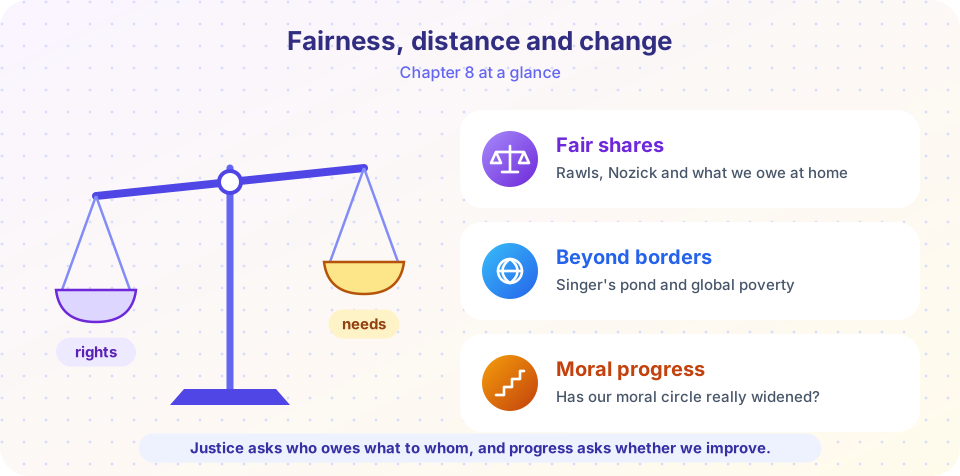
An overview of chapter 8: theories of distributive justice, duties to distant strangers, and whether moral progress is real, with a map of the lessons ahead.
Earlier chapters asked how individuals should act. This chapter asks how societies should be arranged and what we owe to people beyond our own circle. Who should get what? What do we owe a stranger in another country? And when moral views change over time, is the change an improvement, or just a shift in fashion?
These questions connect personal ethics to politics, economics and history. They also test every theory you have met, because a theory that sounds fine for one person's choices may produce odd results at the scale of a country.
What you will learn
- The main questions of distributive justice and how Rawls, Nozick and others answer them.
- The ethical case for helping distant strangers and the main objections.
- What moral progress might mean and how historians and philosophers explain moral change.
- How this chapter ties earlier theories to real institutions.
Key terms
Justice: giving each person what is owed; fairness in how benefits and burdens are shared.
Distributive justice: the fair distribution of resources, opportunities and burdens in a society.
Desert: what a person deserves because of their effort, contribution or conduct.
Moral progress: change in moral beliefs, practices or institutions that is an improvement by some defensible standard.
Positive and negative duties: duties to help and duties not to harm.
Three big questions
Fair shares
Lesson 2
Beyond borders
Lesson 3
Moral progress
Lesson 4
A walk through the chapter
- Rawls, Nozick and fair shares. The veil of ignorance, the two principles, entitlement theory, desert, luck, capabilities and priority.
- Global poverty and the duty to help. Singer's pond, the demandingness objection, partiality, duties of justice and what we know about effective aid.
- Moral progress and moral change. Milestones, mechanisms of change, doubts about progress and a model of norm tipping.
- Chapter review. A one-picture summary and a ten-question quiz.
Why connect justice to progress?
Justice is partly the project of correcting past wrongs and extending equal consideration. Moral progress, if real, is a story about that project's successes and failures. But the idea of progress is controversial: a claim that "we are better" can be arrogant, and history includes setbacks. A good habit is to ask about each claimed improvement: By what standard is it better? Who gained and who lost? What caused the change? Could it be reversed?
Facts and figures to hold lightly
Questions of justice depend on empirical claims about inequality, poverty, the effects of aid and the causes of social change. Estimates differ between sources and over time. This chapter focuses on the structure of arguments and uses invented numbers for illustration; when you study a real policy, check current data.
Common misconceptions
"Justice means everyone gets exactly the same." Most theories reject strict equality of outcomes. They differ on what inequalities are acceptable.
"Helping strangers is charity, not duty." Singer and others argue it can be a duty; critics resist this. The disagreement is real.
"Moral progress is automatic." History includes reversals; progress, if it happens, needs people to argue and act for it.
Try it
Press Run (or Ctrl + Enter) to see the result here.
Program input · what you'd type while the program runs
Type the answers before you press Run, one per line. Each time the program reads a line (with input()), it gets the next line from this box.
Check your understanding
Quick check · 3 questions
of 3 answered You scored / 3 · perfect!
-
1. What does distributive justice study?
It asks how benefits and burdens should be shared in a society. -
2. Which is a negative duty?
Negative duties are duties not to harm; positive duties are duties to help. -
3. What is a good first question about a claim of moral progress?
A claim of progress requires a defensible standard of improvement.
Summary
- Chapter 8 moves from personal choices to social arrangements and global duties.
- Three questions guide it: who gets what, whom do we owe, and are we improving.
- Justice and progress are linked: both concern correcting wrongs and extending fair treatment.
- Use invented numbers for practice and real data for real decisions.
Track your progress
Create a free account to tick off lessons and pick up where you left off on any device.
of Ethics lessons completed