


















Lesson 10 of 45 · Consequentialism
Consequentialism: Judging Actions by Results
Chapter 3 overview: what consequentialism claims, the questions that divide its versions (what counts, for whom, which acts) and what the next lessons cover.
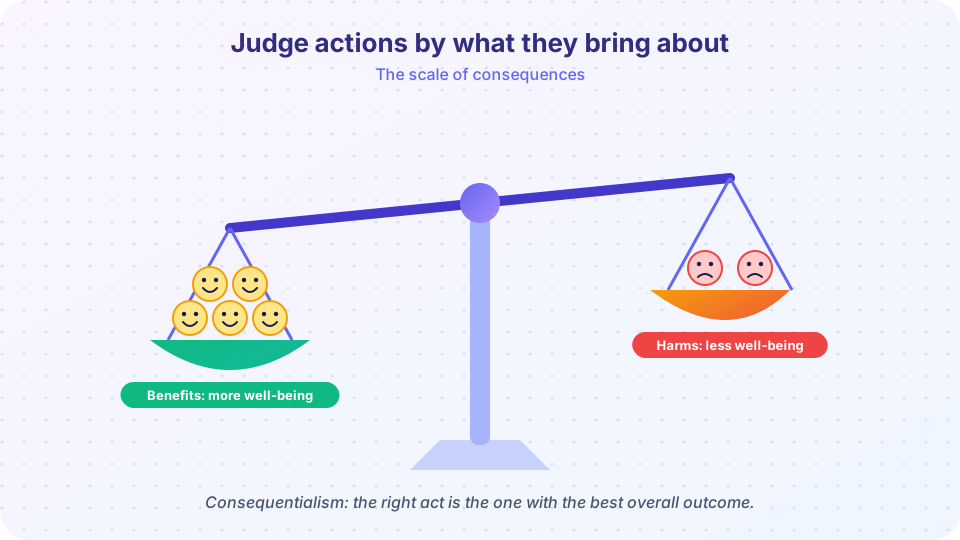
When you decide whether to take one job or another, whether to speak up at a meeting or stay silent, or how a city should spend a limited budget, you probably think about what will happen as a result. Which option leaves people better off? Which causes less harm? This outcome-focused way of thinking comes naturally. Consequentialism is the ethical theory that turns it into a principle: the right act is the one with the best consequences.
It is one of the three great families of moral theory, along with deontology (Chapter 4) and virtue ethics (Chapter 5). It is also the most influential in public policy: cost-benefit analysis, public health planning and effective charity all use consequentialist reasoning, whether or not they use the name.
What you will learn
- The core claim of consequentialism and what it rejects.
- Three questions that divide versions of the theory: what counts as good, for whom, and how rules fit in.
- A preview of the four lessons that follow.
Key terms
Consequence: a result of an action, including effects on people's well-being.
Utility: a stand-in word for whatever is good for a person, such as well-being.
Impartiality: counting each person's well-being equally, no matter who they are.
Maximizing: choosing the option with the best total outcome, not merely a good one.
The core idea
Consequentialism has three parts.
- Outcomes matter. An act is right or wrong depending on what it brings about. There is no such thing as an act that is wrong "in itself" if its results are excellent.
- A standard of the good. To compare outcomes, we need a view about what makes outcomes better or worse. The classical answer is human (and animal) well-being.
- Impartial aggregation. Everyone's good counts equally. Your own happiness does not weigh more than a stranger's, and distance or nationality is not a reason to discount.
The slogan "the ends justify the means" is a rough summary but a misleading one. A consequentialist counts the harm done by the means as part of the outcome. If the means produce enough harm, they are not justified.
Three dividing questions
What counts as good?
Whose good counts?
Which act is right?
Lessons 2 to 4 take these questions one by one.
The first question is about value: what makes an outcome good? Jeremy Bentham and John Stuart Mill said pleasure and the absence of pain. Others say desires satisfied, or a list of goods such as knowledge, friendship and health. The second is about scope: whose well-being counts? Utilitarianism, the best-known version, says everyone's, equally. The third is about method: should we choose the best act in each situation, or follow the rules that would give the best results if generally accepted?
Other versions adjust the formula. Prioritarianism gives extra weight to the worst off. Satisficing consequentialism asks for a good enough outcome, not the best. Negative utilitarianism treats reducing suffering as more important than increasing happiness. We touch on some of these in the lessons.
The chapter in four lessons
- Classical Utilitarianism introduces Bentham and Mill, the principle of utility and the felicific calculus, with a worked example.
- Well-Being and Welfare compares hedonism, preference theories and objective-list theories, and the experience machine.
- Act, Rule and the Objections separates act from rule versions and tests them against the utility monster, demandingness, rights and integrity.
- Chapter 3 Review pulls it together.
Common misconceptions
"Consequentialists ignore motives and character." They can value good motives and character because these tend to produce good results. They simply do not make rightness depend on motive alone.
"Consequentialism permits anything if the results are good." The calculation includes every harm, including the harm of breaking trust and violating rights. Whether it can fully explain why some acts are off the table is the central dispute.
"Consequentialism requires certainty about the future." No theory can. Consequentialists usually say we should choose the act with the best expected outcome, given what we can reasonably foresee.
Try it
The first demonstration is a decision calculator that compares options by expected well-being: the sum of each outcome's value times its probability. The numbers are made up for illustration. Change them and see how the ranking changes.
Press Run (or Ctrl + Enter) to see the result here.
Program input · what you'd type while the program runs
Type the answers before you press Run, one per line. Each time the program reads a line (with input()), it gets the next line from this box.
The second demonstration is a visual scale. Set how many people benefit or are harmed and by how much. It tips toward the larger total. This is a deliberately simple model of aggregation: real well-being cannot be measured in single numbers, a point we return to in the next lessons.
Check your understanding
Quick check · 4 questions
of 4 answered You scored / 4 · perfect!
-
1. What is the core claim of consequentialism?
Consequentialism makes the value of outcomes the standard of right action. -
2. 'Impartial aggregation' means
Each person's good counts the same, and the results are combined. -
3. Which version asks for the best rule rather than the best act?
Rule consequentialism asks which rules, if generally accepted, give the best results. -
4. Which is a misunderstanding of consequentialism?
The theory counts every harm, including harm done by the means. Whether it explains rights well is a separate debate.
Summary
- Consequentialism says the right act is the one with the best consequences, judged impartially.
- Versions differ on what counts as good, whose good counts and whether to judge acts or rules.
- It is influential in policy, and it faces serious objections that the later lessons examine.
- A consequentialist chooses by expected outcome and counts every harm, including harms from the means.
Next: Classical Utilitarianism
Track your progress
Create a free account to tick off lessons and pick up where you left off on any device.
of Ethics lessons completed