


















Lesson 23 of 45 · Virtue Ethics and Other Theories
Contractualism and the ethics of care
Compare two ideas of moral community: contractualism (agreement among equals) and the ethics of care (relationships and dependence), with thinkers, objections and a game you can run.
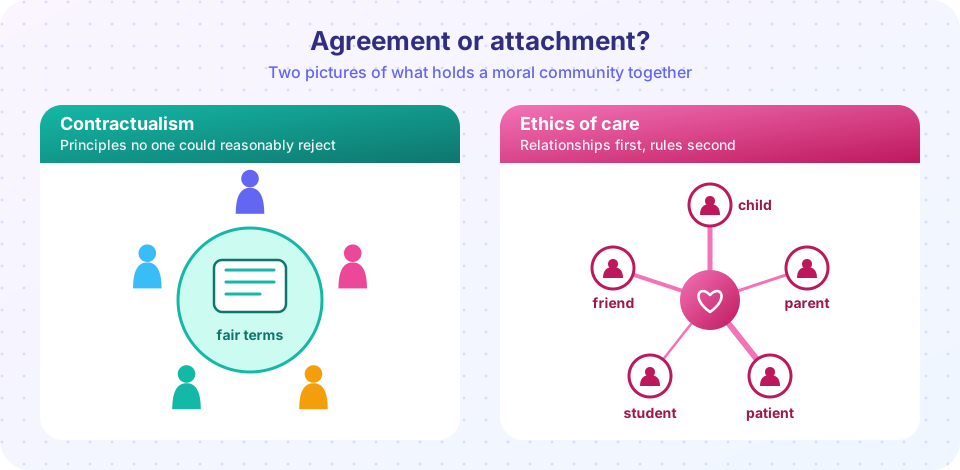
What makes a set of moral rules legitimate? One famous answer says: the rules we would all agree to. Another answer says: moral life does not begin with free adults making deals. It begins with babies, invalids and old people who cannot bargain at all, and with the people who care for them.
These are the two pictures behind contractualism and the ethics of care. They lead to different priorities, and the clash between them is one of the most productive in modern moral philosophy.
What you will learn
- The social-contract tradition from Hobbes to Scanlon and what each version tries to explain.
- Scanlon's test of "principles no one could reasonably reject".
- The main objections to contractualism, including the problem of those who cannot bargain.
- The origins of care ethics (Gilligan, Noddings, Held, Kittay, Tronto) and its four phases of care.
- Where the two theories complement or collide.
Key terms
State of nature: an imagined condition without government or shared rules, used to test why we need them.
Reasonable rejection: Scanlon's idea that an act is wrong if it is forbidden by principles nobody could reasonably reject as a basis for general agreement.
Ethics of care: a family of views that treat caring relationships and responsiveness to need as basic to morality.
Dependency work: the labor of caring for those who cannot look after themselves, a term associated with Eva Kittay.
Contractualism: morality as fair agreement
The idea that political and moral rules come from agreement is old, but three versions are worth knowing.
Thomas Hobbes (Leviathan, 1651) imagined a state of nature without authority. Everyone fears everyone, and life would be "solitary, poor, nasty, brutish, and short." Rational self-interested people would therefore agree to give up some freedom to a sovereign who enforces peace. David Gauthier (Morals by Agreement, 1986) later developed a modern version: morality is the set of constraints that rational self-interested bargainers would accept.
John Rawls (A Theory of Justice, 1971) asked what principles of justice free and equal people would choose behind a "veil of ignorance," not knowing their own place in society. Chapter 8 returns to this.
T. M. Scanlon (What We Owe to Each Other, 1998) turned the contract idea into a theory of right and wrong in general. An act is wrong, he says, if it would be disallowed by a principle that no one could reasonably reject as a basis for general regulation of behavior. The test is about justifiability to each person. If a principle would impose a heavy burden on someone for a small benefit to others, that person has a reasonable complaint. So Scanlon explains why we cannot sacrifice one innocent person for slight gains to many, a result that simple totals miss.
Objections to contractualism
- No one signed. David Hume (1748) asked when anyone actually agreed. Today's defenders reply that the agreement is hypothetical: the test is what could be justified, not what was signed.
- Who is at the table? If bargaining power determines the result, those who cannot bargain (infants, severely disabled people, animals, future generations) may be left out. Scanlon and others reply that principles must be justifiable to every person, and that some duties to animals are handled separately; critics find this unsatisfying.
- The contract was not neutral. Carole Pateman (The Sexual Contract, 1988) and Charles Mills (The Racial Contract, 1997) argued that historical social-contract thought assumed that women or non-white people were outside the parties to the agreement. Their point is about both history and ideals: a theory of equals must check who it counts as equal.
- Circularity. "Reasonable" is doing a lot of work. If it means "moral," the theory risks assuming what it means to explain.
Ethics of care: morality begins with relationships
The ethics of care grew in the 1980s, and it is a family of views, not one doctrine.
- Carol Gilligan (In a Different Voice, 1982) responded to Lawrence Kohlberg's stage theory of moral development, which ranked justice-based reasoning as the highest stage. She reported that many women described moral problems in terms of relationships and responsibility, and argued that this "care voice" was neglected. Later research suggests that differences between men and women are smaller than the early claims, and Gilligan herself emphasizes that the voices are not tied to sex. The lasting contribution is the second voice, not a claim about gender.
- Nel Noddings (Caring, 1984) described caring as an encounter in which one person attends to another and the other recognizes the care.
- Virginia Held (The Ethics of Care, 2006) developed it as a moral theory that applies also to politics and global issues.
- Eva Kittay (Love's Labor, 1999) argued that human beings are dependent for much of their lives. A theory of justice that imagines only independent adults hides the people who give care, usually women, and often for low or no pay.
- Joan Tronto (Moral Boundaries, 1993) analysed care as a practice with phases: attentiveness (noticing a need), responsibility (taking it on), competence (doing the work well) and responsiveness (checking how the receiver experiences it). She later added a fifth idea, solidarity in shared caring.
The key moves are to treat dependence as normal, to value emotions and attention as moral skills, and to focus on particular relationships over abstract principles.
Objections to care ethics
- Parochialism. Caring for those close to you could excuse favoritism. Defenders reply that care ethics can be widened to institutions and global care chains, as Held and Tronto argue.
- Entrenched gender roles. Praising care could keep women in unpaid roles. Care ethicists answer that the point is to make care visible and shared, not to assign it.
- Paternalism and burnout. Care can be controlling or exhausting. Responsiveness (listening to what the cared-for person actually wants) and limits on the carer are part of good care.
- Does it need justice? Many writers combine care with principles of justice for strangers.
Do the two clash?
Often they complement each other. Contractualism protects equal standing and gives reasons strangers can accept. Care ethics reminds us who is missing from the table and why attention matters. A nurse (care) works within hospital rules that no patient could reasonably reject (contract). A thoughtful person uses both.
Common misconceptions
"The contract is a real historical event." For nearly all modern contractualists it is a thought experiment about justification.
"Care ethics says feelings replace reasoning." It values attention, judgment and competence. Care without competence harms.
"Contractualism says might makes right." Hobbes comes close, but Scanlon and Rawls require principles justifiable to every person as an equal.
Try it
Press Run (or Ctrl + Enter) to see the result here.
Program input · what you'd type while the program runs
Type the answers before you press Run, one per line. Each time the program reads a line (with input()), it gets the next line from this box.
Check your understanding
Quick check · 5 questions
of 5 answered You scored / 5 · perfect!
-
1. In Scanlon's contractualism, an act is wrong if
Scanlon's test is whether a principle could be justified to each person affected. -
2. Who wrote 'The Racial Contract' (1997)?
Charles Mills argued that the classic social contract excluded non-white people from full personhood. -
3. Which is the correct order of Tronto's first four phases of care?
You notice a need, take responsibility, do the work competently, and check how it is received. -
4. Why does Kittay emphasize dependency work?
Human beings depend on care at many points; ignoring that hides the carers and the cared-for. -
5. Which is a standard worry about care ethics?
Critics note that a focus on particular relationships can seem parochial; defenders extend care to institutions and strangers.
Summary
- Contractualism (Hobbes, Gauthier, Rawls, Scanlon) explains morality as what could be justified to everyone.
- Objections stress that no one signed, that some cannot bargain, that history excluded groups, and that "reasonable" can be circular.
- Care ethics (Gilligan, Noddings, Held, Kittay, Tronto) starts from dependence, relationships and responsive attention.
- Tronto's phases of care are attentiveness, responsibility, competence and responsiveness.
- The theories complement each other: one guards equal standing, the other shows who is missing.
Next: Chapter review
Track your progress
Create a free account to tick off lessons and pick up where you left off on any device.
of Ethics lessons completed