


















Lesson 29 of 45 · Metaethics
Chapter 6 review: a map of metaethics
Review chapter 6 with a two-question map of metaethical positions, a recap table of arguments and objections, and a ten-question mixed quiz.
Metaethics can feel like a jumble of -isms. The trick to keeping them straight is to ask two questions of any position: What do moral claims do? (state beliefs or express attitudes) and Is there anything that makes them true independent of minds? Nearly every view lands in a different place on that grid.
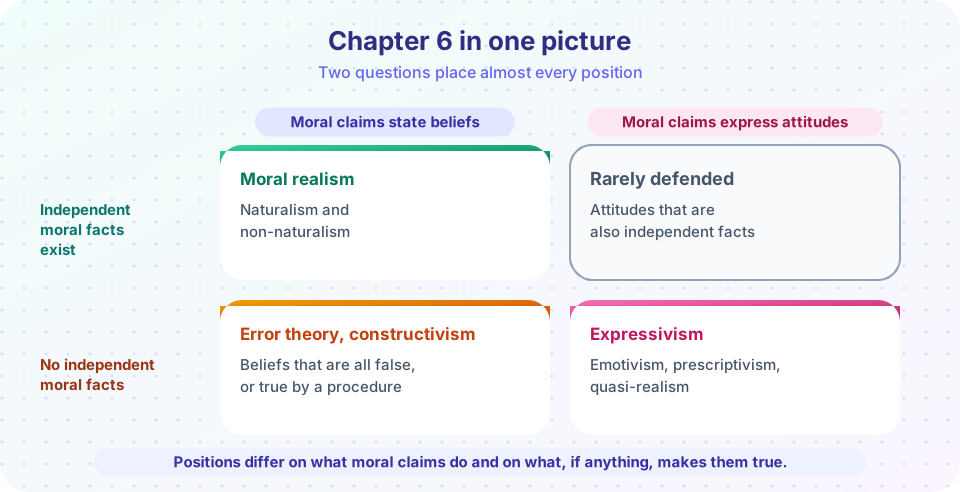
What you will review
- The grid of positions and the main argument for and against each.
- The is-ought gap, direction of fit and the Frege-Geach problem.
- What moral psychology and evolution do and do not show.
Key terms
Cognitivism / non-cognitivism: moral claims express beliefs / attitudes.
Realism / anti-realism: there are / are not stance-independent moral facts.
Error theory: moral claims are cognitive but all false.
Quasi-realism: expressivism that earns the language of truth.
Debunking: undermining a belief by showing its origin is unconnected to its truth.
Recap table
| Position | What moral claims do | Are there independent facts? | Key thinkers | Main objection |
|---|---|---|---|---|
| Naturalist realism | State beliefs | Yes, natural | Boyd, Sturgeon, Brink | Open question argument |
| Non-naturalist realism | State beliefs | Yes, sui generis | Moore, Parfit, Enoch | Queerness; how do we know them? |
| Error theory | State beliefs (all false) | No | Mackie, Joyce | Seems to undermine morality or be unstable |
| Expressivism | Express attitudes or plans | No | Ayer, Stevenson, Hare, Blackburn, Gibbard | Frege-Geach; mistakes of morality |
| Constructivism | State beliefs true by procedure | Procedure-dependent | Korsgaard, Street, Rawls | Is the procedure itself moral? |
Arguments to remember
- Open question argument (Moore): for any natural definition of good, it still seems open whether it is good.
- Queerness and relativity (Mackie): objective values would be strange, and moral variation suggests a human origin.
- Direction of fit: beliefs fit the world, desires try to make the world fit them. Moral judgments seem to motivate.
- Frege-Geach (1960s): attitudes cannot sit in "if" clauses; how can moral reasoning be valid?
- Is-ought gap (Hume): an ought needs an ought-bridge.
- Haidt and Greene: intuition and dual processes shape judgment; evidence is mixed and not normative.
- Debunking (Street, Joyce): evolutionary origins may undermine realism, but replies say the argument over-generalizes.
Common misconceptions
"Cognitivism equals realism." Error theorists and constructivists are cognitivists without being realists.
"Expressivism is relativism." Relativism says truth varies with the code; expressivism is about what moral claims do.
"Psychology answers metaethics." It supplies evidence about how judgment works; philosophers argue over what follows.
Try it
Press Run (or Ctrl + Enter) to see the result here.
Program input · what you'd type while the program runs
Type the answers before you press Run, one per line. Each time the program reads a line (with input()), it gets the next line from this box.
Press Run (or Ctrl + Enter) to see the console output here.
No output.
Check your understanding
Quick check · 10 questions
of 10 answered You scored / 10 · perfect!
-
1. Which position is cognitivist but denies that any moral claim is true?
Error theory says moral claims aim to state facts, but none exist, so all are false. -
2. The open question argument was developed by
Moore (Principia Ethica, 1903) used it against naturalistic definitions of good. -
3. Which pair of terms best fits expressivism?
Expressivists say moral claims express attitudes, plans or norms. -
4. In direction-of-fit terms, which is the odd one out?
A shopping list has world-to-word fit; the others aim to match the world. -
5. What is the Frege-Geach problem about?
It asks how moral sentences keep meaning when embedded, for example in an if-clause. -
6. Which of these is a fair summary of Mackie's argument from relativity?
Mackie used variation in moral codes to argue that objective values are an implausible explanation. -
7. Which statement is accurate?
Constructivism has moral truth fixed by a procedure; it is cognitivist but not stance-independent realism. -
8. What is an evolutionary debunking argument?
Street and Joyce argued that if evolution shaped our moral attitudes without regard to truth, belief in moral truth lacks support. -
9. The is-ought gap means that
A bridging normative premise is required. -
10. Which would be the most careful conclusion from Haidt's moral dumbfounding studies?
The findings support a role for intuition without proving that reasoning is idle.
Summary
- Place any metaethical view by what moral claims do and whether independent facts exist.
- The main arguments: open question, queerness, direction of fit, Frege-Geach, is-ought and debunking.
- Moral psychology describes how judgment works; it does not settle what we ought to do.
- A careful student can hold a firm moral view and still be unsure about its metaethical foundation.
Track your progress
Create a free account to tick off lessons and pick up where you left off on any device.
of Ethics lessons completed