


















Lesson 30 of 45 · Applied Ethics: Life, Technology and Environment
Chapter 7 overview: ethics in practice
A guide to applied ethics: how to bring theories to real cases in medicine, animal and environmental ethics and technology, with a four-lens method.
Theory earns its keep when it meets a real decision. A doctor must decide whether to continue treatment, a city must choose between a park and housing, an engineer must decide whether a system is safe enough to release. Applied ethics is the work of bringing the ideas of earlier chapters to such cases without pretending that any theory can do the job alone.
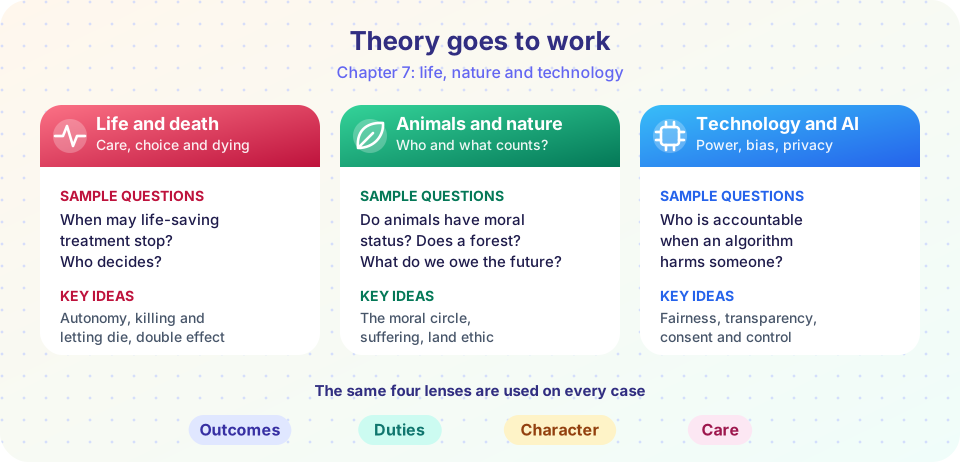
This chapter covers three fields: life and death, animals and the environment, and technology and AI. They differ in facts, but the method is the same: gather the facts, name who is affected, and ask what several ethical lenses suggest.
What you will learn
- What applied ethics is and how it differs from pure theory.
- The four-lens method used in this chapter.
- What each lesson covers and what to expect from it.
- Why good applied ethics begins with facts.
Key terms
Applied ethics: the use of ethical thinking on practical questions in particular fields, such as medicine, business or technology.
Bioethics: ethics of medicine and the life sciences.
Stakeholder: a person or group whose interests are affected by a decision.
Moral status: whether, and how much, a being's interests matter morally for their own sake.
Reflective equilibrium: adjusting principles and judgments about cases until they fit together (Rawls).
How applied ethics works
Applied ethics, step by step
Life and death
Lesson 2
Animals and nature
Lesson 3
Technology and AI
Lesson 4
The four lenses
Each case in this chapter is viewed through four questions drawn from earlier chapters.
- Outcomes (consequentialist): What results will each option have for everyone affected, now and later?
- Duties and rights (deontological): What do people have a right to, and what promises, consent and fairness constrain us?
- Character (virtue): What would a wise, honest, compassionate person do? What does each option express?
- Care and relationships: Who depends on whom, and what do they actually need?
Sometimes the lenses agree. Sometimes they conflict, and noticing the conflict is a sign of a hard case, not a failure of method. Philosophers describe the goal as reflective equilibrium: you test principles against your judgments about specific cases and adjust either until they fit.
A walk through the chapter
- Life and death. The four principles of biomedical ethics, killing and letting die, double effect and the debates over assisted dying and abortion, presented with the strongest arguments on each side.
- Animals and the environment. The moral circle, Singer and Regan on animals, land ethics, climate and the rights of future generations.
- Technology and AI. Privacy, algorithmic bias, fairness metrics that cannot all be satisfied, responsibility and regulation.
- Chapter review. A matrix of domains by lenses and a ten-question quiz.
Why facts matter first
Many ethical disagreements are really disagreements about facts. Is a treatment effective? Do animals feel pain in this way? Does an algorithm make more errors for one group? Ethicists must learn the relevant science, law and context, or they risk elegant answers to the wrong question. This chapter therefore pairs each topic with the kind of evidence that matters and flags where evidence is uncertain.
A note on sensitive topics
Some topics here (dying, abortion, animal use) are deeply felt and divide thoughtful people. The lessons present the main arguments and the best case for each side so that you can think about them. They are educational and do not give medical, legal or personal advice. If you or someone close to you faces such a decision, speak to qualified professionals and people who care for you.
Common misconceptions
"Applied ethics just applies one theory to cases." In practice, ethicists use several theories, plus facts, law and professional codes.
"If theories disagree, ethics is hopeless." Disagreement identifies what is at stake. Many cases have broad agreement on the main points.
"Ethics is a personal feeling, so cases cannot be argued." Arguments, evidence and consistency matter, and good analysis can change minds.
Try it
Press Run (or Ctrl + Enter) to see the result here.
Program input · what you'd type while the program runs
Type the answers before you press Run, one per line. Each time the program reads a line (with input()), it gets the next line from this box.
Check your understanding
Quick check · 4 questions
of 4 answered You scored / 4 · perfect!
-
1. What is applied ethics?
Applied ethics brings theory to real decisions in particular fields. -
2. Which is NOT one of the four lenses in this chapter?
The four lenses are outcomes, duties and rights, character, and care. -
3. Why does applied ethics begin with facts?
Accurate facts and context are needed before any lens can be applied well. -
4. Reflective equilibrium means
Rawls described it as mutual adjustment between principles and considered judgments.
Summary
- Applied ethics brings ethical thinking to practical fields, starting with facts.
- This chapter uses four lenses: outcomes, duties and rights, character and care.
- The three fields are life and death, animals and the environment, and technology and AI.
- Conflict among lenses marks a hard case; it does not defeat the method.
- Sensitive topics deserve respectful treatment of the best arguments on all sides.
Next: Life and death
Track your progress
Create a free account to tick off lessons and pick up where you left off on any device.
of Ethics lessons completed