


















Lesson 5 of 45 · What Is Ethics
What Is Ethics? The Big Picture
Chapter 2 overview: what ethics is, how its three branches (metaethics, normative ethics, applied ethics) fit together, and what the next lessons cover.
The word ethics comes from the Greek ethos, meaning character or custom. The word morality comes from the Latin mores, meaning customs. Both point to the same human concern: how should we live, and how should we treat each other? People have asked this question in every culture, and every society has some answer built into its habits, stories and rules.
Philosophers turn the question into a field of study. They ask what is good, what is right, what we owe each other, and whether moral claims can be justified at all. This chapter paints the big picture before you meet the theories in Chapters 3 to 5.
What you will learn
- The three branches of ethics and the question each one asks.
- Where descriptive studies of morality (psychology, anthropology) fit in.
- What the four lessons of this chapter cover and how to use them.
Key terms
Metaethics: the study of the nature, meaning and status of moral claims.
Normative ethics: the study of what makes actions right or wrong and what we ought to do.
Applied ethics: the use of ethical thinking on specific problems such as medicine or technology.
Descriptive ethics: the empirical study of what people actually believe and do.
Three branches, four questions
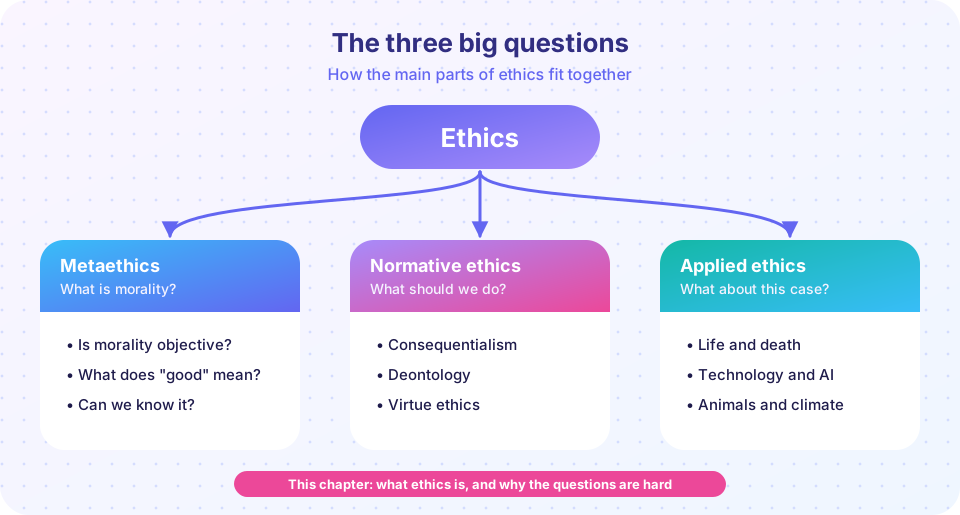
Think of ethics as a tree with three main branches.
Metaethics asks questions about morality itself. When you say "cruelty is wrong", are you stating a fact, expressing a feeling or giving a command? Can moral claims be true or false? Is morality the same for everyone, or does it depend on culture? Chapter 6 is devoted to these questions, and Lesson 4 of this chapter previews one of them.
Normative ethics asks which actions are right or wrong, and why. The classic families of theory answer in different ways. Consequentialists look at results, deontologists look at duties and rights, and virtue ethicists look at character. You will meet them in Chapters 3, 4 and 5.
Applied ethics takes ethical thinking to concrete problems. May doctors help patients end their lives? Is it right to eat animals? What does a company owe the people whose data it collects? Chapter 7 covers life, technology and environment.
A fourth field sits beside the three: descriptive ethics. It does not say what is right. It records what people believe and do, and how moral thinking works. Psychologists, anthropologists and sociologists do this work. Its findings matter to philosophers, but a description of what people think is not an argument about what is true. That is the is-ought gap you met in Chapter 1.
What the chapter covers
Chapter 2 at a glance
Guiding questions
Short answers appear in the lessons.
- Ethics, Law and Etiquette compares three systems of rules and shows why something can be legal yet wrong, or illegal yet right.
- Moral Psychology: How We Actually Judge looks at what research says about intuition, emotion and reasoning, and at the limits of those findings.
- Relativism and Universalism examines the claim that right and wrong depend on culture, and the best replies.
- Chapter 2 Review pulls it together with a ten-question quiz.
Common misconceptions
"Ethics is just personal opinion." Opinions are part of the story, but ethics asks for reasons, and some reasons are better than others. Even if morality turned out to be partly relative, that conclusion itself needs an argument.
"Ethics is only for religious people." Moral philosophy exists in religious and secular traditions. Many religious thinkers use philosophical arguments, and many secular philosophers use ideas about duty and compassion.
"Moral philosophers decide what is right for everyone." Their role is to clarify, argue and test. Moral decisions stay with each person and community.
Try it
The first demonstration sorts example questions into the three branches. It is a small learning aid: sort each question, then read the explanation.
The second demonstration is a crude "is or ought?" detector. It marks sentences that contain normative words such as should or wrong. It is a keyword trick for illustration, not a real language analysis, and it will make mistakes, which is part of the lesson.
Press Run (or Ctrl + Enter) to see the result here.
Program input · what you'd type while the program runs
Type the answers before you press Run, one per line. Each time the program reads a line (with input()), it gets the next line from this box.
Check your understanding
Quick check · 4 questions
of 4 answered You scored / 4 · perfect!
-
1. Which branch asks 'What makes an action right?'
Normative ethics studies what makes acts right or wrong and what we ought to do. -
2. A study that records how people in different countries judge lying belongs to
It describes beliefs and behavior without deciding which are correct. -
3. 'Is it ever right for doctors to withhold information from patients?' is a question of
It asks about a specific professional situation. -
4. Which is a metaethical question?
Metaethics studies the nature, meaning and status of moral claims.
Summary
- Ethics studies how we ought to live; its three branches are metaethics, normative ethics and applied ethics.
- Descriptive ethics records what people believe and do; it informs but does not settle normative questions.
- The chapter covers ethics versus law and etiquette, moral psychology and relativism.
- Opinion is part of morality, but ethics asks for reasons.
Track your progress
Create a free account to tick off lessons and pick up where you left off on any device.
of Ethics lessons completed