


















Lesson 26 of 45 · Metaethics
Moral realism and its rivals
Explore the main metaethical positions: naturalism, non-naturalism, Mackie's error theory, constructivism and relativism, with their best arguments and objections.
Imagine a mathematician claims that there are infinitely many prime numbers. Most people think this is true whatever anyone believes, and that the mathematician discovered it. Now imagine someone claims that slavery is wrong. Is that like the prime-number claim, true whatever anyone believes? Or is it more like "chocolate is delicious," a claim that depends on responses?
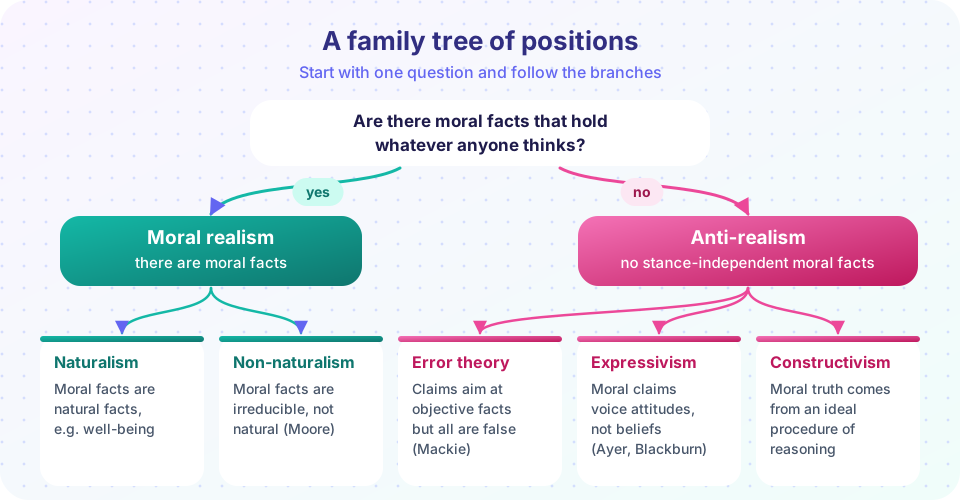
Moral realism says the first. This lesson maps the main ways of agreeing and disagreeing with it, and gives the strongest argument on each side.
What you will learn
- What moral realism claims and the difference between naturalist and non-naturalist versions.
- Moore's open question argument and what it was supposed to show.
- Mackie's two arguments for error theory: queerness and relativity.
- What constructivism says and why it is a middle path.
- Why moral disagreement does not settle the question by itself.
Key terms
Stance-independent fact: a fact that holds regardless of anyone's attitudes or opinions about it.
Naturalism (ethical): moral facts are natural facts, the kind science or ordinary experience could study.
Non-naturalism: moral facts exist but are of their own kind, not reducible to natural facts.
Error theory: moral claims aim to state objective facts, but no such facts exist, so they are systematically false.
Constructivism: moral truths are fixed by the outcome of an idealized procedure of reasoning or agreement.
Moral realism
Moral realists accept two claims. First, moral sentences purport to describe how things are, so they are true or false (cognitivism). Second, some of them are true, and what makes them true does not depend on anyone's say-so.
The best motives for realism are simple. Moral thought seems factual. We argue, change our minds on evidence and feel we have discovered that something was wrong. We also think some moral views, such as that gratuitous cruelty is wrong, are not merely tastes, and we think that past societies that endorsed slavery were mistaken, not just different. Realism explains why moral progress looks like progress.
Naturalist versions
Ethical naturalists say moral properties are natural properties. For example, goodness might be whatever promotes the flourishing of beings, which can be studied with biology, psychology and social science. The Cornell realists (Richard Boyd, Nicholas Sturgeon, David Brink) argue that moral properties may be natural properties in the way that "being a healthy organism" is, and that they play a real explanatory role.
The open question argument was G. E. Moore's reply in Principia Ethica (1903). Suppose someone says goodness is pleasure. We can still ask, "Yes, this is pleasant, but is it good?" and the question seems open and meaningful in a way that "Is a bachelor unmarried?" does not. Moore concluded that goodness cannot be defined in natural terms. Critics reply that two terms can pick out the same property without meaning the same thing, as "water" and "H₂O" do, so an open question does not show distinct properties.
Non-naturalist versions
Non-naturalists (Moore, and more recently Derek Parfit and David Enoch) say moral facts are sui generis, their own kind, like mathematical truths. We know them through reason or intuition. The main objection is Mackie's, below.
Error theory
J. L. Mackie (Ethics: Inventing Right and Wrong, 1977) argued that moral thought presupposes objective, action-guiding facts, and that there are none. He gave two arguments.
- The argument from queerness. Objective moral properties would be very strange things: they would have to guide action by their own nature, to motivate anyone who recognized them, and also be part of the world. And we would need a strange faculty to detect them.
- The argument from relativity. Moral codes vary widely across societies and history. The best explanation, Mackie says, is that they reflect ways of life, not perception of objective facts.
If Mackie is right, "cruelty is wrong" is false, in the way that "witches exist" is false. A few error theorists, such as Richard Joyce, then ask whether we should keep using moral language anyway because it helps people cooperate.
Replies. Realists answer that moral facts are not weirder than mathematical or logical facts, which we accept. They also say disagreement is common in science and history, and that disagreement does not show there is no truth. Differences in belief can come from bias, ignorance and self-interest.
Constructivism and relativism
Constructivists (Christine Korsgaard, Sharon Street, and the Rawlsian tradition) say moral truths are neither objective facts out there nor mere feelings. They are the results of an idealized process: what we would endorse after reasoning correctly from our own standpoint, or what rational agents would agree to. The truth of "cruelty is wrong" is fixed by the procedure, so it is not arbitrary.
Moral relativism is a related but weaker idea: what is right depends on the moral code of a society or person. Note two kinds: descriptive relativism (societies differ, which is plainly true) and metaethical relativism (no code is more correct than another, which is far more controversial). Many critics point out that relativism struggles with moral criticism of one's own society.
Does disagreement refute realism?
Not by itself. When evidence is limited, people may estimate the same quantity differently even if there is a true answer. The simulation below shows how persistent disagreement can appear even when there is a fact to find. It does not show that morality is like that; it shows that disagreement alone does not decide.
Common misconceptions
"Realism means moral facts are easy to know." Realists accept that moral knowledge is difficult and fallible.
"Anti-realists must be relativists." Error theory, expressivism and constructivism are different from relativism, and several defend firm moral views.
"Disagreement proves there is no moral truth." Scientists disagree about plenty of questions that do have answers.
Try it
Press Run (or Ctrl + Enter) to see the result here.
Program input · what you'd type while the program runs
Type the answers before you press Run, one per line. Each time the program reads a line (with input()), it gets the next line from this box.
Press Run (or Ctrl + Enter) to see the console output here.
No output.
Check your understanding
Quick check · 5 questions
of 5 answered You scored / 5 · perfect!
-
1. What does moral realism claim?
Realists hold that some moral claims are true, and that their truth is stance-independent. -
2. What was the point of Moore's open question argument?
Moore argued that for any natural property, it still makes sense to ask whether it is good, so good is not that property. Critics reply that co-referring terms can differ in meaning. -
3. Mackie's argument from queerness says
Objective values would be unlike anything else in the world and would need a special faculty to detect. -
4. Which is a fair reply to the argument from disagreement?
Disagreement alone does not show that no fact exists; one needs to ask why people disagree. -
5. Constructivism says moral truths are
Constructivists locate moral truth in what ideal reasoning or agreement would produce.
Summary
- Realism says some moral claims are true regardless of anyone's attitudes; naturalists treat these as natural facts, non-naturalists as a separate kind.
- Moore's open question argument and Mackie's arguments from queerness and relativity are the classic opposing arguments.
- Error theory says moral claims are false because the facts they presuppose do not exist.
- Constructivism fixes moral truth by an idealized procedure.
- Disagreement alone does not settle whether a fact exists.
Track your progress
Create a free account to tick off lessons and pick up where you left off on any device.
of Ethics lessons completed