


















Lesson 20 of 45 · Virtue Ethics and Other Theories
Chapter 5 overview: virtue, agreement and care
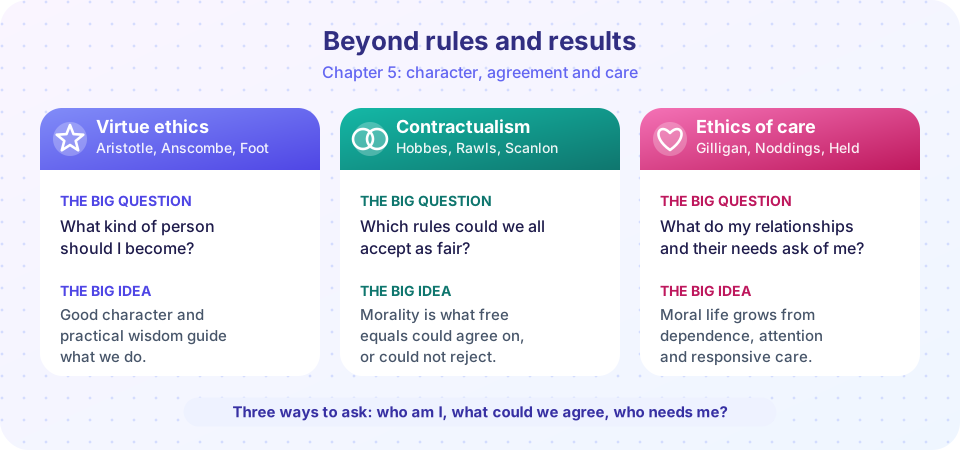
A map of chapter 5: virtue ethics, modern debates about character, contractualism and the ethics of care, and how they differ from rules and results.
So far you have met two famous ways to ask what makes an act right: look at the results, or look at the duties. Both start from the act. This chapter changes the starting point. Virtue ethics starts from the person who acts. Contractualism starts from the agreement people could reach. The ethics of care starts from the relationships in which people live.
These are not three random extras. Each one grew out of a complaint about the older theories. Philosophers worried that rule books ignore character, that results-thinking ignores fairness between persons, and that both ignore the dependent, the small and the sick. Seeing those complaints is the fastest way to see why the newer theories exist.
What you will learn
- Why some philosophers moved the starting point of ethics from acts to character, agreements and relationships.
- The main claim of each of the three theories, and one landmark thinker for each.
- How the lessons in this chapter fit together and in what order to read them.
- How to ask three new questions about any moral problem.
Key terms
Virtue: a stable trait of character, such as courage or honesty, that helps a person live and act well.
Contract (moral): an agreement, real or imagined, on rules for living together.
Care: attentive, responsive concern for the needs of particular people, seen as a moral practice and not only a feeling.
Normative theory: a theory about what we ought to do or be.
The big picture
Why look beyond acts?
Virtue ethics
Lessons 2 and 3
Contractualism
Lesson 4, first half
Ethics of care
Lesson 4, second half
How they fit
A walk through the chapter
- Aristotle and the doctrine of the mean. The oldest and still most influential virtue theory: flourishing, habit, the mean and practical wisdom.
- Modern virtue ethics and the situationist challenge. How Elizabeth Anscombe, Philippa Foot, Alasdair MacIntyre and Rosalind Hursthouse revived the tradition, and how social-psychology experiments tested it.
- Contractualism and the ethics of care. Two rival pictures of what holds a moral community together: agreement or attachment.
- Chapter review. A comparison table, a ten-question quiz and a one-picture summary.
One scenario, three questions
Imagine your friend Maya asks whether you like the business plan she has worked on for a year. You think it will probably fail. What should you say?
A virtue ethicist asks: what would an honest, kind and wise person say? That person does not blurt out every doubt and does not lie either. They find words that are true and gentle, and they choose a moment when Maya can use the advice.
A contractualist asks: what rule about honest feedback could everyone in our position accept? Perhaps: "Tell friends your real concerns when they are asking for your view, but do it with respect." Nobody could reasonably reject that rule, and a rule that allowed comforting lies would let people be misled about decisions that matter to them.
A care ethicist asks: what does this relationship ask of me? Maya depends on your honesty, but she also depends on your support. The question becomes how to stay attentive to her actual needs, perhaps by asking what kind of feedback she wants before you give it.
None of these answers is silly, and they overlap a great deal. The differences appear in hard cases, which is why we study them.
Common misconceptions
"Virtue ethics has no rules." It has plenty of guidance ("be honest, avoid cruelty"), but it explains rules by appeal to virtue instead of the other way round.
"Contractualism says morality is whatever people agree to." Most contractualists say the agreement is hypothetical and constrained by fairness, so a bad deal that people happened to sign is not automatically right.
"Care ethics is only for women or only for families." Its founders argued that care is a human practice that concerns everyone, and later authors apply it to nursing, teaching, politics and global justice.
Try it
Press Run (or Ctrl + Enter) to see the result here.
Program input · what you'd type while the program runs
Type the answers before you press Run, one per line. Each time the program reads a line (with input()), it gets the next line from this box.
Check your understanding
Quick check · 4 questions
of 4 answered You scored / 4 · perfect!
-
1. What is the main starting point of virtue ethics?
Virtue ethics asks what kind of person to be and what a person of good character would do. -
2. Which question best fits contractualism?
Contractualists test principles by whether people could reasonably accept or reject them. -
3. Why do care ethicists emphasize dependence?
Dependence in childhood, illness and old age is a normal part of human life, and care ethics builds on that fact. -
4. A contractualist agreement is usually described as
Most contractualists use an imagined agreement constrained by fairness, not a literal historical document.
Summary
- Virtue ethics, contractualism and the ethics of care move the starting point from the act to the person, the agreement and the relationship.
- Each began as a complaint about older theories and each captures something the others tend to miss.
- The three often agree in everyday cases and diverge in hard ones.
- The rest of the chapter takes them in turn, then compares them.
Track your progress
Create a free account to tick off lessons and pick up where you left off on any device.
of Ethics lessons completed