


















Lesson 11 of 45 · Consequentialism
Classical Utilitarianism: Bentham and Mill
Learn the principle of utility, Bentham's felicific calculus, Mill's higher pleasures, and how to apply utilitarian reasoning with a worked example.
In 1789, the English reformer Jeremy Bentham opened a book on law and morals with a bold sentence: nature has put humankind under two sovereign masters, pain and pleasure. From that starting point he built the most influential consequentialist theory, utilitarianism. If pain is bad and pleasure is good, then the right way to act, and the right way to make laws, is to produce as much good and as little bad as possible, for everyone.
Utilitarianism was radical for its time. It said that noble birth did not make anyone's happiness count for more. It said that the suffering of the poor mattered as much as the comfort of the rich. Bentham used it to argue for prison reform, the end of harsh punishments and, in private papers, for rights for animals and for equality of women. This lesson covers its main ideas, a worked example and the key improvement by John Stuart Mill.
What you will learn
- The principle of utility and the idea of impartial aggregation.
- Bentham's seven dimensions of the felicific calculus.
- Mill's distinction between higher and lower pleasures.
- How to run a simple utilitarian calculation, and why the answer depends on assumptions.
Key terms
Principle of utility: the right act is the one that produces the greatest happiness for the greatest number.
Hedonism: the view that pleasure is the only intrinsic good and pain the only intrinsic bad.
Felicific calculus: Bentham's method for estimating the pleasure and pain an act produces.
Higher pleasures: Mill's term for pleasures of the intellect, imagination and moral feeling.
Aggregation: adding the well-being of many people to reach a total.
The principle of utility
Utilitarianism has four steps in its reasoning.
- Well-being is what ultimately matters, and for classical utilitarians well-being is pleasure and the absence of pain.
- Each person's well-being counts equally. The phrase "each to count for one and nobody for more than one" is usually credited to Bentham (Mill quotes it).
- The right act is the one with the greatest total well-being, summed over everyone affected.
- The same standard applies to individual choices, to laws and to institutions.
"The greatest happiness of the greatest number" is a popular slogan but can mislead. The aim is the greatest total, not the benefit of a majority at any cost. A policy that gave small gains to many and ruinous losses to a few could fail the test.
Bentham's calculus
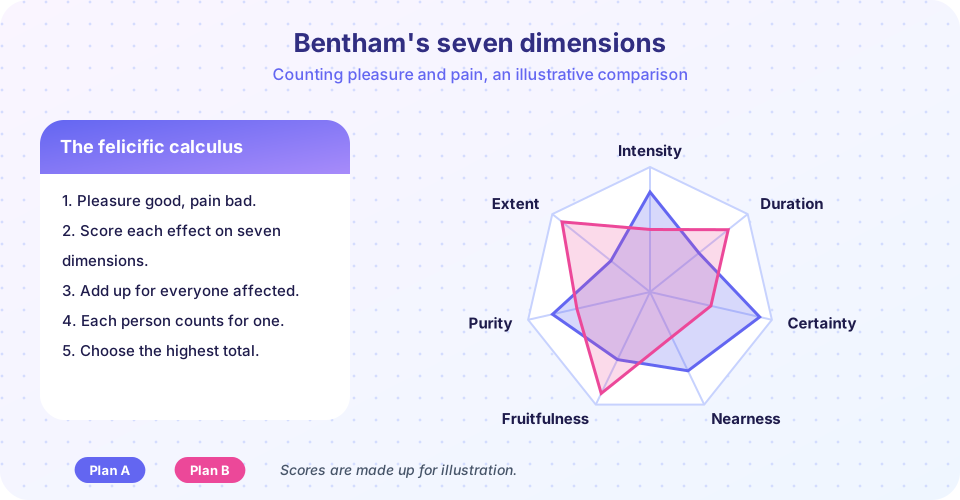
Bentham listed seven circumstances for judging how much pleasure or pain an act would cause.
| Dimension | Question |
|---|---|
| Intensity | How strong is the feeling? |
| Duration | How long does it last? |
| Certainty | How likely is it to occur? |
| Propinquity (nearness) | How soon will it come? |
| Fecundity | Will it lead to more of the same feeling? |
| Purity | Will it be followed by the opposite feeling? |
| Extent | How many people are affected? |
These are less a formula than a checklist. Bentham never claimed that the numbers could be precise, only that the kinds of consideration were the ones that mattered. Modern cost-benefit analysis in health, transport and environmental policy has a similar structure: estimate effects on people, weight them by their probability and size, and compare.
A worked example
A town can afford one of two projects for the next four years. Let us score each as people × intensity (1 to 5) × duration (years) × certainty (0 to 1), subtracting the costs.
| Library extension | Sports field | |
|---|---|---|
| Benefit | 300 people × 3 × 4 years × 0.9 = 3,240 | 500 people × 2 × 4 years × 0.8 = 3,200 |
| Cost | construction noise: 100 × 1 × 0.5 × 1.0 = 50 | injuries: 40 × 4 × 0.5 × 0.5 = 40 |
| Net | 3,190 | 3,160 |
The totals are very close. The result depends on the assumptions: if the sports field were more certain to be used (0.9 instead of 0.8), it would win clearly (3,600 minus 40). That is the lesson of the example. Utilitarian calculation is a way of making your assumptions visible and open to challenge. The numbers do not decide the question; they show what you would have to believe for each option to win.
Mill's higher pleasures
Bentham treated all pleasures as comparable on the same scale: "pushpin is as good as poetry", he reportedly said, if the amount of pleasure is the same. Critics, including Thomas Carlyle, mocked utilitarianism as a "doctrine fit for swine".
John Stuart Mill, in Utilitarianism (1861), replied that pleasures differ in quality, not only quantity. A pleasure is higher if people who have experienced both kinds, "competent judges", would prefer it, even if it came with more discomfort and even if they could have a larger amount of a lower pleasure. His famous line: it is better to be a human being dissatisfied than a pig satisfied, better to be Socrates dissatisfied than a fool satisfied.
This improved the theory's fit with ordinary intuitions, but critics ask whether Mill can keep both hedonism and a quality test. If quality is something other than pleasure, then pleasure is no longer the only thing that counts. Others ask who the competent judges are and whether the preference of the educated for poetry reflects the nature of pleasure or only their taste. Defenders reply that the test gives a workable way to rank pleasures and that Mill's argument is subtler than its critics allow.
Mill also tried to connect utility to justice and rights. Rights, he said, are claims that society ought to protect because their protection serves general utility in the strongest and most lasting way. Whether this fully explains rights is, as later lessons show, contested.
Utilitarianism in practice
Classical utilitarians were reformers, and the habit of asking "who is affected, and how much?" has influenced many practices.
- Public health: comparing treatments by the number of healthy years they produce per unit cost.
- Charity: modern thinkers such as Peter Singer ask which donations achieve most good per dollar.
- Law and punishment: Bentham's question, "does this punishment prevent more suffering than it causes?", still guides debates on criminal justice.
- Animals: Bentham wrote that the question is not "can they reason?" nor "can they talk?" but "can they suffer?". Singer's Animal Liberation (1975) builds on this.
Common misconceptions
"Utilitarianism means doing what makes most people happy." It means maximizing the total well-being of everyone affected, including the minority and including future people. Majority preference alone is not the test.
"The calculus must produce exact numbers." Estimates and ranges are the realistic goal. Even rough reasoning can show which option is better.
"Utilitarians do not care about justice." Many argue that justice and rights are justified because of their good consequences. Critics doubt that this fully explains them, but it is a position, not neglect.
Try it
The first demonstration reproduces the worked example and tests how sensitive the answer is to one assumption, the certainty that the sports field will actually be used. The numbers are the made-up values from the table above.
Press Run (or Ctrl + Enter) to see the result here.
Program input · what you'd type while the program runs
Type the answers before you press Run, one per line. Each time the program reads a line (with input()), it gets the next line from this box.
The second demonstration is a simplified calculator for Bentham's seven dimensions. It multiplies and adds the factors in one possible way. Bentham did not propose this exact formula, so use it as a way to see how each dimension changes the total, not as a method to decide real cases.
Check your understanding
Quick check · 5 questions
of 5 answered You scored / 5 · perfect!
-
1. Who wrote that nature has placed humankind under two sovereign masters, pain and pleasure?
It is the opening of Bentham's Introduction to the Principles of Morals and Legislation (1789). -
2. Which of these is NOT one of Bentham's seven dimensions?
The seven are intensity, duration, certainty, propinquity, fecundity, purity and extent. Nobility is not one of them. -
3. Mill's 'higher pleasures' are pleasures that
Mill used the preference of competent judges as the test of quality. -
4. In the worked example, why did the ranking change when the sports field's certainty rose from 0.8 to 0.9?
Benefit is people x intensity x duration x certainty; raising certainty raises the benefit. -
5. Which statement best captures what the 'greatest happiness' principle means?
The aim is the greatest total, with each person counting equally, not majority preference.
Summary
- Classical utilitarianism says the right act maximizes total well-being, counting each person equally.
- Bentham's seven dimensions are a checklist for estimating pleasure and pain; the numbers depend on assumptions.
- Mill added quality: some pleasures are higher, as judged by competent judges.
- Utilitarian reasoning clarifies trade-offs and shapes public health, charity and law, but it faces challenges explored in the next lessons.
Next: Well-Being and Welfare
Track your progress
Create a free account to tick off lessons and pick up where you left off on any device.
of Ethics lessons completed