


















Lesson 7 of 45 · What Is Ethics
Moral Psychology: How We Actually Judge
What research says about moral judgment: Kohlberg's stages, Gilligan's critique, Haidt's intuitionism, Greene's dual-process view, and why findings are debated.
Moral philosophers ask how we should judge. Moral psychologists ask how we do judge. Do we reason our way to verdicts, or do we feel first and justify later? Does moral thinking develop in stages? Is there a universal moral sense, or does each culture install its own?
The answers matter for ethics in two ways. First, a theory that asks people to do something impossible for human minds is in trouble. Second, if some of our intuitions come from bias, we may want to discount them. But there is a trap: findings about how people think do not tell you what is true. In this lesson you will meet four influential research programs, and see why each is debated.
What you will learn
- Kohlberg's stages of moral development and Gilligan's critique.
- Haidt's social intuitionist model and the phenomenon of moral dumbfounding.
- Greene's dual-process account of trolley judgments.
- Why these results are contested, and why description cannot replace argument.
Key terms
Moral psychology: the empirical study of how people form moral judgments and behave morally.
Intuition: a quick, automatic evaluation that appears in consciousness without conscious steps.
Dual-process theory: the idea that judgments can come from a fast, automatic system and a slower, deliberate one.
Moral dumbfounding: holding a moral judgment while being unable to give reasons for it.
Moral foundations: the proposed basic concerns (such as care, fairness, loyalty) that moral systems draw on.
Kohlberg: reasoning in stages
Lawrence Kohlberg (from his 1958 dissertation, developed through the 1970s and 1980s) built on Jean Piaget's work. He presented people with dilemmas, such as the Heinz story about a man who considers stealing a drug he cannot afford to save his wife. He was less interested in whether people said Heinz was right than in the reasons they gave. He grouped reasons into three levels. At the preconventional level, people reason about punishment and personal gain. At the conventional level, they appeal to social approval, rules and law. At the postconventional level, they appeal to principles such as justice and rights that could criticize existing rules. He argued that people move through these levels in a fixed order.
Carol Gilligan (1982) criticized the approach. Kohlberg's early samples were largely boys and men, she argued, and his scale ranked reasoning about abstract justice above reasoning about care and relationships. She proposed that an "ethics of care" is a mature perspective too. Later studies found smaller sex differences than she first suggested, and cross-cultural work questioned whether the highest stage is universal. Still, both authors changed the field: moral thinking is not a fixed trait but something that develops, and its content may include more than rules.
Haidt: the rider follows the elephant
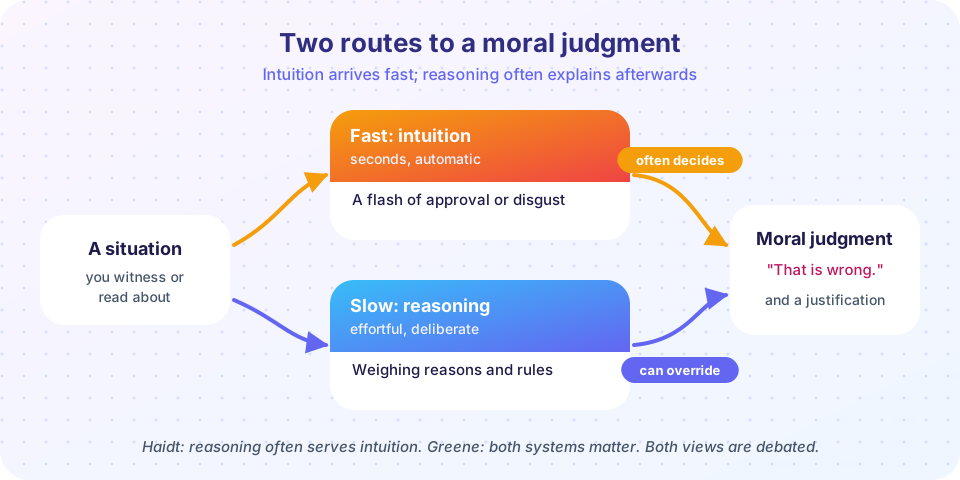
Jonathan Haidt (2001) proposed the social intuitionist model. His image: the conscious reasoner is a rider on a large intuitive elephant. The elephant usually decides where to go, and the rider mostly explains the choice. Evidence for this view includes moral dumbfounding. In Haidt's studies, participants heard a scenario in which nobody is harmed, such as an act that others find disgusting or disrespectful, and many said it was wrong. When their stated reasons were countered, some persisted with the judgment, sometimes admitting they could not say why.
Critics reply that people may simply distrust a stipulated "nobody is harmed" story, or that the experimenters' cases are artificial. Others point out that reasoning does change minds, especially in conversation over time, and that Haidt himself allows for this. The fairest summary is that intuition often leads, reasoning can sometimes revise, and the balance depends on the person and the question.
Haidt and collaborators (Haidt and Graham 2007) also proposed moral foundations theory: moral concern draws on several foundations such as care/harm, fairness, loyalty, authority and sanctity, with liberty sometimes added. Liberals and conservatives, they argued, weight these differently. The theory is influential, yet debates continue about how many foundations there are and how well the survey scales measure them.
Greene: two systems and the trolley
Joshua Greene and colleagues (2001) used brain imaging while people judged moral dilemmas. They reported that "personal" dilemmas, such as pushing someone off a bridge, engaged brain regions associated with emotion more than "impersonal" ones, such as flipping a switch. Greene proposed a dual-process account: a fast emotional response against harming someone with one's own hands and a slower calculation that favors the greater good. He argued that deontological-sounding judgments often reflect the first system, and consequentialist ones the second.
This claim is contested. Critics, such as Guy Kahane and colleagues, argue that the "personal versus impersonal" distinction is not clean and that responses sometimes labeled "utilitarian" may reflect low empathy or general indifference rather than careful concern for the greater good. Another worry is that brain imaging shows which areas are active, not whether the judgment is correct. Even if Greene is right about why we react as we do, philosophers disagree about whether that undermines the reaction.
What follows for ethics
Three tempting conclusions deserve caution.
- "Intuitions are only evolutionary leftovers, so ignore them." This is a debunking argument (see Lesson 3 of Chapter 1). It needs more: showing that an intuition has a cause does not show it is false. Our arithmetic skills also have causes.
- "Reasoning is irrelevant." Not so. Argument changes laws, institutions and people's views over years. The abolition of slavery and expansion of women's rights involved both moral feeling and moral argument.
- "Psychology tells us what is right." It tells us what people think and feel. To claim that something is right you need a moral premise, as the is-ought gap shows.
Moral psychology is best used as a check: it can reveal where our judgments are inconsistent, easily swayed by irrelevant factors, or shaped by group loyalty. That gives us reason to examine them, which is what reflective equilibrium asks us to do anyway.
Common misconceptions
"Studies prove we have no free reasoning." The research shows that intuition plays a large role, not that reasoning is an illusion. Findings are probabilistic and often come from small or WEIRD (Western, educated, industrialized, rich, democratic) samples.
"Kohlberg showed that the highest stage is the most correct." His scheme describes reasoning styles. Whether the postconventional style is better is a philosophical question, not an empirical one.
"A brain scan can show which moral theory is true." A scan can show which processes accompany a judgment. It cannot show which judgment is justified.
Try it
The first demonstration is a toy model of a dual-process judgment. It is a simplified illustration written for this lesson, not a reproduction of any experiment. Each case has a benefit (lives saved) and an emotional aversion to the act. The model compares the two with an adjustable weight on aversion. Notice how the "personal" case shifts more when the weight changes.
Press Run (or Ctrl + Enter) to see the result here.
Program input · what you'd type while the program runs
Type the answers before you press Run, one per line. Each time the program reads a line (with input()), it gets the next line from this box.
The second demonstration lets you try the dumbfounding scenario for yourself. A person privately cuts up an old national flag to clean the bathroom and nobody ever finds out. Choose a reason that it is wrong and see what a defender of the act could answer. This illustrates the pattern Haidt described. It does not show the act is acceptable: some readers will think the reasons given are strong, and that is a fine conclusion.
Check your understanding
Quick check · 5 questions
of 5 answered You scored / 5 · perfect!
-
1. Kohlberg was most interested in which aspect of people's answers to moral dilemmas?
He grouped the reasoning behind answers into preconventional, conventional and postconventional levels. -
2. What was Gilligan's main criticism of Kohlberg?
She argued for an ethics of care as a mature perspective that the justice-focused scale ranked lower. -
3. Haidt's 'rider and elephant' image suggests that
The rider (reasoning) frequently serves the elephant (intuition), though it can sometimes steer. -
4. Which is a fair criticism of Greene's dual-process claims?
Critics question the contrast and note that describing the cause of a judgment does not settle whether it is justified. -
5. 'People feel disgust at X, so X is wrong' fails because
This is the is-ought gap: you need a moral premise connecting the feeling to the conclusion.
Summary
- Moral psychology studies how people judge; it cannot by itself settle what is right.
- Kohlberg proposed stages of moral reasoning, and Gilligan argued that care deserves equal weight.
- Haidt emphasizes intuition and dumbfounding; Greene proposes two systems of judgment. Both are debated.
- Findings are useful checks on bias, not proofs that intuitions or reasoning should be dismissed.
Track your progress
Create a free account to tick off lessons and pick up where you left off on any device.
of Ethics lessons completed