


















Lesson 24 of 45 · Virtue Ethics and Other Theories
Chapter 5 review: virtue, contract and care
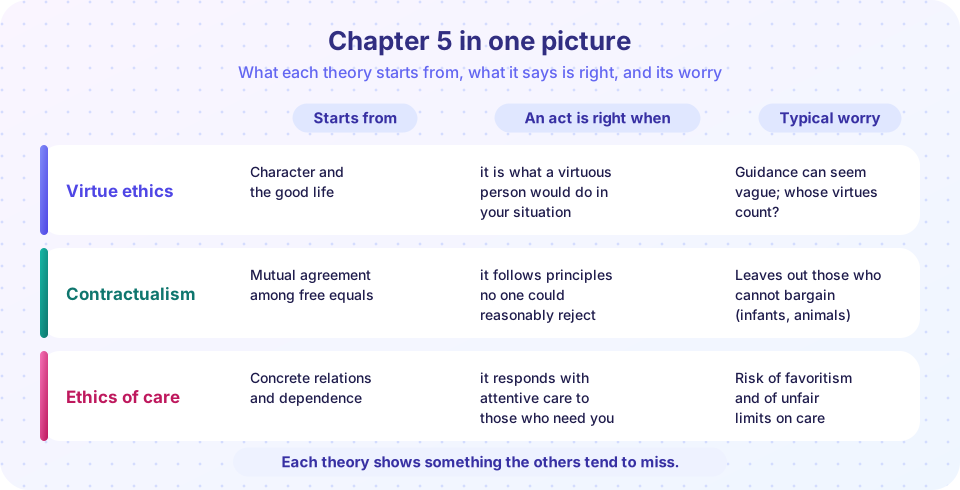
A one-picture review of chapter 5 with a comparison table of virtue ethics, contractualism and the ethics of care, plus a ten-question quiz mixing all lessons.
You have now met three theories that start somewhere other than the act. This review puts them side by side, gives you a comparison you can reuse, and tests how well the ideas have settled.
What you will review
- The core claim, key thinker and best-known objection for each theory.
- The two debates of the chapter: the doctrine of the mean and the situationist challenge.
- How to choose which question to ask for a given problem.
Key terms
Eudaimonia: a flourishing life; the goal in Aristotle's ethics.
Phronesis: practical wisdom, the skill of finding the fitting response.
v-rule: a rule expressed in virtue or vice terms (Hursthouse).
Reasonable rejection: Scanlon's test for wrong acts.
Dependency work: care for those who cannot care for themselves (Kittay).
Recap table
| Theory | Starting point | An act is right when | Landmark works | Typical worry |
|---|---|---|---|---|
| Virtue ethics | Character and the good life | It is what a virtuous agent would do | Aristotle, Nicomachean Ethics; Anscombe 1958; Foot; MacIntyre 1981; Hursthouse 1999 | Vague guidance; do stable traits exist? |
| Contractualism | Agreement among free equals | It follows principles no one could reasonably reject | Hobbes 1651; Rawls 1971; Scanlon 1998 | Excludes those who cannot bargain; "reasonable" is loaded |
| Ethics of care | Relationships and dependence | It responds with attentive care to those in need | Gilligan 1982; Noddings 1984; Kittay 1999; Tronto 1993; Held 2006 | Favoritism and entrenched roles |
Key arguments in a sentence each
- Function argument (Aristotle): the good of a thing is to do its characteristic activity well, so the human good is excellent rational activity over a life.
- Doctrine of the mean: each virtue of character lies between a vice of deficiency and one of excess, relative to the person and situation, and found by practical wisdom.
- Anscombe's challenge: the moral "ought" has lost its framework, so go back to virtue, vice and psychology.
- Situationism: experiments show behavior depends strongly on circumstances, so global traits may be rare; replies say virtue is rare and evidence is limited.
- Reasonable rejection: a principle is acceptable if no one could reasonably refuse it as a basis for living together.
- Care's complaint: theories of independent adults hide dependence and the labor that meets it.
How to choose a lens
Use the virtue lens when the question is about who you are becoming (habits, integrity, long projects). Use the contract lens when the question is about rules for strangers (policies, fairness, institutions). Use the care lens when the question is about specific people who depend on each other (families, health, teaching). Often use two.
Common misconceptions
"These theories are rivals, so only one can be right." Many philosophers are pluralists who use virtues, justifiable rules and care together.
"Virtue ethics has been refuted by psychology." The evidence challenges naive trait views, not every form of virtue ethics, and some of it has not replicated.
"Contract theory ignores the vulnerable." Its critics say so; its defenders add principles for the vulnerable. The question is open and important.
Try it
Press Run (or Ctrl + Enter) to see the result here.
Program input · what you'd type while the program runs
Type the answers before you press Run, one per line. Each time the program reads a line (with input()), it gets the next line from this box.
Check your understanding
Quick check · 10 questions
of 10 answered You scored / 10 · perfect!
-
1. Which pair correctly matches a thinker and a work?
Hursthouse wrote On Virtue Ethics (1999); the others are mismatched. -
2. Aristotle's function argument concludes that the human good is
He argues from the characteristic human function, reasoning, to excellent rational activity. -
3. In the doctrine of the mean, why is the mean not an arithmetic average?
The trainer example shows that the fitting amount varies with the person. -
4. Which claim fits situationism?
Situationists argue that circumstances often outweigh stable traits, though defenders resist the strongest versions. -
5. Which is a limit of the Darley and Batson study?
Percentages from 40 students should not be pushed too far; Milgram's study is the one about obedience. -
6. Scanlon's wrongness test asks whether a principle
An act is wrong if it is forbidden by principles no one could reasonably reject. -
7. Which critique of the classic social contract do Pateman and Mills share?
They argue that women (Pateman) and non-white people (Mills) were excluded or subordinated in the classic story. -
8. Which is NOT one of Tronto's four phases of care?
The phases are attentiveness, responsibility, competence and responsiveness. -
9. What is a v-rule?
Hursthouse uses v-rules to show that virtue ethics gives practical guidance. -
10. Which problem is best suited to the care lens?
Care ethics focuses on particular relationships and dependence.
Summary
- Virtue ethics asks who to become, contractualism asks what rules we could all accept, and care ethics asks what relationships require.
- The mean is relative; practical wisdom finds it.
- Situationism challenges global traits, but replies and replication problems limit its force.
- Contractualism must answer the problem of those who cannot bargain and of historical exclusion; care ethics must answer favoritism.
- The best practice is to use more than one lens and to say why.
Track your progress
Create a free account to tick off lessons and pick up where you left off on any device.
of Ethics lessons completed