


















Lesson 44 of 45 · Projects and Practice
The ethics cheat sheet
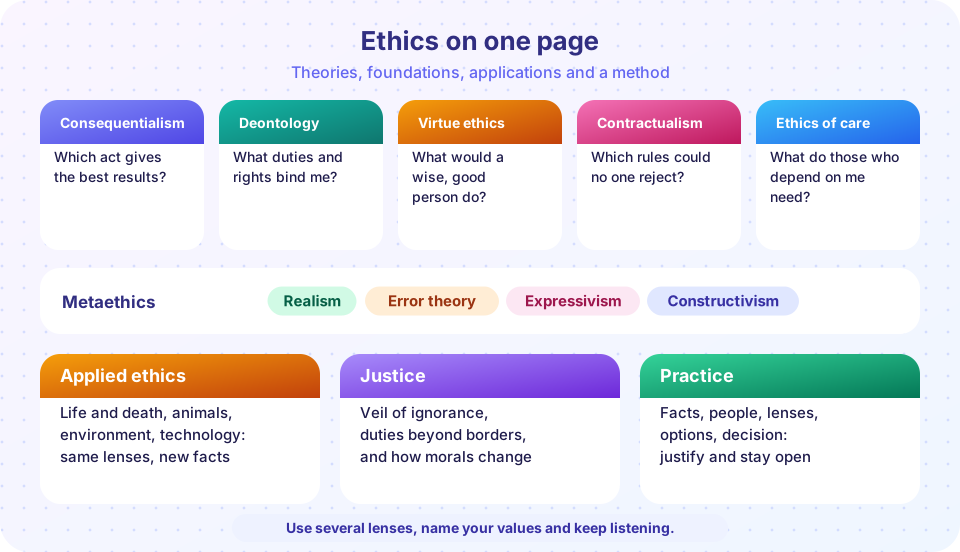
A one-page recap of the whole ethics course: five normative theories, metaethical positions, applied lenses, justice ideas and the five-step case method.
This lesson is a one-page recap. Print it, save it, or use it to check yourself before an exam or a discussion. Every row points back to a lesson in the course, so use it as a map and return to the full explanation when something feels thin.
What you will learn
- The key question of each major ethical theory in one line.
- The main metaethical positions and their central claims.
- The method for analyzing cases and the questions that keep it honest.
Key terms
Normative theory: a theory of what we ought to do or be.
Metaethics: the study of what moral claims mean and whether they can be true.
Applied ethics: ethical thinking about practical questions.
Lens: a question from one theory used to examine a case.
Normative theories at a glance
| Theory | Guiding question | Best insight | Typical worry |
|---|---|---|---|
| Consequentialism | Which act gives the best results? | Results matter, and everyone counts | Can sacrifice individuals; demanding |
| Deontology | What duties and rights bind me? | Persons are not mere means | Rigid; conflicts of duties |
| Virtue ethics | What would a wise, good person do? | Character and practical wisdom | Vague guidance; do stable traits exist? |
| Contractualism | Which rules could no one reasonably reject? | Justifiability to each person | Leaves out those who cannot bargain |
| Ethics of care | What do those who depend on me need? | Dependence and attention are central | Favoritism; entrenched roles |
Metaethics at a glance
| Position | Core claim | Key names |
|---|---|---|
| Moral realism | Some moral claims are true, independent of attitudes | Moore, Parfit, Boyd, Sturgeon |
| Error theory | Moral claims aim at facts that do not exist | Mackie, Joyce |
| Expressivism | Moral claims express attitudes or plans | Ayer, Stevenson, Hare, Blackburn, Gibbard |
| Constructivism | Moral truth is fixed by an idealized procedure | Korsgaard, Street, Rawls |
Remember also the is-ought gap (Hume), direction of fit (Anscombe), the Frege-Geach problem and debunking arguments (Street, Joyce).
Applied ethics at a glance
- Life and death: four principles (autonomy, non-maleficence, beneficence, justice), informed consent, killing versus letting die, double effect.
- Animals and environment: sentience, equal consideration (Singer), rights (Regan), land ethic (Leopold), discount rates and future people.
- Technology and AI: privacy, bias through data and proxies, conflicting fairness metrics, responsibility gaps.
Justice and progress at a glance
- Rawls: veil of ignorance; equal liberties, fair equality of opportunity and the difference principle.
- Nozick: entitlement from just acquisition and transfer; Wilt Chamberlain.
- Others: desert, luck egalitarianism, prioritarianism, sufficiency, capabilities.
- Global duties: Singer's pond; demandingness and partiality; Pogge on harm; Rawls on assistance.
- Moral progress: needs a standard; explained by argument, contact, struggle, economics and honor; threshold models.
The five-step method
- Facts: what is known, unknown and assumed?
- People: who is affected, including those without a voice?
- Lenses: outcomes, duties and rights, character, care.
- Options: at least three; best reason and strongest objection for each.
- Decide: choose, say why, say what would change your mind, say what is lost.
Common mistakes to avoid
- Mixing up descriptive and normative claims (the is-ought gap).
- Using one lens and calling it ethics.
- Treating a fairness metric or a discount rate as a purely technical number.
- Assuming disagreement means there is no truth, or that agreement proves truth.
- Treating a hard case as if it must have a painless answer.
Common misconceptions
"A cheat sheet replaces reading." It is a reminder. The arguments are in the lessons.
"Each theory is wrong, so choose none." Each captures something; use them together and justify your weights.
"Ethics is just opinion." Reasons, consistency and evidence shape better and worse answers even when disagreement remains.
Try it
Press Run (or Ctrl + Enter) to see the result here.
Program input · what you'd type while the program runs
Type the answers before you press Run, one per line. Each time the program reads a line (with input()), it gets the next line from this box.
Check your understanding
Quick check · 4 questions
of 4 answered You scored / 4 · perfect!
-
1. Which guiding question belongs to contractualism?
Scanlon's test of reasonable rejection. -
2. What does expressivism claim?
Expressivists treat moral language as attitude-expressing. -
3. Which is the last step of the five-step method?
The method ends with an honest decision. -
4. Which pair is correctly matched?
Parfit (1984) introduced the non-identity problem.
Summary
- Five normative theories each ask a different question and capture a different insight.
- Metaethics asks what moral claims are and whether they can be true.
- Applied ethics uses facts and several lenses; justice and progress extend them to societies.
- The five-step method keeps reasoning transparent and honest.
Track your progress
Create a free account to tick off lessons and pick up where you left off on any device.
of Ethics lessons completed