


















Lesson 38 of 45 · Justice and Moral Progress
Moral progress and moral change
Does morality progress? Learn what moral progress means, milestones such as abolition and human rights, explanations of change, doubts about progress, and a threshold model.
Most of us believe that some moral changes were improvements. Few people today defend chattel slavery, deny women the vote or treat open persecution of minorities as normal. When we say "we have made progress," we assume there is a standard by which later views are better than earlier ones.
That assumption is philosophically interesting and politically important. This lesson asks what moral progress could mean, looks at some famous changes, compares explanations of how change happens, and takes the doubts seriously.
What you will learn
- The difference between moral change and moral progress.
- Possible standards for calling a change an improvement.
- Four kinds of explanation: argument, contact, power and economics, and institutions.
- Doubts about progress: whiggish history, backsliding and bias.
- How tipping-point models help us understand sudden change.
Key terms
Moral change: any shift in moral beliefs or practices over time, whether or not it is an improvement.
Moral progress: a change that is an improvement by a defensible standard, such as greater inclusion, less suffering, or better reasoning.
Expanding circle: the idea that moral concern widens from kin and tribe towards all humans and beyond (Lecky; Singer).
Whig history: a story that reads the past as a steady march toward the present's values.
Threshold model: a model in which people adopt a behavior once enough others have (Granovetter).
Change versus progress
Moral beliefs obviously change. The harder question is whether the changes are improvements. To say so you need a standard. Candidates include:
- Inclusion: Does the change extend equal moral consideration to people previously excluded? (Singer's "expanding circle.")
- Suffering and well-being: Does it reduce avoidable harm?
- Reasoning: Does it correct errors, inconsistency or false factual beliefs?
- Rights and autonomy: Does it protect basic freedoms?
- Reflective endorsement: Would people on both sides, fully informed and free of coercion, accept the new view?
Different theories prefer different standards, so disagreements about progress are often disagreements about moral theory. Relativists doubt any standard can be neutral; realists say there are moral truths we gradually discover; constructivists say progress is movement toward what ideal reasoning would endorse.
Some milestones
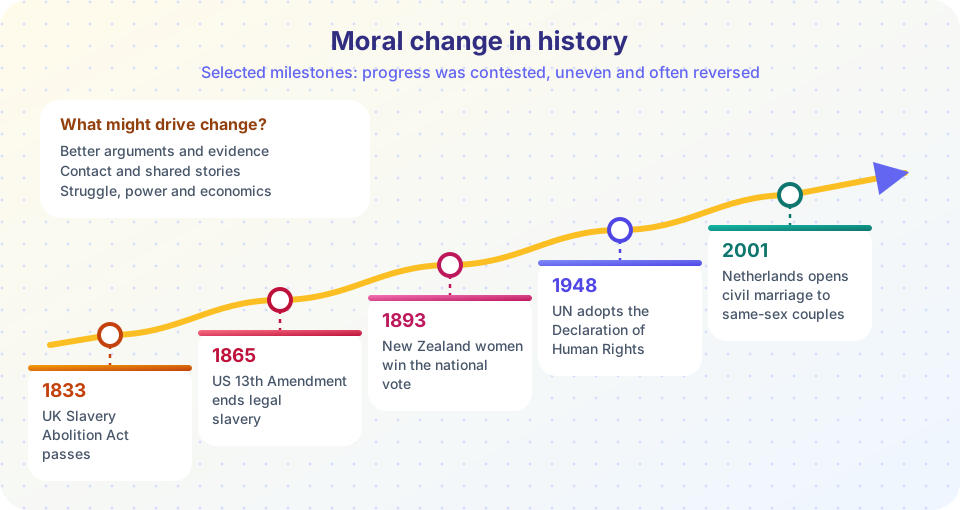
- 1833, United Kingdom. The Slavery Abolition Act outlawed slavery in most of the British Empire (taking effect in 1834). The law compensated slave owners, not the enslaved, which shows how limited the change was.
- 1865, United States. The Thirteenth Amendment ended legal slavery, with an exception for punishment of crime. Legal and social subordination continued for generations afterwards.
- 1893, New Zealand. Women won the right to vote in national elections, the first self-governing country to do so; they could not stand for parliament until 1919.
- 1948, United Nations. The General Assembly adopted the Universal Declaration of Human Rights. It is a declaration, not a treaty, but it shaped later binding agreements and gave a common language for rights claims.
- 2001, the Netherlands. The Netherlands became the first country to open civil marriage to same-sex couples. Many other countries followed; others have not, and views still differ.
Each milestone was contested, incomplete and in places reversed. This is typical.
How does moral change happen?
Historians, philosophers and social scientists propose several explanations, which usually work together.
- Better arguments and evidence. Writers and activists exposed inconsistencies, such as claiming to value liberty while holding slaves. Peter Singer and others stress the role of reasoning and of extending principles consistently.
- Contact and imagination. Stories, novels, travel and meeting members of other groups can make people recognize them as fully human. Some historians credit the rise of reading and empathy-building narratives.
- Struggle and changes in power. Movements of enslaved people, workers, women and colonized peoples forced issues. Those with power rarely give it up purely because of argument.
- Economic and technological change. Changes in production, communication and war can make old practices costly or unnecessary. These conditions do not explain everything, but they affect what is possible.
- Honor and shame. Kwame Anthony Appiah (The Honor Code, 2010) argues that practices like dueling, foot-binding and slavery ended when they came to be seen as dishonorable, not only when their cruelty was shown.
Steven Pinker (The Better Angels of Our Nature, 2011) argued that violence has declined over history for reasons including states, commerce, literacy and the growth of empathy. His data and interpretation are debated by other scholars.
Doubts
- Whiggish bias. Winners write history, and we tend to treat our own values as the goal of history. Future people may judge us as harshly as we judge the past.
- Backsliding. Rights can be lost; atrocities such as genocide in the twentieth century occurred after supposed enlightenment.
- Moral change without improvement. Fashion, propaganda and panic also change opinions.
- Hidden costs. Some changes shift harm elsewhere or leave other groups behind.
- Circularity. If we judge past views by our own, we cannot be sure we are right; defenders reply that we can criticize our own view too, and that arguments, not date, decide.
A sensible position is that some changes are very well supported as improvements (ending slavery), while claims of progress elsewhere deserve scrutiny and humility. Believing in progress does not require believing it is inevitable. It makes progress a task.
Common misconceptions
"Moral progress means later is always better." Only specific changes that meet a defensible standard count.
"If views changed, there is no moral truth." Scientific views change too. Change may reflect discovery of better answers.
"Moral change comes only from philosophers." Social movements, economics, technology and stories all play roles.
"We are the endpoint." Almost certainly we hold views that future generations will reject.
Try it
Press Run (or Ctrl + Enter) to see the result here.
Program input · what you'd type while the program runs
Type the answers before you press Run, one per line. Each time the program reads a line (with input()), it gets the next line from this box.
Check your understanding
Quick check · 5 questions
of 5 answered You scored / 5 · perfect!
-
1. What is the difference between moral change and moral progress?
Calling a change progress requires a standard of improvement. -
2. Which explanation of moral change stresses that practices ended when they became dishonorable?
In The Honor Code (2010), Appiah argued that dueling, foot-binding and slavery ended when seen as dishonorable. -
3. What is a worry about 'whiggish' history?
It risks assuming that we are the endpoint and flattering ourselves. -
4. What does a threshold model illustrate?
In Granovetter's model people adopt once enough others have; changing one person can stall the chain. -
5. Which is a fair conclusion about moral progress?
Believing in progress does not require believing it is automatic or complete.
Summary
- Moral change is not automatically moral progress; progress needs a standard.
- Standards include inclusion, reduced suffering, better reasoning and rights.
- Change is driven by arguments, contact, struggle, economics and changing ideas of honor.
- Doubts about progress include whiggish bias, backsliding and hidden costs.
- Threshold models show how small differences can decide whether change tips.
Next: Chapter review
Track your progress
Create a free account to tick off lessons and pick up where you left off on any device.
of Ethics lessons completed