


















Lesson 47 of 47 · Projects and Practice
Further study: where to go after dynamics
Plan your next steps after rigid-body dynamics: the topics that build on it, how they connect to other tracks on this site, and a practical study plan.
You now know how to describe and predict the motion of particles and rigid bodies, how vibrations behave and how to simulate systems with no closed-form answer. That is the core of mechanical engineering dynamics. This lesson maps what lies beyond it, shows how it links to other parts of the site, and suggests a practical plan.
What you will learn
- See which subjects build on dynamics and which feed into it.
- Know what to study next for your own goal.
- Get a realistic weekly plan.
- Try a small bridge example into another track.
Key terms
Multi-degree-of-freedom system: a system needing more than one coordinate; vibrations become matrix equations.
Modal analysis: describing a complex vibration as a sum of simple patterns (modes).
Lagrangian mechanics: a way to derive equations of motion from energy rather than forces.
Finite-element method (FEM): a numerical method that divides a structure into small elements.
What builds directly on dynamics
Multi-degree-of-freedom vibration and modal analysis. Two masses on springs already have two natural frequencies and two mode shapes. Buildings, aircraft and car bodies have thousands. The mathematics is linear algebra: eigenvalues are ω² and eigenvectors are mode shapes.
Lagrangian and Hamiltonian mechanics. When a system has constraints (a double pendulum, a robot arm), writing forces is painful. Lagrange's equations use the kinetic and potential energies instead, and give the equations of motion with little geometry.
Three-dimensional rigid-body dynamics. In 3D, angular velocity and angular momentum are not parallel in general: the inertia becomes a tensor, and phenomena such as gyroscopic precession and the tumbling of a thrown book (the intermediate-axis theorem) appear.
Control and robotics. The equations of motion M(q) q̈ + C(q, q̇) q̇ + g(q) = τ of a robot arm are rigid-body dynamics with several joints. Controllers use them to compute torques.
Machine and engine dynamics. Balancing of rotors and multi-cylinder engines, cam and follower design, gear dynamics and torsional vibration of shafts all apply chapters 5 to 8 directly.
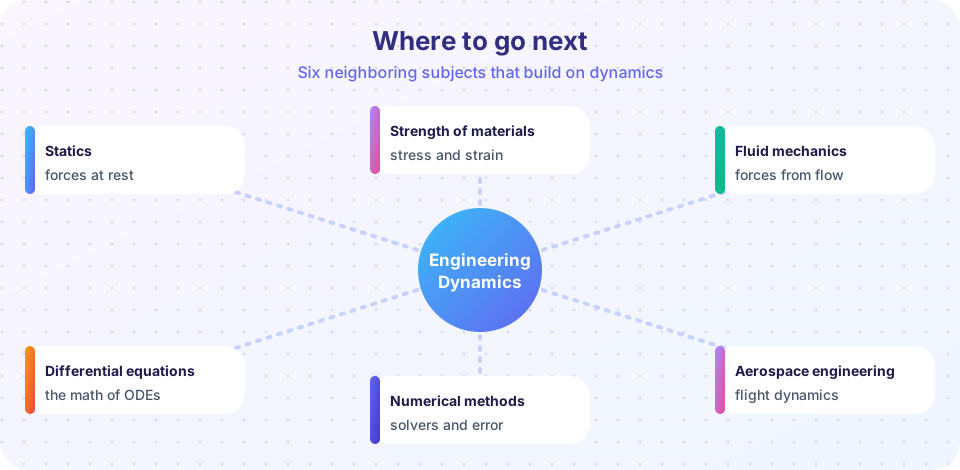
Neighboring tracks on this site
| Track | Why it matters for dynamics |
|---|---|
| Engineering Statics | Free-body diagrams and equilibrium: the α = 0, a = 0 special case |
| Strength of Materials | Stiffness k of beams and shafts, stress under dynamic loads |
| Fluid Mechanics | Drag and lift forces that enter your simulations |
| Differential Equations | The mathematics behind the vibration solutions |
| Numerical Methods | Error analysis, stiffness and solvers beyond RK4 |
| Aerospace Engineering | Flight dynamics and spacecraft attitude use rigid-body equations |
| Physics: Mechanics | The fundamentals behind Newton's laws and conservation principles |
A study plan
| Weeks | Focus | Output |
|---|---|---|
| 1 to 2 | Repeat the practice set and rebuild each worked example in code | A notebook with every chapter's main example |
| 3 to 4 | Two-degree-of-freedom vibration; eigenvalues in NumPy | A two-mass simulator with mode shapes |
| 5 to 6 | Lagrange's method on a double pendulum | A simulation compared with the numerical solver |
| 7 to 8 | 3D rotation basics and gyroscopes | A tumbling-body simulation |
Spend about 60 % of your time solving problems and building small simulations, and 40 % reading. Dynamics is learned by doing.
Common misconceptions
"I must learn all the math first." Learn the math as the problems demand it; start a small simulation project early.
"Software does the dynamics for me." Commercial multi-body programs still need you to build the model and interpret the results. Your intuition catches the errors.
"Only mechanical engineers need dynamics." Aerospace, civil (earthquakes, bridges), biomechanics, robotics and even computer graphics use the same laws.
Try it
A bridge from vibrations into strength of materials: the stiffness of a cantilever beam is k = 3EI/L³, so you can estimate its natural frequency with the formulas of chapter 7. The calculator below uses a steel beam with a mass at the tip (ignoring the beam's own mass, which would add about a quarter of its mass to the effective tip mass).
Press Run (or Ctrl + Enter) to see the result here.
Program input · what you'd type while the program runs
Type the answers before you press Run, one per line. Each time the program reads a line (with input()), it gets the next line from this box.
Now a first taste of two-degree-of-freedom vibration. Two equal masses are joined by three springs. The natural frequencies come from an eigenvalue problem, a step up from the single ωn = √(k/m).
Press Run (or Ctrl + Enter) to see the result here.
Program input · what you'd type while the program runs
Type the answers before you press Run, one per line. Each time the program reads a line (with input()), it gets the next line from this box.
Check your understanding
Quick check · 4 questions
of 4 answered You scored / 4 · perfect!
-
1. What does a system with more than one degree of freedom have that a single mass does not?
An n-degree-of-freedom linear system has n natural frequencies, each with a mode shape. -
2. Lagrange's equations are built from:
They use T and V and the generalized coordinates. -
3. A cantilever's stiffness varies with length as:
k = 3EI/L³: doubling the length makes the beam eight times softer. -
4. Which track would help you understand the stiffness of a shaft or beam?
Strength of materials gives stiffness formulas such as 3EI/L³ and GJ/L.
Summary
- Dynamics leads to multi-degree-of-freedom vibration, Lagrangian mechanics, 3D rotation, control and machine dynamics.
- Neighboring tracks supply stiffness (strength of materials), forces (fluids), mathematics (differential equations) and numerics.
- Learn by building: repeat chapter examples in code, then extend them.
- Return to the course page any time to review a chapter.
Track your progress
Create a free account to tick off lessons and pick up where you left off on any device.
of Engineering Dynamics lessons completed