


















Lesson 46 of 47 · Projects and Practice
Cheat sheet: rigid-body dynamics and vibrations
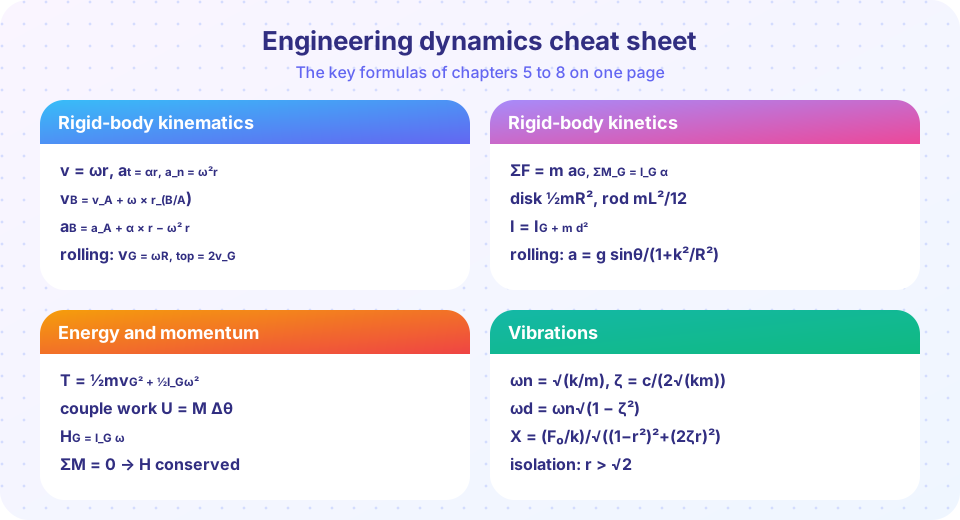
A one-page recap of the formulas of chapters 5 to 8 with a method chooser, common values and a calculator that evaluates the main relations.
This page is the one-page recap of rigid-body kinematics, kinetics, energy and momentum, vibrations and simulation. Keep it open while solving problems. Each block is short on purpose: it reminds you of a formula you have already derived, so look back at the lesson if any line feels unfamiliar.
What you will learn
- See all key relations in one place.
- Pick a method from the form of the question.
- Remember typical values for sanity checks.
Key terms
Use SI units throughout: m, kg, s, N, rad, rad/s.
Always convert rpm: ω = 2πN/60.
Positive directions: choose them once, at the start, and keep them.
Formulas by chapter
Chapter 5: rigid-body kinematics
| Situation | Formula |
|---|---|
| Fixed axis | v = ωr, a_t = αr, a_n = ω²r |
Constant α |
ω = ω₀ + αt, θ = θ₀ + ω₀t + ½αt², ω² = ω₀² + 2αΔθ |
| Relative velocity | v_B = v_A + ω × r_(B/A), ` |
| Instant center | v = ω d, perpendicular to the line to the IC |
| Relative acceleration | a_B = a_A + α × r − ω² r |
| Rolling wheel | v_G = ωR, a_G = αR, v_top = 2v_G, a_contact = ω²R |
Chapter 6: rigid-body kinetics
| Situation | Formula |
|---|---|
| Equations of motion | ΣF = m a_G, ΣM_G = I_G α; fixed pin: ΣM_O = I_O α |
| Inertia | disk ½mR², ring mR², rod mL²/12 (end: mL²/3), sphere (2/5)mR² |
| Axis shift | I = I_G + md²; I = mk² |
| Rolling down a slope | a = g sinθ/(1 + k²/R²); friction f = I_G a/R² |
| Pivoting rod from horizontal | α = 3g/(2L), pin force mg/4 at release |
| Energy | T = ½mv_G² + ½I_Gω²; couple work MΔθ |
| Momentum | H_G = I_Gω; ∫ΣM dt = ΔH; ΣM = 0 conserves H |
Chapter 7: vibrations
| Situation | Formula |
|---|---|
| Equation | m ẍ + c ẋ + k x = F(t) |
| Natural frequency | ωn = √(k/m), T = 2π/ωn, ωn = √(g/δ_st) |
| Damping | ζ = c/(2√(km)), ωd = ωn√(1 − ζ²), δ = 2πζ/√(1 − ζ²) |
| Forced response | X = (F₀/k)/√((1 − r²)² + (2ζr)²); at r = 1: δ_st/(2ζ) |
| Transmissibility | TR = √(1 + (2ζr)²)/√((1 − r²)² + (2ζr)²); isolates for r > √2 |
Chapter 8: simulation and mechanisms
| Situation | Formula |
|---|---|
| Loop | state (x, v) → a = F/m → v += aΔt, x += vΔt |
| Order | Euler 1, semi-implicit Euler 1, RK4 4 |
| Time step | Δt ≤ T/50 for oscillations |
| Slider-crank | x = r cosθ + √(l² − r² sin²θ); ẍ ≈ −rω²(cosθ + (r/l) cos2θ); stroke 2r |
Choosing a method
| The question asks for... | Use |
|---|---|
| Acceleration or a reaction at an instant | ΣF = ma_G, ΣM = Iα |
| Speed after a distance or angle | Work and energy |
| Speed after a collision or short push | Impulse and momentum |
| Velocity of a point on a linkage | Relative velocity or the IC |
| Acceleration of a point on a linkage | Relative acceleration |
| Response to a periodic force | Magnification factor and r |
| Anything without a formula | Simulate, then verify |
Typical values for sanity checks
g = 9.81 m/s². Car engines: 6000 rpm = 628 rad/s.- Piston acceleration in a road engine: several hundred
g. - Steel density about 7850 kg/m³; aluminum about 2700 kg/m³.
- Car suspension: 1 to 1.5 Hz for the body. Machine mounts: 5 to 15 Hz.
- Light damping
ζ = 0.01to0.05for steel structures;0.2to0.3for car dampers.
Common misconceptions
Treating this page as a substitute for the derivations. Every formula has conditions (constant α, small angles, no slipping, linear spring).
Mixing sign conventions. A single positive direction for x, v, a (and for θ, ω, α) saves most errors.
Skipping the check. Units, limiting cases and energy take two minutes and catch most mistakes.
Try it
A single calculator that evaluates the main relations for a system you define. Change the numbers at the top and run it.
Press Run (or Ctrl + Enter) to see the result here.
Program input · what you'd type while the program runs
Type the answers before you press Run, one per line. Each time the program reads a line (with input()), it gets the next line from this box.
Not sure which method fits a question? This little helper asks what is being asked and answers with the method.
Check your understanding
Quick check · 4 questions
of 4 answered You scored / 4 · perfect!
-
1. Which formula gives the natural frequency?
ωn = √(k/m). -
2. A rod of mass m and length L is spun about its end. I =
I_end = mL²/12 + m(L/2)² = mL²/3. -
3. Which method answers 'how fast after a 3 m drop'?
Energy links speed to the change in height directly. -
4. A vibration isolator is effective for:
TR < 1 only above √2.
Summary
- One page holds all the formulas; each has conditions, so check the lesson if unsure.
- Choose the method from the question, not from habit.
- Sanity checks catch most errors: units, limits, energy.
Next: Further study
Track your progress
Create a free account to tick off lessons and pick up where you left off on any device.
of Engineering Dynamics lessons completed