


















Lesson 20 of 47 · Work, Energy and Momentum
Impulse and Momentum
Use the impulse-momentum principle for forces acting over short times, conserve linear momentum for recoil and rockets, and see why airbags and crumple zones work.
A baseball bat meets a ball for about a thousandth of a second. During that instant the force changes wildly and nobody can write it down as a clean function. Yet we can say exactly how fast the ball leaves the bat if we know how it arrived and the total push over time. That total is the impulse, and it is the second shortcut of this chapter.
What you will learn
- Linear momentum and impulse, and the principle that links them.
- How to find an average force from a change of momentum.
- When momentum of a system is conserved, and how to use it for recoil and explosions.
- Why a longer stopping time reduces the force (airbags, crumple zones).
Key terms
Linear momentum: p = m v, a vector, in kg·m/s.
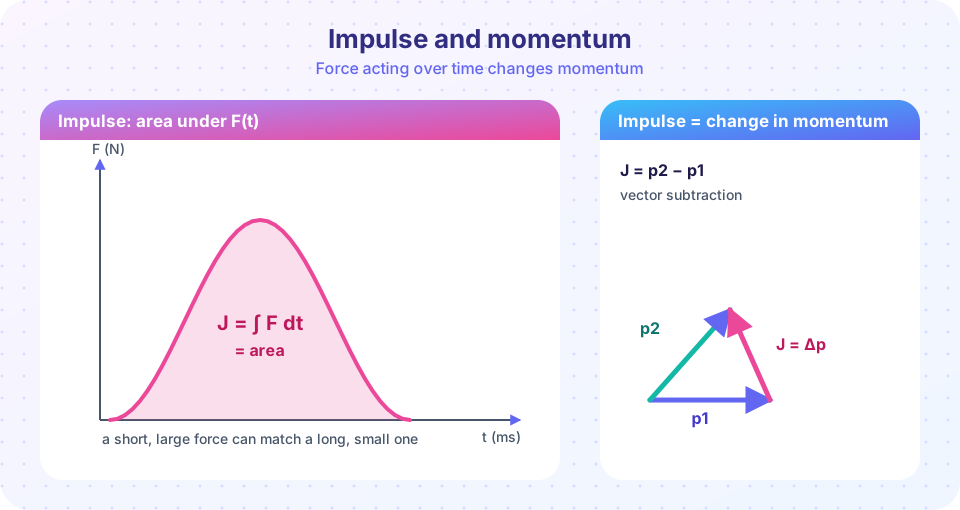
Impulse: J = ∫F dt, a vector, in N·s; equal to the area under the force-time graph.
Average force: F_avg = J / Δt.
Closed system: one with no net external force, so its total momentum is constant.
The impulse-momentum principle
Integrate ΣF = d(m v)/dt over time:
m v₁ + ∫ΣF dt = m v₂, or J = p₂ − p₁.
It is a vector equation, so you apply it along each axis. It is ideal when the force acts for a known time (a push, a kick, an engine burn) and what you want is a speed, or the reverse: the speeds are known and you want the average force.
Worked example: a tennis serve. A 0.057 kg ball arrives at a racket at 25 m/s and leaves in the opposite direction at 35 m/s (illustrative values). Choose the outgoing direction as positive: Δp = 0.057 × (35 − (−25)) = 3.42 N·s. If the contact lasts 5 ms, then F_avg = 3.42 / 0.005 = 684 N, about 70 times the ball's weight. The peak force is larger than the average, perhaps 1.5 times for a smooth pulse.
Why airbags work
A 70 kg occupant moving at 15 m/s must lose all momentum: Δp = 70 × 15 = 1,050 N·s. Stop in 0.05 s against a hard dashboard: F = 21,000 N. Stop in 0.10 s with an airbag: F = 10,500 N. The impulse is the same; spreading it over more time halves the force. Crumple zones, bent knees on landing and padded gloves follow the same principle: F = Δp / Δt.
Conservation of linear momentum
If the net external force on a system is zero (or negligible for the time considered), Σp is constant.
Worked example: rifle recoil. A 4.0 kg rifle fires a 0.010 kg bullet at 800 m/s. Initially everything is at rest, so the total momentum is zero afterward too: 4.0 v_r + 0.010 × 800 = 0, giving v_r = −2.0 m/s. The rifle's kinetic energy is ½ × 4 × 4 = 8 J, while the bullet's is ½ × 0.01 × 640,000 = 3,200 J. Same momentum magnitude, hugely different energy, because T = p²/(2m) and a small mass carries more energy for the same momentum.
Rockets
A rocket expels mass backward at speed v_e (relative to the rocket). With no external force, momentum conservation gives the rocket equation (Tsiolkovsky, 1903): Δv = v_e ln(m₀ / m_f). For v_e = 3,000 m/s and a mass ratio of 5: Δv = 3,000 × ln 5 = 4,828 m/s. Because of the logarithm, doubling the fuel gives much less than double the speed change, which is why rockets are mostly fuel and why staging is used.
Common misconceptions
"Momentum and kinetic energy are the same thing." Momentum is a vector, m v; kinetic energy is a scalar, ½ m v². Two equal masses moving in opposite directions have zero total momentum but positive energy.
"Momentum is conserved whenever things collide." Only if the external forces are negligible. A car braking on a road is not isolated: the road pushes on it.
"A longer collision means less change of momentum." The change is fixed by the speeds; only the force changes.
Try it
First, a force pulse with a known shape. The program computes its impulse and the final velocity of a 0.5 kg object, and shows how a longer, softer pulse with the same area gives the same result but smaller peak force.
Press Run (or Ctrl + Enter) to see the result here.
Program input · what you'd type while the program runs
Type the answers before you press Run, one per line. Each time the program reads a line (with input()), it gets the next line from this box.
Second, calculators for recoil and the rocket equation.
Press Run (or Ctrl + Enter) to see the console output here.
No output.
Check your understanding
Quick check · 5 questions
of 5 answered You scored / 5 · perfect!
-
1. A 0.15 kg ball moving at 30 m/s is stopped by a catcher in 0.02 s. The average force is
F = Δp/Δt = 0.15 × 30 / 0.02 = 225 N. -
2. The area under a force-time graph is
∫F dt = J = Δp. -
3. A 60 kg skater at rest throws a 3 kg ball forward at 10 m/s on ice. The skater's velocity is
60 v + 3 × 10 = 0, v = −0.5 m/s. -
4. Why does an airbag reduce injuries?
J = F Δt is fixed by Δp; a larger Δt means a smaller F. -
5. A rocket with exhaust speed 2,500 m/s burns until its mass drops to one tenth. Δv = (ln 10 = 2.30)
Δv = v_e ln(m₀/m_f) = 2,500 × 2.30 = 5,756 m/s.
Summary
- Impulse
J = ∫F dt = Δpis a vector principle; the area under F(t). - Average force
F_avg = Δp/Δt: a longer stopping time gives a smaller force. - With no net external force, total momentum is conserved (recoil, explosions).
- The rocket equation:
Δv = v_e ln(m₀/m_f).
Next: Collisions
Track your progress
Create a free account to tick off lessons and pick up where you left off on any device.
of Engineering Dynamics lessons completed