


















Lesson 45 of 47 · Projects and Practice
Glossary of rigid-body dynamics and vibration
A concise glossary of terms from chapters 5 to 8: rotation, relative motion, inertia, energy, momentum, vibration, damping, resonance and simulation.
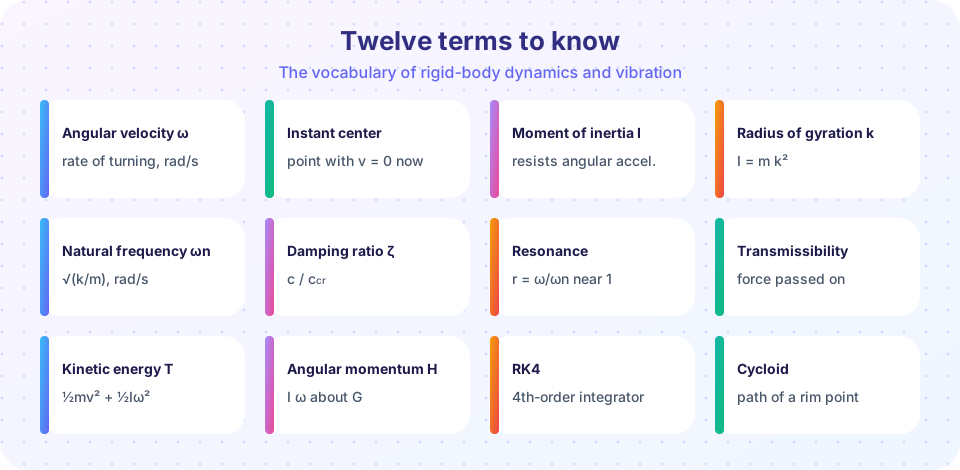
Dynamics has a precise vocabulary. This glossary collects the terms used in chapters 5 to 8, each with a short, exact definition and the symbol or formula you will meet. Use it as a reference while solving problems, or as a checklist before a test: if you cannot explain a term in a sentence, revisit the lesson linked next to it.
What you will learn
- Recall the definition and symbol of each key term.
- Distinguish look-alike terms such as angular velocity and angular momentum.
- Find the lesson where each term is developed.
Key terms
Read definitions with units. Many dynamics errors are unit errors: rad/s versus rpm, kg·m² versus kg·m.
Look-alikes: velocity ≠ speed, ωn ≠ ωd, I ≠ m, H ≠ L.
Glossary
Rigid-body kinematics
| Term | Meaning | Lesson |
|---|---|---|
Angular position θ |
Orientation angle of a body, in radians | Fixed axis |
Angular velocity ω |
dθ/dt; the same for every point of a rigid body |
Fixed axis |
Angular acceleration α |
dω/dt |
Fixed axis |
| Cycloid | The path of a rim point of a wheel rolling without slipping | Overview |
| General plane motion | Translation plus rotation | Overview |
| Instant center (IC) | Point with zero velocity at this instant | Instant center |
Normal acceleration a_n |
ω²r, toward the axis |
Fixed axis |
Relative velocity v_(B/A) |
ω × r_(B/A), perpendicular to the link |
Relative velocity |
| Rigid body | An object whose point-to-point distances never change | Overview |
| Rolling without slipping | Contact point has zero velocity; v_G = ωR |
Instant center |
Tangential acceleration a_t |
αr, along the path |
Fixed axis |
| Translation | Motion with no rotation; all points move alike | Overview |
Rigid-body kinetics
| Term | Meaning | Lesson |
|---|---|---|
| Angular impulse | ∫ ΣM dt, equals the change in angular momentum |
Energy and momentum |
Angular momentum H_G |
I_G ω about the mass center |
Energy and momentum |
| Couple | Pair of equal, opposite, parallel forces; pure moment | Planar equations |
| Free-body diagram | Body alone with all external forces and couples | Planar equations |
| Kinetic diagram | Sketch of m a_G and I_G α |
Chapter 6 overview |
Kinetic energy T |
½ m v_G² + ½ I_G ω² |
Energy and momentum |
Mass center G |
Point where the body's mass acts for translation | Chapter 6 overview |
Moment of inertia I |
∫ r² dm, in kg·m² |
Moment of inertia |
| Parallel-axis theorem | I = I_G + m d² |
Moment of inertia |
Radius of gyration k |
I = m k² |
Moment of inertia |
| Static friction limit | Friction cannot exceed μ_s N |
Planar equations |
| Work of a couple | M Δθ |
Energy and momentum |
Vibrations
| Term | Meaning | Lesson |
|---|---|---|
Critical damping c_cr |
2√(km); fastest return without oscillation |
Damped |
Damped frequency ωd |
ωn √(1 − ζ²) |
Damped |
Damping ratio ζ |
c/c_cr |
Damped |
| Degree of freedom | Independent coordinate describing the system | Overview |
Frequency ratio r |
ω/ωn |
Forced |
Logarithmic decrement δ |
ln(x₁/x₂) |
Damped |
| Magnification factor | X/(F₀/k) |
Forced |
Natural frequency ωn |
√(k/m) |
Free |
| Resonance | Large response when r ≈ 1 |
Forced |
Static deflection δ_st |
mg/k, or F₀/k for a force |
Free |
| Transmissibility | Ratio of transmitted to applied force | Isolation project |
Applications and simulation
| Term | Meaning | Lesson |
|---|---|---|
| Convergence study | Error vs Δt on log axes; slope is the order |
Integration |
| Dead center | Slider-crank position where the piston stops | Slider-crank |
| Order of accuracy | Error ∝ Δt^p |
Integration |
| RK4 | Fourth-order Runge-Kutta method | Integration |
| Semi-implicit Euler | Update v, then x with the new v |
Integration |
| State | Variables that fix the future, e.g. (x, v) |
Simulation overview |
| Stroke | Piston travel, 2r |
Slider-crank |
Time step Δt |
Interval between simulation updates | Simulation overview |
Common misconceptions
Angular velocity versus angular momentum. ω describes how fast a body turns; H = Iω also depends on how the mass is distributed.
Natural versus damped frequency. ωd is slightly lower than ωn; the difference matters only for large ζ.
Speed versus velocity. Velocity has direction; speed is its magnitude.
Try it
Flip through flashcards: click a card to reveal the definition.
Units cause many errors. This converter handles the conversions you meet most often in this course.
Press Run (or Ctrl + Enter) to see the result here.
Program input · what you'd type while the program runs
Type the answers before you press Run, one per line. Each time the program reads a line (with input()), it gets the next line from this box.
Check your understanding
Quick check · 4 questions
of 4 answered You scored / 4 · perfect!
-
1. Which quantity is the same for all points of a rotating rigid body?
ω and α belong to the whole body. -
2. The radius of gyration k satisfies:
I = m k² defines k. -
3. A damping ratio of 1 means:
ζ = c/c_cr = 1 is critical damping. -
4. Which pair of terms is NOT interchangeable?
ωd = ωn√(1 − ζ²) differs from ωn whenever damping exists.
Summary
- Terms come with units and a formula; learn all three together.
- Many look-alike pairs (
ω/H,ωn/ωd, speed/velocity) are distinct ideas. - The lesson links tell you where each idea was developed.
Next: Cheat sheet
Track your progress
Create a free account to tick off lessons and pick up where you left off on any device.
of Engineering Dynamics lessons completed