


















Lesson 39 of 47 · Applications and Simulation
Numerical integration: Euler, semi-implicit Euler and RK4
Compare explicit Euler, semi-implicit Euler and fourth-order Runge-Kutta on an oscillator, measure their order of accuracy and see why energy drifts.
The previous lesson said a simulation advances the state by small steps. How you take each step matters a great deal. The same oscillator, simulated with the same step size, can decay, stay steady or explode, depending only on the integrator.
This lesson compares the three methods you will meet most often, shows how to measure their accuracy, and gives you a rule for choosing among them.
What you will learn
- Write explicit Euler, semi-implicit Euler and RK4 updates for
ẍ = f(x, v). - Explain order of accuracy and measure it numerically.
- Recognize energy drift and choose a method that fits the problem.
- Select a step size.
Key terms
Order p: a method of order p has global error proportional to Δt^p.
Truncation error: the error from cutting off the Taylor series.
Energy drift: slow change of the conserved energy caused by the method.
Stiff problem: one with widely different time scales, where explicit methods need tiny steps.
Explicit Euler
Replace the derivative by a difference using the state at the start of the step:
x_(n+1) = x_n + Δt · v_n
v_(n+1) = v_n + Δt · a(x_n, v_n)
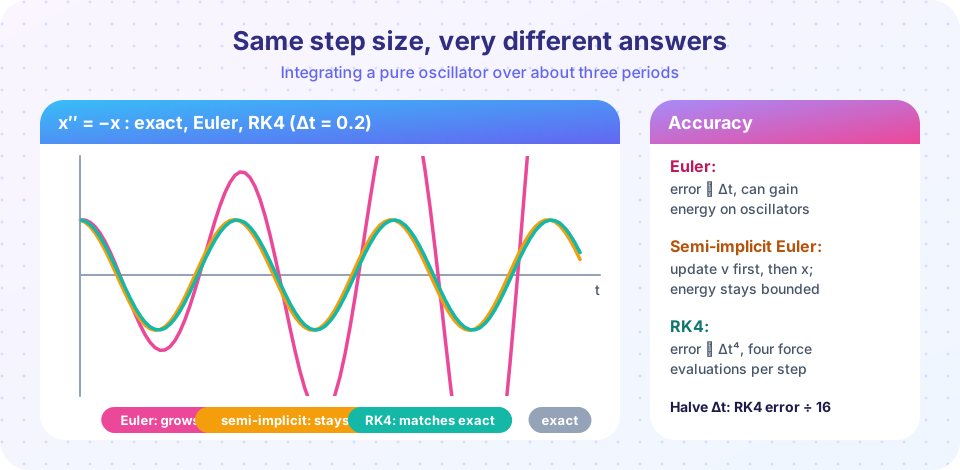
It is easy, but only first-order accurate: halve Δt and the error halves. For an undamped oscillator it is also unstable in a gentle way. Each step multiplies the amplitude by √(1 + (ωΔt)²), always greater than 1, so the energy grows exponentially. For ω = 1 and Δt = 0.2, the factor is 1.0198 per step; after 100 steps (about three periods) the amplitude is about seven times larger, matching the pink curve in the figure.
Semi-implicit (symplectic) Euler
Update velocity first, then use the new velocity for the position:
v_(n+1) = v_n + Δt · a(x_n, v_n)
x_(n+1) = x_n + Δt · v_(n+1)
Still first-order, but it conserves a slightly modified energy, so the amplitude stays bounded for oscillators. It costs the same as Euler and is the default choice in games and in long orbital or vibrational simulations. The method works best for forces that depend on position only.
Runge-Kutta 4 (RK4)
RK4 evaluates the derivative four times per step and combines them. For y' = f(t, y):
k₁ = f(t, y)
k₂ = f(t + Δt/2, y + Δt/2 · k₁)
k₃ = f(t + Δt/2, y + Δt/2 · k₂)
k₄ = f(t + Δt, y + Δt · k₃)
y_(n+1) = y + Δt/6 · (k₁ + 2k₂ + 2k₃ + k₄)
It is fourth-order: halving Δt divides the error by 16. With Δt = 0.2 on the oscillator, the result is visually indistinguishable from the exact cosine over three periods. The price is four force evaluations per step, which is cheap compared with the gain, unless each evaluation is very expensive (a finite-element model). RK4 does not conserve energy exactly, but its drift is tiny for reasonable Δt.
Measuring the order
A good habit: run the same problem with Δt, Δt/2, Δt/4, record the error against the exact answer, and plot error against Δt on log axes. The slope is the order p. If it does not match the theory, there is a bug. This "convergence study" is the best verification test for an integrator.
Choosing a method
| Situation | Good choice |
|---|---|
| Quick, rough, or real-time (games) | Semi-implicit Euler with a small step |
| Smooth problem, accuracy matters | RK4 |
| Long-time oscillation, orbits | Symplectic methods (semi-implicit Euler, velocity Verlet) |
| Stiff (fast decays mixed with slow motion) | Implicit methods or adaptive solvers such as SciPy's solve_ivp with Radau |
| Unknown | Use an adaptive library solver and tight tolerances |
Common misconceptions
"Euler is fine if the step is small." For long runs on oscillators the energy still grows; the error accumulates.
"RK4 is always the best." It is expensive per step and not energy-conserving, so for very long runs symplectic methods may do better.
"A smaller step cures instability." It helps for explicit methods on stable problems, but the steps required for stiff problems can be absurdly small.
"Global error equals the error of one step." Errors accumulate over many steps; one order of accuracy is lost (local Δt^(p+1), global Δt^p).
Try it
This program implements the three methods and measures the largest position error over five periods for several time steps, then estimates the order from the slopes. Euler and semi-implicit Euler should show a slope near 1; RK4 near 4.
Press Run (or Ctrl + Enter) to see the result here.
Program input · what you'd type while the program runs
Type the answers before you press Run, one per line. Each time the program reads a line (with input()), it gets the next line from this box.
Now a nonlinear case, a pendulum swung from 150°. We compare RK4 and semi-implicit Euler with a reference from SciPy and print the energy drift of each over 20 seconds.
Press Run (or Ctrl + Enter) to see the result here.
Program input · what you'd type while the program runs
Type the answers before you press Run, one per line. Each time the program reads a line (with input()), it gets the next line from this box.
Check your understanding
Quick check · 5 questions
of 5 answered You scored / 5 · perfect!
-
1. If you halve the time step of a fourth-order method, the error becomes about:
Error ∝ Δt⁴, so halving Δt divides it by 2⁴ = 16. -
2. What does explicit Euler do to the energy of an undamped oscillator?
Each step multiplies the amplitude by √(1 + (ωΔt)²) > 1. -
3. How does semi-implicit Euler differ from explicit Euler?
Using the updated velocity for the position keeps oscillator energy bounded. -
4. How many derivative evaluations does one RK4 step need?
k₁ through k₄ each need one evaluation. -
5. A convergence study plots error against Δt on log-log axes. What does the slope give?
Error ∝ Δt^p is a straight line with slope p.
Summary
- Euler is first order and gains energy on oscillators; semi-implicit Euler is first order with bounded energy; RK4 is fourth order.
- Measure the order with a convergence study; a wrong slope signals a bug.
- Pick by problem: real-time and long oscillations favor semi-implicit Euler, smooth accuracy favors RK4, stiff problems need implicit or adaptive solvers.
- Always check energy and halve
Δtas a sanity test.
Track your progress
Create a free account to tick off lessons and pick up where you left off on any device.
of Engineering Dynamics lessons completed