


















Lesson 30 of 47 · Rigid Body Kinetics
Planar equations of motion
Solve rigid-body kinetics problems with ΣF = m a_G and ΣM = I α: a wheel on an incline, a pulley with a hanging mass and a bar released from rest.
You now have the two ingredients: the kinematics of chapter 5 and the moment of inertia of the last lesson. This lesson combines them into a method that solves most plane-motion problems: a wheel rolling down a ramp, a winch lifting a load, a door swinging shut, a bar pivoting about a pin.
The method is always the same: draw the free-body diagram, write the three equations, add the kinematic relation that links the unknowns, and solve.
What you will learn
- Write
ΣF = m a_GandΣM_G = I_G α, andΣM_O = I_O αfor a fixed pin. - Apply the rolling constraint
a_G = αRand check whether friction is enough. - Solve a pulley-and-mass problem and a pivoting-bar problem.
- Find support reactions at the instant of release.
Key terms
Free-body diagram (FBD): the body alone with all external forces and couples.
Rolling constraint: for no slipping, a_G = αR (and v_G = ωR).
Static friction limit: friction cannot exceed μ_s N; if the required friction is larger, the body slips.
Fixed-axis form: about a fixed pin O, ΣM_O = I_O α.
The recipe
- Draw the FBD, with unknown forces and a chosen positive direction for
a_Gandα. - Write
ΣF_x = m a_Gx,ΣF_y = m a_Gy,ΣM_G = I_G α. - Add kinematic constraints: rolling, rope not stretching, a pin fixed.
- Count equations against unknowns and solve.
- Check signs, units and limiting cases.
For a body that turns about a fixed pin O, take moments about O: ΣM_O = I_O α. This removes the unknown pin force from the moment equation, which saves work. (The general rule is ΣM_P = I_G α + (r × m a_G), which reduces to the pin form when P is fixed.)
Example 1: a cylinder on an incline
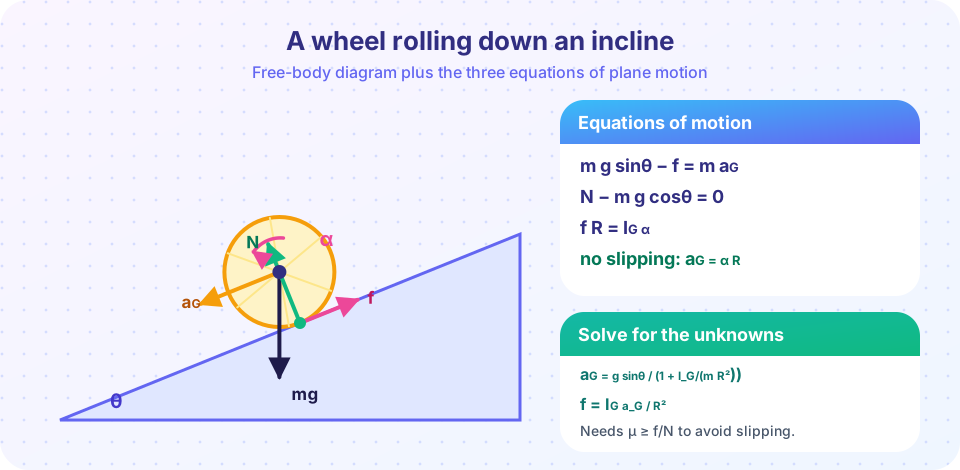
A solid cylinder (m = 10 kg, R = 0.30 m) rolls down an incline at θ = 22°. Choose down the slope as positive and the rolling sense as positive for α.
Equations: down the slope m g sinθ − f = m a_G; perpendicular N − m g cosθ = 0; moments about G: f R = I_G α with I_G = ½ m R²; rolling: a_G = αR.
Substitute α = a_G/R into the moment equation: f = ½ m a_G. Then m g sinθ = m a_G + ½ m a_G, so
a_G = (2/3) g sinθ f = ½ m a_G = (1/3) m g sinθ
Numbers: a_G = (2/3)(9.81)(0.3746) = 2.45 m/s², f = 12.2 N and N = m g cosθ = 91.0 N. The wheel needs a friction coefficient of at least f/N = 0.135, which equals tanθ/3. If the surface is slicker than that, the wheel slips and the rolling constraint no longer holds: use f = μ_k N and treat a_G and α as independent. Compare with sliding with no friction: a = g sinθ = 3.67 m/s². Rolling is slower because part of the gravitational work goes into spin.
In general, for any body with I_G = m k²: a_G = g sinθ/(1 + k²/R²).
Example 2: a pulley and a hanging mass
A rope is wrapped around a disk pulley (M = 8 kg, R = 0.20 m, fixed axle) and carries a block m = 5 kg. The pulley is a solid disk, I = ½ M R².
Block: m g − T = m a. Pulley about its axle: T R = I α = ½ M R² (a/R), so T = ½ M a. Adding the two: m g = (m + M/2) a, giving
a = m g / (m + M/2) = 49.05 / 9 = 5.45 m/s² T = ½ M a = 21.8 N
The tension is less than the weight mg = 49.05 N, because the block accelerates. It is also different on the two sides of a pulley with inertia: that is the effect of I. With a massless pulley (M = 0) the formulas give T = 0 and a = g: the block would simply fall freely, so a pulley carrying a single hanging mass only makes sense when the pulley has inertia.
Example 3: a bar released from rest
A uniform bar (m = 3 kg, L = 1.2 m) is pinned at one end and released from the horizontal. Find α and the pin force at the instant of release.
The bar is at rest, so ω = 0 and the normal acceleration is zero. About the pin O: m g (L/2) = I_O α with I_O = m L²/3, so
α = (m g L/2) / (m L²/3) = 3g / (2L) = 12.26 rad/s²
The mass center is at L/2, so a_G = α L/2 = 3g/4 = 7.36 m/s² downward. Vertical forces: m g − R_y = m a_G, so R_y = m (g − 3g/4) = m g/4 = 7.36 N upward.
That is only one quarter of the weight. A common wrong guess is that the pin carries half the weight (as it would in static equilibrium). A bar swinging from the horizontal is much harder on its pin once it starts moving, because ω grows and the normal acceleration ω² L/2 appears.
Common misconceptions
"Friction on a rolling wheel does work and removes energy." Static friction at the contact point does no work in rolling without slipping, since the contact point does not move.
"The pin carries half the weight when a bar starts to swing." It carries a quarter at release from horizontal.
"The tension on both sides of a pulley is equal." Only for a massless, frictionless pulley.
"Rolling means f = μN." Static friction takes whatever value is needed up to the limit μ_s N.
Try it
This calculator runs the incline problem for several bodies and checks the friction requirement. Then it simulates a wheel on a slippery incline, where μ is too small and the wheel slides while it spins.
Press Run (or Ctrl + Enter) to see the result here.
Program input · what you'd type while the program runs
Type the answers before you press Run, one per line. Each time the program reads a line (with input()), it gets the next line from this box.
The next demo integrates the pivoting bar numerically with SciPy, starting from the horizontal, and plots the pin force components. The first value should match the mg/4 result.
Press Run (or Ctrl + Enter) to see the result here.
Program input · what you'd type while the program runs
Type the answers before you press Run, one per line. Each time the program reads a line (with input()), it gets the next line from this box.
Check your understanding
Quick check · 5 questions
of 5 answered You scored / 5 · perfect!
-
1. A solid cylinder rolls without slipping down a 30° incline. What is a_G?
For a solid cylinder a = g sinθ/(1 + ½) = (2/3) g sinθ. -
2. For the rolling cylinder, why does moment equation use G rather than the contact point?
About G, weight and normal force have no moment (their lines pass through G); only friction creates a moment. -
3. A uniform bar of length L pinned at one end is released from the horizontal. What is α at release?
α = (mgL/2)/(mL²/3) = 3g/(2L). -
4. Which condition tells you a wheel will slip?
Static friction can supply only up to μ_s N. -
5. A block of 5 kg hangs from a disk pulley of 8 kg. The tension is:
T = ½ M a = 4 × 5.45 = 21.8 N.
Summary
- Draw an FBD, write three equations, add the kinematic constraint, solve.
- Rolling without slipping:
a_G = αR; friction takes the value needed, up toμ_s N. - Rolling down an incline:
a = g sinθ/(1 + k²/R²). - A pivoting bar released from horizontal has
α = 3g/(2L)and a pin force of onlymg/4at release.
Track your progress
Create a free account to tick off lessons and pick up where you left off on any device.
of Engineering Dynamics lessons completed