


















Lesson 5 of 47 · Getting Started
Chapter 1 Review: Getting Started
Review models, units, vectors and free-body diagrams from Chapter 1 with a one-picture summary, a recap table and a ten-question mixed quiz.
Chapter 1 built the foundation: what dynamics is, how to keep your units straight, how to handle vectors and how to turn a physical situation into a model and a free-body diagram. Everything in the next three chapters leans on these habits.
What you will learn
- A one-page recap of Chapter 1.
- A six-step checklist you can apply to any problem.
- Self-test questions mixing all four lessons.
Key terms
ΣF = m a: Newton's second law, a vector equation relating net force and acceleration.
FBD: free-body diagram, the sketch of one body with all external forces.
Component: the projection of a vector on an axis.
Dimensional analysis: checking that both sides of an equation have the same dimensions.
Recap table
| Lesson | Big idea | Formula or rule |
|---|---|---|
| What is dynamics? | Kinematics describes motion, kinetics links it to forces | ΣF = m a |
| Units and vectors | SI units, components, dot product | vx = v cos θ, vy = v sin θ |
| Modeling and FBDs | Choose a model, isolate the body, draw all external forces | a = g (sin θ − μ cos θ) on a ramp |
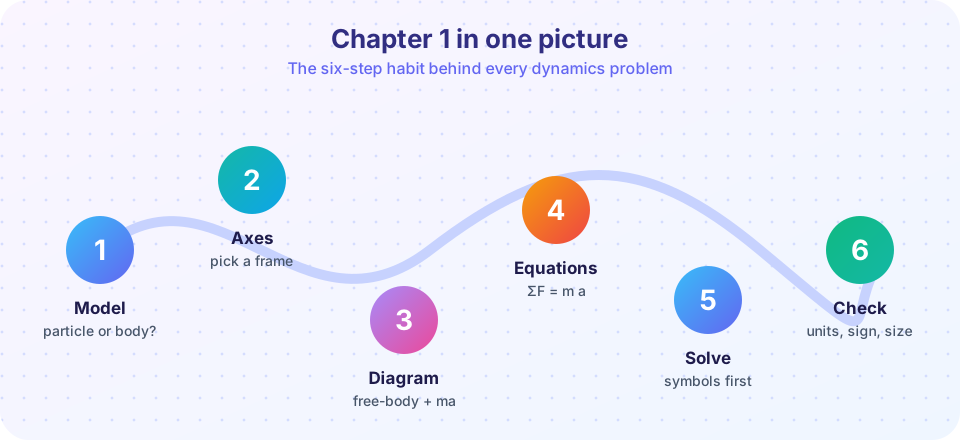
The six-step habit
- Model: particle or rigid body? List assumptions.
- Axes: choose them to line up with the acceleration.
- Diagram: FBD plus kinetic diagram.
- Equations:
ΣF = m afor each axis. - Solve: algebra in symbols first, then numbers with units.
- Check: units, sign, size and limiting cases.
Common misconceptions
"If I get a number, I'm done." An answer is finished only after the check. A braking car with a = 70 m/s² is a mistake somewhere.
"Mass and weight are interchangeable." One is kg and invariant; the other is a force in N.
Try it
A mini auto-checker for the six steps. It computes the ramp problem in several variations and prints a unit-tagged result with a sanity flag.
Press Run (or Ctrl + Enter) to see the console output here.
No output.
A second box recaps the unit conversions: change the inputs and watch the SI outputs.
Press Run (or Ctrl + Enter) to see the result here.
Program input · what you'd type while the program runs
Type the answers before you press Run, one per line. Each time the program reads a line (with input()), it gets the next line from this box.
Check your understanding
Quick check · 10 questions
of 10 answered You scored / 10 · perfect!
-
1. Which is a correct statement of Newton's second law?
ΣF = m a, where both ΣF and a are vectors. -
2. A speed of 54 km/h is
54 / 3.6 = 15 m/s. -
3. Which pair of units is dimensionally the same as a joule?
Energy is force times distance: N·m = kg·m²/s². N·s is impulse. -
4. A vector of 50 N at 30° above the x-axis has a y-component of
50 sin 30° = 25 N. The x-component is 43.3 N. -
5. Which should NOT appear in a free-body diagram?
m a is the result of the forces and is drawn separately in the kinetic diagram. -
6. A block sits on a 20° ramp and does not slide. Which statement must be true?
Static friction must balance the slope component: μs ≥ tan θ = 0.364. -
7. Why is a falling feather slower than a hammer on Earth but not on the Moon (no air)?
Without drag, both accelerate at g. Drag is a large fraction of the feather's weight. -
8. In the six-step habit, when do you substitute numbers?
Symbolic solutions let you check units and limits before arithmetic. -
9. A 4 kg object has net force 12 N. Its acceleration is
a = ΣF / m = 12 / 4 = 3 m/s². -
10. Doubling a car's speed multiplies its braking distance (same grip) by
d = v²/(2μg), so d scales with v².
Summary
- Models, units, vectors and diagrams are the common language of dynamics.
- Follow the six steps: model, axes, diagram, equations, solve, check.
- Mass cancels in many gravity-driven problems; weight does not.
Track your progress
Create a free account to tick off lessons and pick up where you left off on any device.
of Engineering Dynamics lessons completed