


















Lesson 25 of 47 · Rigid Body Kinematics
Relative velocity of rigid bodies
Find the velocity of any point on a rigid body from another point and the angular velocity. Worked ladder and engine examples with a vector triangle.
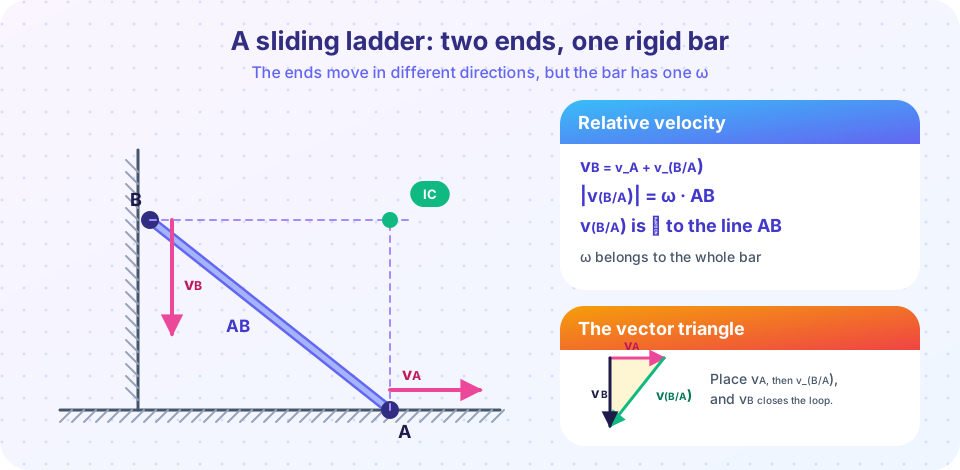
A ladder slides down a wall. Its top end moves down, its bottom end moves out, and the middle does something in between. How are those motions related? The ladder is rigid, so the distance between the two ends cannot change. That single fact ties the velocities together.
The tool for this is the relative velocity equation. It says that the velocity of one point on a rigid body equals the velocity of another point plus the velocity that comes from the body spinning about that point. It is the workhorse for linkages, engines, robots and any machine with pinned bars.
What you will learn
- Write
v_B = v_A + ω × r_(B/A)and explain every term. - Draw and solve the vector triangle graphically and with components.
- Handle sliders and pins as velocity constraints.
- Recognize instantaneous translation and dead-center positions.
Key terms
Relative velocity v_(B/A): the velocity of B as seen by an observer who moves with A but does not rotate.
Position vector r_(B/A): the vector from A to B.
Constraint: a geometric condition, such as "B slides along a horizontal guide", that fixes the direction of a velocity.
Instantaneous translation: a moment when ω = 0 and all points have the same velocity.
Why the equation is true
Choose two points A and B on one rigid body. Write the position of B as r_B = r_A + r_(B/A), then differentiate:
v_B = v_A + d(r_(B/A))/dt
Because the body is rigid, the vector r_(B/A) keeps its length. The only way it can change is by rotating with the body. A vector of constant length that rotates with angular velocity ω has derivative ω × r. So:
v_B = v_A + ω × r_(B/A)
In plane motion ω = ω k and the cross product reduces to a perpendicular vector: |v_(B/A)| = ω · AB, perpendicular to the line AB, in the sense of ω. In components, with r_(B/A) = (x, y), we get ω × r = ω(−y, x). This is worth memorizing, since it is all you need to code the method.
Two warnings. First, ω belongs to the whole body, so it does not depend on which two points you pick. Second, the relative velocity v_(B/A) is always perpendicular to AB. It can never have a component along the bar, otherwise the bar would be stretching.
The solution recipe
- Sketch the body and mark the points whose velocity you know or need.
- Write what you know about each velocity: a magnitude, a direction, or both. A pin on a rotating crank has known magnitude and direction. A slider has a known direction only.
- Write
v_B = v_A + ω × r_(B/A)with the unknowns. - Solve by drawing the triangle (graphical) or by taking
xandycomponents (two equations, two unknowns). - Check that
v_(B/A)is perpendicular toAB, and that signs and directions make sense.
Worked example: the sliding ladder
A ladder of length L = 2.0 m leans on a wall, making 60° with the floor. The lower end A slides away from the wall at v_A = 1.5 m/s. Find ω and the speed of the top end B.
Put the origin where the wall meets the floor. Then A = (1.0, 0) and B = (0, 1.732), so r_(B/A) = (−1.0, 1.732). Known directions: v_A = (1.5, 0) and v_B = (0, v_B).
Write the equation in components, with ω counter-clockwise (we check the sign afterwards):
x:   0   = 1.5 + ω(−1.732)    →   ω = 0.866 rad/s
y:   v_B = 0   + ω(−1.0)      →   v_B = −0.866 m/s
The negative sign means B moves down, as expected, with ω counter-clockwise (the ladder leans further over as the foot slides out). The top end moves at 0.866 m/s, slower than the foot at 1.5 m/s. As the ladder gets flatter, the top end speeds up: the two equations give v_B = v_A / tan φ, which grows without limit as φ approaches 0. (A real ladder would have left the wall long before: this model assumes the contacts never separate.)
You can cross-check this with the constraint x_A = L cos φ, y_B = L sin φ. Differentiating gives v_A = −L sin φ · φ̇, so |φ̇| = 1.5/(2 × 0.866) = 0.866 rad/s ✓.
Worked example: the piston at dead center
An engine crank OA has length r = 0.15 m and turns counter-clockwise at 40 rad/s. The rod AB is l = 0.45 m long, and B is a piston that slides along the horizontal axis through O. At θ = 0 the crank points along the axis and A is at (0.15, 0), B at (0.60, 0).
Then v_A = ω(−y, x) = 40 × (0, 0.15) = (0, 6.0) m/s. With r_(B/A) = (0.45, 0):
x:   v_B = 0   + ω_AB(−0)    →   v_B = 0
y:   0   = 6.0 + ω_AB(0.45)  →   ω_AB = −13.33 rad/s
At dead center the piston has zero velocity, while the rod spins at 13.3 rad/s. This is the reversal point of the stroke. Notice that the equation gave this without any calculus.
Instantaneous translation
Try the same engine at θ = 90°, with A directly above O. Then v_A is horizontal, v_B is horizontal, and the y equation becomes 0 = 0 + ω_AB x_(B/A), which forces ω_AB = 0. The rod does not rotate at this instant, and B moves with the same velocity as A: v_B = v_A. This is instantaneous translation. A moment later ω_AB is nonzero again, so the situation is momentary. The instant center lies at infinity here.
Common misconceptions
"The relative velocity points along the bar." It is always perpendicular to the bar for a rigid link.
"Each point of a rigid body has its own ω." One angular velocity for the whole body.
"The velocity of a sliding end is perpendicular to the guide." It is along the guide. Mixing these up is the most common mistake with sliders.
Try it
The first demo moves the ladder by changing its angle φ. The foot speed is fixed at 1.5 m/s. The tool shows how ω and the top speed vary. Slide towards 90°: the top end slows to a stop.
The second demo solves the engine rod for every crank angle with the relative velocity equation and compares it with the closed-form piston velocity. It is a short example of turning a vector method into code.
Press Run (or Ctrl + Enter) to see the result here.
Program input · what you'd type while the program runs
Type the answers before you press Run, one per line. Each time the program reads a line (with input()), it gets the next line from this box.
Check your understanding
Quick check · 4 questions
of 4 answered You scored / 4 · perfect!
-
1. In v_B = v_A + ω × r_(B/A), the vector ω × r_(B/A) is:
A rigid link cannot stretch, so the relative velocity is perpendicular to the link. -
2. A rigid bar AB is 0.8 m long and has ω = 5 rad/s. What is |v_(B/A)|?
|v_(B/A)| = ω × AB = 5 × 0.8 = 4 m/s. -
3. A slider B moves along a horizontal guide. What do you know about v_B?
A constraint fixes the direction; the magnitude is an unknown. -
4. In the engine at dead center, the piston velocity is zero but the rod ω is not. Why?
v_A is vertical and r_(B/A) is horizontal, so only a rotation of the rod can cancel it in the vertical direction while v_B stays horizontal.
Summary
v_B = v_A + ω × r_(B/A), with|v_(B/A)| = ω · ABperpendicular toAB.- Solve with a vector triangle or with
xandycomponents: two equations, two unknowns. - Sliders fix directions; pins on cranks give magnitude and direction.
- When
ω = 0the body is in instantaneous translation.
Track your progress
Create a free account to tick off lessons and pick up where you left off on any device.
of Engineering Dynamics lessons completed