


















Lesson 12 of 47 · Kinetics: Force and Acceleration
Chapter 3 Overview: Force and Acceleration
Preview Chapter 3: how Newton's second law connects forces to motion, how apparent weight works in an elevator, and what each kinetics lesson teaches.
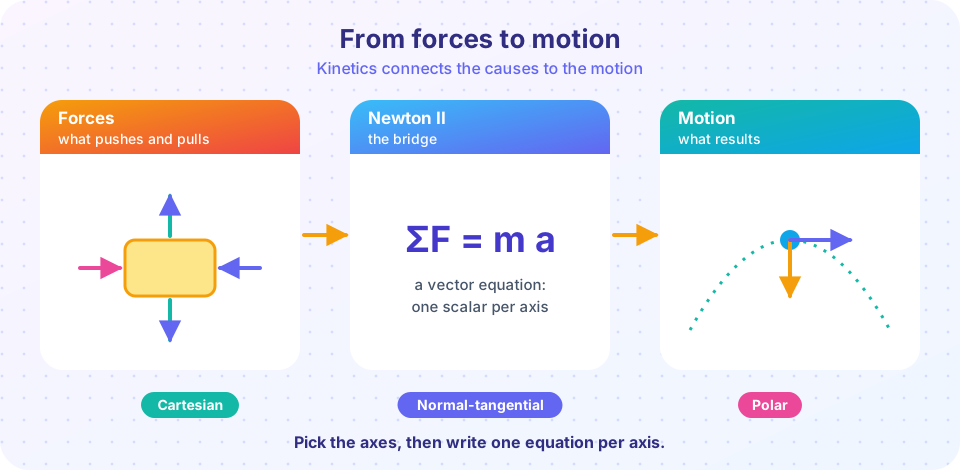
Chapter 2 told you how things move. Chapter 3 asks why. The answer is one line, Newton's second law, but using it well is a craft: choosing the system, drawing the free-body diagram, picking axes and solving the resulting equations. By the end of the chapter you will handle ramps, pulleys, banked roads, orbits and falling objects with air drag.
What you will learn
- How
ΣF = m ais used as a recipe: diagram, axes, equations, solve, check. - Why the scale reading in an elevator differs from your weight.
- What the next four lessons cover.
Key terms
Newton (N): the force that gives 1 kg an acceleration of 1 m/s².
Net force: the vector sum of all external forces.
Apparent weight: what a scale reads, i.e. the normal force on you.
Equation of motion: ΣF = m a written along each axis for a chosen body.
The chapter in seven slides
The recipe
Straight lines
Curves
Resistance
Computers
An elevator and a bathroom scale
You stand on a scale in an elevator. Two forces act on you: your weight m g down and the normal force N from the scale up. Take up as positive:
N − m g = m a, so N = m (g + a).
For an 80 kg rider:
| Elevator motion | a (m/s²) | Scale reads (N) | Feels like |
|---|---|---|---|
| Rest or constant speed | 0 | 785 | normal |
| Accelerating up at 1.5 | +1.5 | 905 | heavier |
| Accelerating down at 1.5 | −1.5 | 665 | lighter |
| Free fall (cable cut) | −9.81 | 0 | weightless |
The scale measures N, so it reports your apparent weight. Your mass is still 80 kg in every row. Astronauts in orbit feel weightless for the same reason as the free-falling rider: they and their spacecraft are accelerating together under gravity, so nothing pushes on them.
What is in this chapter
| Lesson | Focus |
|---|---|
| Newton's second law in practice | Cartesian axes, friction, pulleys and connected bodies |
| Circular motion and banked curves | Normal-tangential equations of motion |
| Drag and variable forces | Forces that depend on speed, and numerical solution |
| Chapter review | Recap and mixed quiz |
Common misconceptions
"A scale measures weight." It measures the contact force on it. In an accelerating elevator that differs from m g.
"There are forces of acceleration." Acceleration is a result; it never appears as an arrow in the free-body diagram.
"Newton's second law needs the force to be constant." ΣF = m a holds at every instant; forces may vary, which is the subject of the last lesson of this chapter.
Try it
First, the elevator as a calculator. Change the acceleration and see what the scale would read.
Press Run (or Ctrl + Enter) to see the console output here.
No output.
Second, a first simulation: a block is pushed with a constant force on a rough floor. The program applies ΣF = m a repeatedly in tiny time steps, the method you will use throughout the course.
Press Run (or Ctrl + Enter) to see the result here.
Program input · what you'd type while the program runs
Type the answers before you press Run, one per line. Each time the program reads a line (with input()), it gets the next line from this box.
Check your understanding
Quick check · 4 questions
of 4 answered You scored / 4 · perfect!
-
1. A 60 kg person stands on a scale in an elevator accelerating upward at 2 m/s². The scale reads (g = 9.81)
N = m(g + a) = 60 × 11.81 = 709 N. -
2. An elevator is in free fall. A scale on its floor reads
N = m(g + a) with a = −g gives zero. -
3. Which is NOT drawn in a free-body diagram?
Acceleration is a result of the net force, never a force itself. -
4. A 10 kg block is pushed with 60 N against 29.4 N of friction. Its acceleration is
a = (60 − 29.4) / 10 = 3.06 m/s².
Summary
- Kinetics = free-body diagram +
ΣF = m aalong each chosen axis. - Apparent weight is the normal force; in an elevator
N = m (g + a). - Acceleration is a result, never a force on the diagram.
- This chapter covers straight and curved paths, then forces that depend on speed.
Track your progress
Create a free account to tick off lessons and pick up where you left off on any device.
of Engineering Dynamics lessons completed