


















Lesson 32 of 47 · Rigid Body Kinetics
Chapter 6 review: rigid body kinetics
A one-page summary, recap table and ten mixed questions on moment of inertia, planar equations of motion, kinetic energy, angular momentum and impulse.
Chapter 6 added forces, moments and inertia to the motion descriptions of chapter 5. The result is a small toolbox that handles wheels, pulleys, pivoting bars and spinning shafts. This review puts the toolbox on one page and tests how well you can pick the right tool.
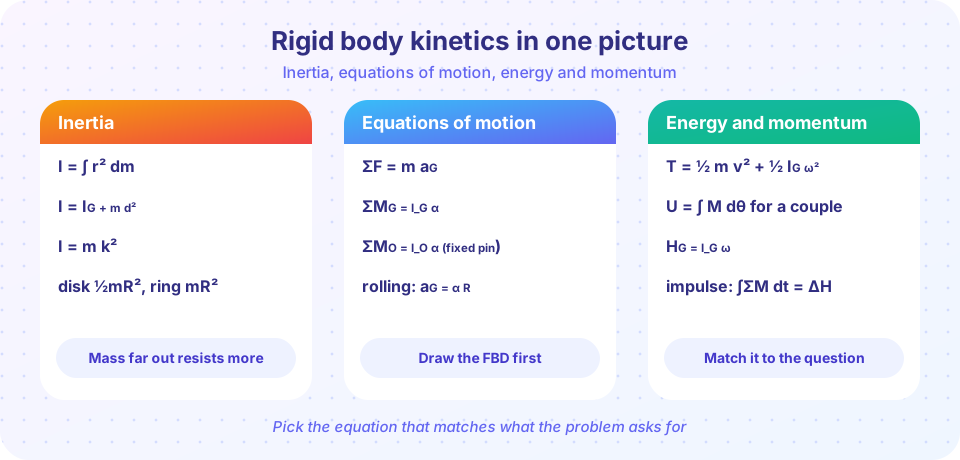
Recap table
| Topic | Key results |
|---|---|
| Moment of inertia | I = ∫ r² dm; disk ½mR², ring mR², rod mL²/12, sphere (2/5)mR²; I = I_G + md²; I = mk² |
| Equations of motion | ΣF = m a_G, ΣM_G = I_G α; fixed pin: ΣM_O = I_O α |
| Rolling | a_G = αR; a = g sinθ/(1 + k²/R²); friction needed f = I_G a/R² |
| Work and energy | T = ½mv_G² + ½I_Gω²; couple work M Δθ; rolling friction does no work |
| Momentum | H_G = I_G ω; angular impulse ∫ΣM dt = ΔH; conserved when ΣM = 0 |
Choosing a method
- Asked for acceleration, a force or a reaction at an instant: force and moment equations.
- Asked for speed after a distance or angle: work and energy.
- Asked for speed after a collision, a coupling or a short push: impulse and momentum.
- Often you need two methods: energy gives
ω, then the equations of motion give the pin force usinga_n = ω² r.
Common mistakes
Adding moments of inertia about different axes. Move everything to one axis first.
Forgetting holes. They subtract mass and inertia.
Drawing m a_G as a force. It belongs on the kinetic diagram.
Using a_G = αR when the wheel slips. Then a_G and α are independent.
Applying energy conservation to an inelastic coupling. Use angular momentum instead.
Try it
A flywheel stores kinetic energy ½ I ω². This calculator compares solid-disk and ring-shaped flywheels with the same mass and outer radius at the same speed, and shows how much energy each stores.
Press Run (or Ctrl + Enter) to see the result here.
Program input · what you'd type while the program runs
Type the answers before you press Run, one per line. Each time the program reads a line (with input()), it gets the next line from this box.
This second tool is a small solver for fixed-axis problems: give it a torque, an inertia and a time, and it returns α, ω and the turns, plus the work done.
Press Run (or Ctrl + Enter) to see the result here.
Program input · what you'd type while the program runs
Type the answers before you press Run, one per line. Each time the program reads a line (with input()), it gets the next line from this box.
Check your understanding
Quick check · 10 questions
of 10 answered You scored / 10 · perfect!
-
1. A solid disk (m = 6 kg, R = 0.5 m) has I about its center of:
I = ½mR² = ½ × 6 × 0.25 = 0.75 kg·m². -
2. A rod of 2 kg and 0.6 m has I about its end of:
I = mL²/3 = 2 × 0.36/3 = 0.24 kg·m². -
3. A 12 N·m net moment acts on a free body with I_G = 3 kg·m². What is α?
α = 12/3 = 4 rad/s². -
4. Which statement about parallel axes is correct?
I = I_G + md² is always at least I_G. -
5. A hoop and a solid cylinder, same mass and radius, roll from rest down the same ramp. Which arrives first?
The cylinder has smaller k²/R², so it accelerates faster. -
6. What does static friction do in rolling without slipping?
It creates the moment about G; its point of application does not move. -
7. A 4 kg wheel with v_G = 2 m/s rolls without slipping, I_G = ½mR². What is T?
T = ¾ m v² = 0.75 × 4 × 4 = 12 J. -
8. A bar is released from the horizontal and swings to the vertical. Which method is quickest for ω at the bottom?
Energy links ω to the drop of G without needing the acceleration. -
9. Two disks couple with no external torque. What is conserved?
Angular momentum is conserved; some kinetic energy turns into heat. -
10. Torque 8 N·m acts through 3 rad. How much work does it do?
U = Mθ = 8 × 3 = 24 J.
Summary
- Mass distribution decides
I; use the parallel-axis theorem and subtract holes. - Forces drive
G; moments drive the spin; the kinetic diagram completes the picture. - Energy answers "how fast after how far"; momentum answers "how fast after the collision".
- Chapter 7 applies the same laws to oscillating systems.
Track your progress
Create a free account to tick off lessons and pick up where you left off on any device.
of Engineering Dynamics lessons completed