


















Lesson 22 of 47 · Work, Energy and Momentum
Chapter 4 Review: Work, Energy and Momentum
Review work, kinetic and potential energy, conservation, impulse, momentum and collisions, with a decision guide for choosing the right principle and a ten-question quiz.
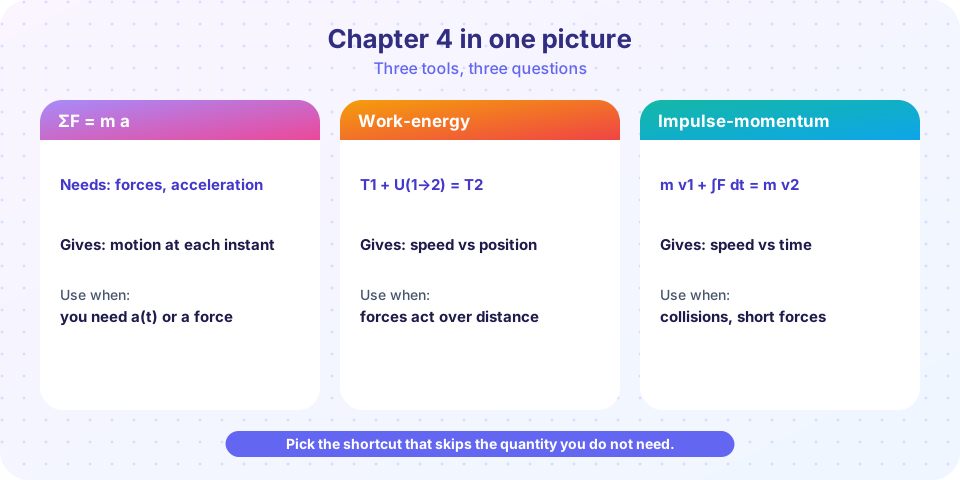
You now have three principles for particle dynamics: Newton's second law for instantaneous behavior, work-energy for speed against position, and impulse-momentum for speed against time. The craft is choosing the one that skips the quantity you do not need.
What you will learn
- A one-page summary of Chapter 4.
- A decision guide for choosing between the three principles.
- A mixed ten-question self-test.
Key terms
Work-energy: T₁ + ΣU₁₂ = T₂.
Conservation of energy: T₁ + V₁ + U_nc = T₂ + V₂.
Impulse-momentum: m v₁ + ∫F dt = m v₂.
Restitution: e = separation speed / approach speed.
Recap table
| Principle | Equation | Use when |
|---|---|---|
| Newton's second law | ΣF = m a |
you need a(t), forces at a point, or times |
| Work-energy | T₁ + ΣU = T₂ |
forces act over a known distance; need speed |
| Conservation of energy | T + V = const |
only gravity and springs do work |
| Impulse-momentum | J = Δp |
forces act over a known time; collisions |
| Conservation of momentum | Σp = const |
no external forces: recoil, explosions, collisions |
| Restitution | e = (v₂′ − v₁′)/(v₁ − v₂) |
impacts |
Decision guide
- Need an acceleration, or a force at an instant? Newton's second law.
- Know the forces and distances, want a speed? Work-energy.
- Know the forces and times, want a speed (or the reverse)? Impulse-momentum.
- A collision? Momentum plus restitution; energy only after the impact.
- Need two unknowns? Combine principles, e.g. energy for the speed, Newton for the tension.
Common misconceptions
"Use energy conservation for everything." It fails with friction unless you add the lost work, and it cannot give forces or times.
"Momentum is conserved through an impact and the swing after it." Only through the impact.
Try it
First, a combined problem: a ball is released from a height, slides on a rough floor and hits a stationary ball. Each stage uses the right principle.
Press Run (or Ctrl + Enter) to see the console output here.
No output.
Second, an energy ledger in Python: it tracks where the initial energy goes in the collision stage.
Press Run (or Ctrl + Enter) to see the result here.
Program input · what you'd type while the program runs
Type the answers before you press Run, one per line. Each time the program reads a line (with input()), it gets the next line from this box.
Check your understanding
Quick check · 10 questions
of 10 answered You scored / 10 · perfect!
-
1. A 3 kg block slides from rest down a smooth curve of height 2 m. Its speed at the bottom is
v = √(2 g h) = √39.24 = 6.26 m/s. -
2. A force of 50 N acts on a 5 kg cart for 4 s from rest on a frictionless floor. Its final speed is
J = 200 N·s = 5 v, so v = 40 m/s. -
3. The same force (50 N) acts on the same cart over 4 m from rest. The speed is
U = 50 × 4 = 200 J = ½ × 5 × v², so v² = 80 and v = 8.94 m/s. -
4. Which quantity is conserved in every collision with no external forces?
Kinetic energy is lost unless e = 1. -
5. A 0.2 kg ball hits a wall at 10 m/s and rebounds at 8 m/s. The impulse magnitude is
J = 0.2 × (8 + 10) = 3.6 N·s. -
6. A bullet embeds in a block. Which statement is right?
The impact is perfectly inelastic: momentum is conserved, kinetic energy is not. -
7. A spring (k = 500 N/m) is compressed 0.1 m and launches a 0.25 kg block. The speed is
½ × 500 × 0.01 = 2.5 J = ½ × 0.25 × v², v = 4.47 m/s. -
8. Power equals
P = dU/dt = F·v. -
9. The area under a force-displacement graph is
U = ∫F ds. -
10. Which problem is best solved with impulse-momentum?
The time of contact and the change of speed are known; impulse links them to the force.
Summary
- Work-energy and impulse-momentum are integrals of
ΣF = m aover distance and over time. - Conservation laws need isolation: energy conserved without friction, momentum without external forces.
- Collisions: momentum plus restitution; energy only after the impact.
Track your progress
Create a free account to tick off lessons and pick up where you left off on any device.
of Engineering Dynamics lessons completed