


















Lesson 6 of 47 · Kinematics of Particles
Chapter 2 Overview: Kinematics of Particles
Preview Chapter 2: how position, velocity and acceleration relate through derivatives and integrals, and what each lesson in the chapter covers.
Before you can ask why something moves, you need a precise way to say how it moves. Kinematics gives you that language: position, velocity and acceleration, and the calculus that links them. In this chapter we describe motion along a line, along a curve in the plane, in three kinds of coordinates, and from the point of view of a moving observer.
What you will learn
- How position, velocity and acceleration are related by derivatives and integrals.
- The difference between distance and displacement, and between speed and velocity.
- How to read a graph of one quantity to sketch the others.
- What each lesson in this chapter adds.
Key terms
Position (r or s): where the particle is, measured from an origin.
Displacement (Δr): change in position; a vector from start to end, not the length of the path.
Velocity (v = dr/dt): rate of change of position; speed is its magnitude.
Acceleration (a = dv/dt): rate of change of velocity, including changes of direction.
Reference frame: the set of axes and clock from which motion is measured.
The chapter in eight slides
Three quantities
Calculus link
Straight lines
Curves
Moving axes
Other observers
Distance and displacement, speed and velocity
A runner completes one lap of a 400 m track. The distance is 400 m, but the displacement is zero because she ends where she began. Average speed is distance over time; average velocity is displacement over time. Over that lap her average velocity is zero even though her average speed is perhaps 5 m/s.
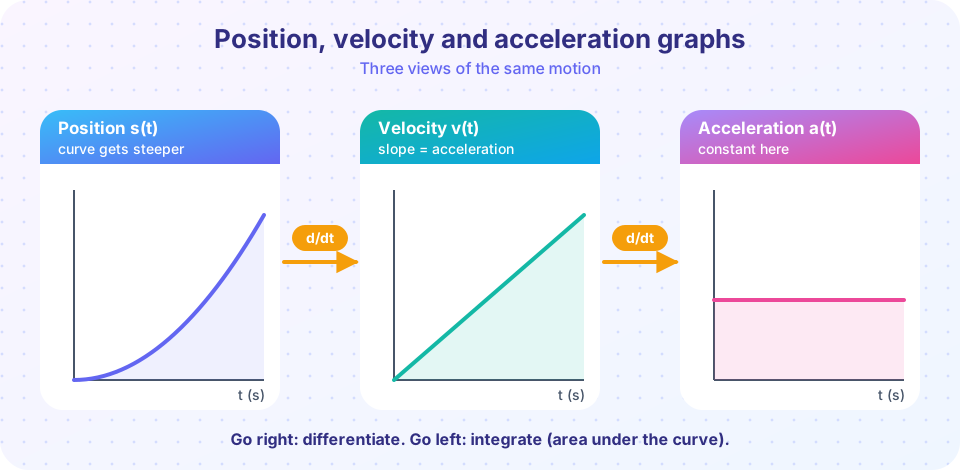
Instantaneous values come from limits: v = dr/dt, a = dv/dt. In one dimension, the three graphs are tied together:
- the slope of the position graph is the velocity;
- the slope of the velocity graph is the acceleration;
- the area under the acceleration graph is the change in velocity;
- the area under the velocity graph is the displacement.
What is in this chapter
| Lesson | You will be able to |
|---|---|
| Rectilinear motion | Solve straight-line problems with constant or varying acceleration |
| Projectile motion | Treat horizontal and vertical motion independently |
| Normal-tangential and polar components | Describe curved motion with axes that move with the particle |
| Relative motion | Add and subtract velocities between observers |
| Chapter review | Test yourself across the chapter |
Common misconceptions
"Zero velocity means zero acceleration." A ball at the top of its flight has zero vertical velocity but its acceleration is still 9.81 m/s² downward.
"Acceleration means speeding up." Acceleration is any change in velocity, so slowing down and turning are accelerations too. A car at constant speed on a bend is accelerating.
Try it
Starting from nothing but a table of positions, compute velocity and acceleration numerically with differences. This is how motion-capture software and data loggers work.
Press Run (or Ctrl + Enter) to see the result here.
Program input · what you'd type while the program runs
Type the answers before you press Run, one per line. Each time the program reads a line (with input()), it gets the next line from this box.
Second, go the other way: integrate an acceleration record to recover velocity and displacement. The area under a curve is computed with the trapezoid rule.
Press Run (or Ctrl + Enter) to see the console output here.
No output.
Check your understanding
Quick check · 4 questions
of 4 answered You scored / 4 · perfect!
-
1. A runner completes exactly one lap of a track. Her displacement is
She ends at the starting point, so the displacement (a vector from start to end) is zero. -
2. On a velocity-time graph, the area under the curve gives
Integrating velocity over time gives the change in position. -
3. A ball at the top of its flight has
Gravity still acts. Only the vertical velocity is momentarily zero. -
4. A car drives at a constant 20 m/s around a circular bend. It is
Acceleration is the rate of change of the velocity vector, and the direction is changing.
Summary
- Position, velocity and acceleration are linked by derivatives; reversing the link uses integrals (areas).
- Displacement and velocity are vectors; distance and speed are scalars.
- Zero velocity does not mean zero acceleration.
- This chapter covers straight lines, projectiles, moving axes and relative motion.
Next: Rectilinear Motion
Track your progress
Create a free account to tick off lessons and pick up where you left off on any device.
of Engineering Dynamics lessons completed