


















Lesson 17 of 47 · Work, Energy and Momentum
Chapter 4 Overview: Work, Energy and Momentum
Preview Chapter 4: three alternatives to solving ΣF = m a step by step. Learn when work-energy and impulse-momentum save time, with a roller-coaster example.
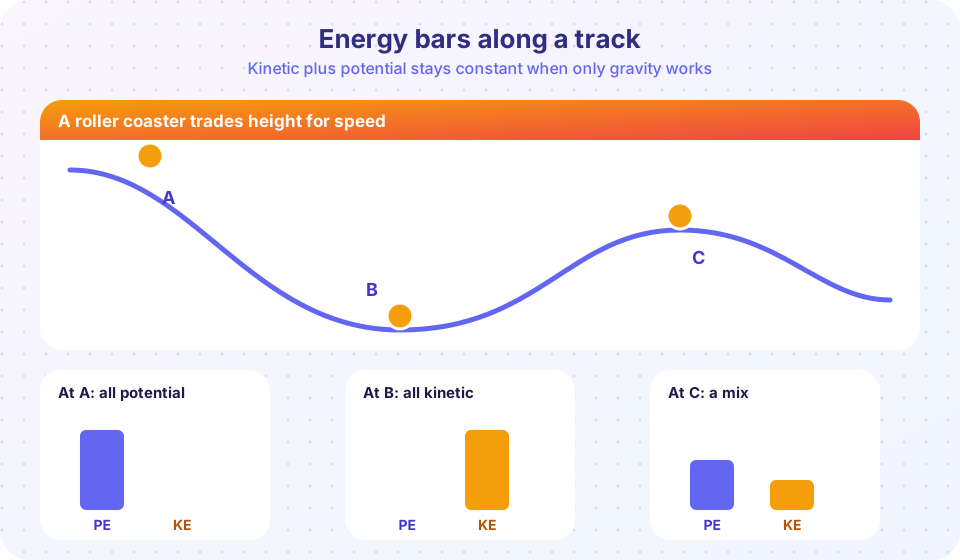
Newton's second law always works, but it asks for the acceleration at every instant. Often you do not care. You want to know how fast a roller coaster is going at the bottom of a drop, not what its acceleration was along the way. Integrating ΣF = m a once over distance gives the work-energy principle. Integrating once over time gives impulse-momentum. These two shortcuts skip the details of the motion and go straight to speeds.
What you will learn
- Why integrating Newton's second law over distance or time gives two new tools.
- How to compute a roller coaster's speed from height alone.
- When to choose force, energy or momentum for a problem.
- What each lesson in this chapter adds.
Key terms
Work (U): the energy a force transfers, U = ∫F·dr, in joules.
Kinetic energy (T): T = ½ m v².
Potential energy (V): stored energy that depends on position (height, spring stretch).
Momentum (p): p = m v; impulse J = ∫F dt.
Power: the rate of doing work, P = F·v, in watts.
The chapter in six slides
Three tools
Energy
Conservation
Momentum
Power
A roller coaster in one line
A coaster car, mass m, starts from rest at a height of 30 m. Ignoring friction and air, how fast is it going at the point 10 m above the ground? Newton's second law would need the track's exact shape. Energy conservation needs only the heights:
m g h1 = ½ m v² + m g h2, so v = √(2 g (h1 − h2)).
- At 10 m:
v = √(2 × 9.81 × 20) = 19.8 m/s(71 km/h). - At the bottom:
v = √(2 × 9.81 × 30) = 24.3 m/s(87 km/h).
The mass cancels, and the answer does not depend on the shape of the track: a steep drop and a gentle spiral give the same speed at the same height.
What is in this chapter
| Lesson | Focus |
|---|---|
| Work and kinetic energy | Work of forces, the work-energy theorem and power |
| Potential energy and conservation | Gravity, springs and conservation of energy |
| Impulse and momentum | Force over time and conservation of momentum |
| Collisions | Elastic, inelastic and restitution |
| Chapter review | Choosing the right tool |
Common misconceptions
"Energy is used up." Energy is converted, not destroyed. Friction turns kinetic energy into thermal energy; the total stays the same, but it is no longer useful mechanical energy.
"A heavier coaster car goes faster." Without friction the mass cancels in v = √(2 g Δh).
Try it
First, plot the speed of a coaster along a track of any shape from the height profile alone. Edit the track function and see the speeds change without writing any force equations.
Press Run (or Ctrl + Enter) to see the result here.
Program input · what you'd type while the program runs
Type the answers before you press Run, one per line. Each time the program reads a line (with input()), it gets the next line from this box.
Second, a one-line comparison of the three tools for the same question: how fast is a falling ball after 5 m?
Press Run (or Ctrl + Enter) to see the console output here.
No output.
Check your understanding
Quick check · 4 questions
of 4 answered You scored / 4 · perfect!
-
1. A frictionless coaster starts from rest 20 m above the ground. Its speed at ground level is (g = 9.81 m/s²)
v = √(2 g h) = √(392) = 19.8 m/s. -
2. Which principle comes from integrating Newton's second law over distance?
∫F·dr = Δ(½ m v²). -
3. Two coaster cars of different mass start from the same height on a frictionless track. At the bottom, the heavier car is
The mass cancels in v = √(2 g h). -
4. The unit of energy is
A joule is one newton-meter. N·s is impulse; W is power.
Summary
- Work-energy (over distance) and impulse-momentum (over time) are integrals of Newton's second law.
- With only gravity doing work,
v = √(2 g Δh)regardless of path or mass. - Choose force methods for accelerations, energy for speed against position, momentum for speed against time and collisions.
Next: Work and Kinetic Energy
Track your progress
Create a free account to tick off lessons and pick up where you left off on any device.
of Engineering Dynamics lessons completed