


















Lesson 27 of 47 · Rigid Body Kinematics
Chapter 5 review: rigid body kinematics
A one-picture summary, recap table and ten mixed questions on fixed-axis rotation, relative velocity, the instant center and relative acceleration.
You now have three ways to describe the motion of a rigid body in a plane, and a clear idea of when to use each. This review gathers them in one place, shows how to choose, and checks your understanding with ten mixed questions.
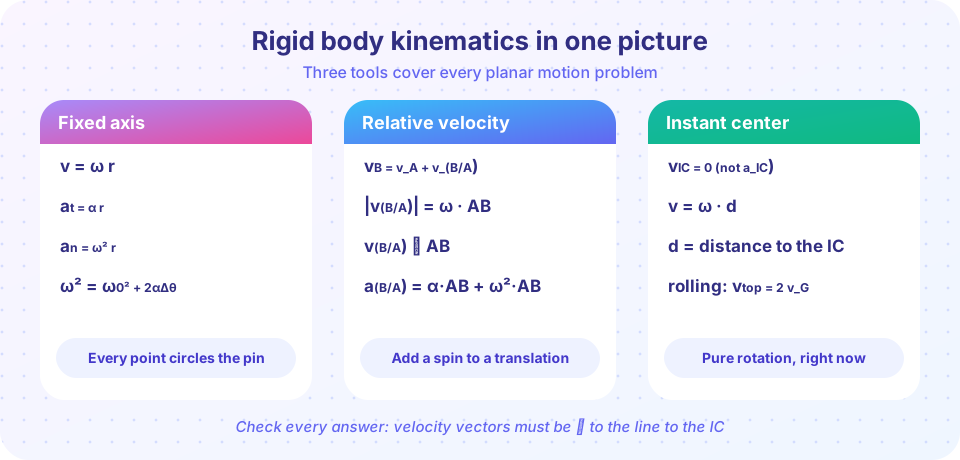
Recap table
| Idea | Key formulas | When to use it |
|---|---|---|
| Fixed-axis rotation | v = ωr, a_t = αr, a_n = ω²r |
A body turns about a pin or axle |
| Constant α | ω = ω₀ + αt, θ = θ₀ + ω₀t + ½αt², ω² = ω₀² + 2αΔθ |
α does not change |
| Belts and gears | ω₁r₁ = ω₂r₂ (belt); ω₂/ω₁ = N₁/N₂ (gears) |
Connected rotating parts |
| Relative velocity | v_B = v_A + ω × r_(B/A) |
You know one point and constraints |
| Instant center | v = ω d, perpendicular to the line to the IC |
Quick velocity picture, rolling wheels |
| Relative acceleration | a_B = a_A + α × r − ω² r |
Accelerations of linkage points |
How to choose a method
- A point is fixed: use the fixed-axis formulas.
- You need velocities only and the geometry is simple: IC.
- You need accelerations, or the geometry is awkward: relative equations with components.
- In every case, check that
v_(B/A)is perpendicular to the bar, and that normal accelerations point toward the relative point.
Common mistakes to avoid
Using rpm in formulas. Convert to rad/s first.
Giving each point its own ω. There is one ω for the whole body.
Treating the IC as an acceleration-free point. It has zero velocity only.
Forgetting the direction of a slider. The velocity is along the guide, not across it.
Try it
This tool combines several ideas: it rolls a wheel with a constant spin-up and prints the velocity and acceleration of the top and contact points. Change the radius or the acceleration and check that the normal acceleration of the contact point is always ω²R.
Press Run (or Ctrl + Enter) to see the result here.
Program input · what you'd type while the program runs
Type the answers before you press Run, one per line. Each time the program reads a line (with input()), it gets the next line from this box.
The second tool turns the instant-center rule into a function. Give it two points and their velocity directions, and it returns the IC and every other speed.
Press Run (or Ctrl + Enter) to see the result here.
Program input · what you'd type while the program runs
Type the answers before you press Run, one per line. Each time the program reads a line (with input()), it gets the next line from this box.
Check your understanding
Quick check · 10 questions
of 10 answered You scored / 10 · perfect!
-
1. A fan turns at 1500 rpm. What is ω?
ω = 2π × 1500/60 = 50π rad/s, about 157 rad/s. -
2. A point 0.2 m from the axis of a disc with ω = 30 rad/s and α = 0 has which normal acceleration?
a_n = ω²r = 900 × 0.2 = 180 m/s². -
3. A disc starts at rest and accelerates uniformly at 4 rad/s² for 5 s. How many radians does it turn?
θ = ½αt² = ½ × 4 × 25 = 50 rad. -
4. Relative velocity v_(B/A) is directed:
For a rigid link, v_(B/A) = ω × r is perpendicular to the link. -
5. A bar of length 0.6 m has ω = 8 rad/s. v_A = 2 m/s. At most, how large can v_B be?
v_B ≤ v_A + ω·AB = 2 + 4.8 = 6.8 m/s, reached when both vectors point the same way. -
6. A cylinder rolls without slipping. Where is its IC?
The contact point has the same (zero) velocity as the ground. -
7. The center of a rolling wheel moves at 3 m/s. How fast is the point at the top?
The top is twice as far from the IC as the center. -
8. Which statement about the IC of a rolling wheel is correct?
That point is momentarily at rest, but it turns around the center, so it accelerates toward it. -
9. Which quantity is the same for all points of a rotating rigid body?
Speeds and accelerations scale with radius; ω and α do not. -
10. Two meshing gears have 20 and 60 teeth. If the small gear turns at 300 rpm, the large one turns at:
ω₂ = ω₁ N₁/N₂ = 300 × 20/60 = 100 rpm, and meshing gears turn opposite ways.
Summary
- Fixed axis, relative velocity and the instant center cover every planar kinematics problem.
- Use
ωandαfor the body,vandafor the point. - Check perpendicularity and directions, and keep rad/s.
- Chapter 6 asks what makes these motions happen: forces, torques and moments of inertia.
Track your progress
Create a free account to tick off lessons and pick up where you left off on any device.
of Engineering Dynamics lessons completed