


















Lesson 18 of 47 · Work, Energy and Momentum
Work and Kinetic Energy
Define work as force along a path, derive the work-energy theorem, compute work of constant and variable forces and springs, and relate power to force and speed.
When you push a shopping cart for 10 m, you do work. When you hold a heavy bag motionless for a minute, you feel tired but, in the physics sense, you do no work on the bag. Work measures energy transferred by a force acting through a distance, and the work-energy theorem links it directly to the change in speed. It is one of the most useful ideas in engineering.
What you will learn
- How to calculate work for constant and variable forces and for springs.
- The work-energy theorem
U₁₂ = T₂ − T₁. - How to handle forces that do no work.
- How power relates to force and velocity.
Key terms
Work: U = ∫F·dr. For a constant force, U = F d cos θ.
Kinetic energy: T = ½ m v².
Power: P = dU/dt = F·v; the unit is the watt (1 W = 1 J/s).
Efficiency: output power divided by input power.
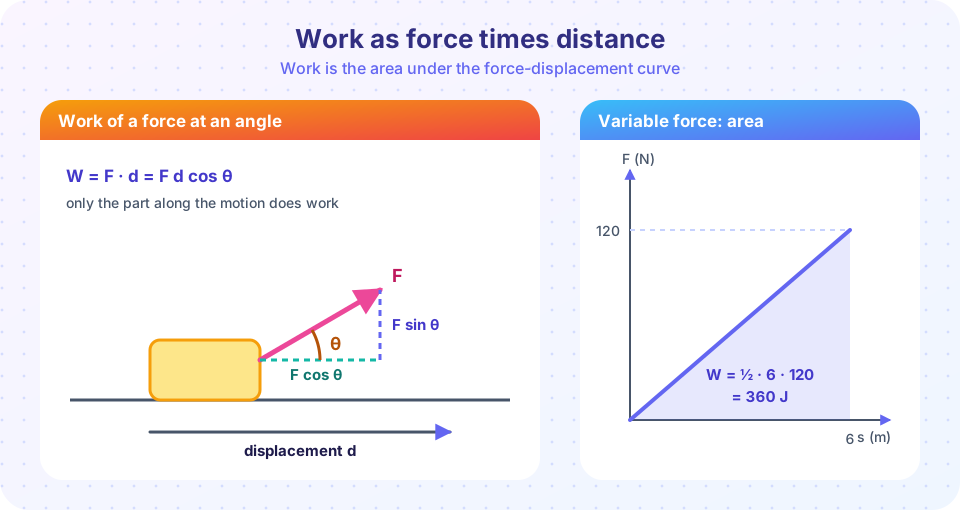
Work of a force
For a constant force and a straight displacement d, U = F·d = F d cos θ, where θ is the angle between them.
θ = 0°: all the force helps;U = F d.θ = 90°: no work, as with the normal force on a sliding block, or gravity on a horizontal slide.θ > 90°: negative work, as with friction, which takes energy away.
Variable force. U = ∫F ds. For F = 20 s (N, s in m) from s = 0 to 6 m: U = ∫20 s ds = 10 s² = 360 J, the area of the triangle in the figure.
Spring. Stretching or compressing a spring (F = k x) from its natural length by x takes ½ k x² of work from you. Between two stretches x₁ and x₂ the spring itself does work ½ k (x₁² − x₂²), positive when it relaxes toward its natural length. A spring with k = 200 N/m stretched 0.30 m stores ½ × 200 × 0.09 = 9 J.
Gravity. Weight does U = −m g Δh as a body rises by Δh (negative going up, positive going down), independent of the path.
The work-energy theorem
Multiply ΣF = m a by dr and integrate along the path using a·dr = v dv:
ΣU₁₂ = ½ m v₂² − ½ m v₁² or T₁ + ΣU₁₂ = T₂.
The net work on a particle equals its change in kinetic energy. It needs no time and no acceleration, only the forces and the displacement. It is a scalar equation, so there is only one, and it cannot tell you direction.
Worked example 1. A 1,200 kg car speeds up from 10 to 25 m/s. ΔT = ½ × 1200 × (625 − 100) = 315,000 J. If the net force is constant over 100 m, F = 315,000/100 = 3,150 N.
Worked example 2. A block slides 5 m down a rough 30° incline from rest, with μk = 0.20. Work done by gravity: m g sin θ · d; by friction: −μ m g cos θ · d. So
½ m v² = m g d (sin 30° − 0.20 cos 30°) = m × 9.81 × 5 × 0.3268 = 16.03 m
and v = √(2 × 16.03) = 5.66 m/s. The normal force does no work (perpendicular to the motion), and the mass cancels.
Which forces do work?
| Force | Work |
|---|---|
| Normal force on a fixed surface | zero (perpendicular to the motion) |
| Friction while sliding | negative |
| Tension in an ideal rope (system view) | internal; cancels |
| Gravity | −m g Δh |
| Applied push or pull | F d cos θ |
Power
P = F·v for a force acting on a moving point. A car at constant 25 m/s against 400 N of total resistance needs P = 400 × 25 = 10 kW at the wheels. If the engine is 25% efficient at turning fuel energy into this output, the fuel must supply 40 kW (fuel energy flow). One horsepower is about 746 W.
Common misconceptions
"Holding a weight does work." No displacement, no work. Your muscles still burn energy because they cannot hold force without small contractions.
"Kinetic energy depends on direction." T = ½ m v² is a scalar, and it does not change when direction changes at constant speed.
"Doubling the speed doubles the kinetic energy." It quadruples it, which is why a car at 100 km/h needs four times the braking energy of one at 50 km/h.
Try it
First, integrate a measured force numerically. The table could come from a force sensor; the program uses the trapezoid rule and compares with the exact answer.
Press Run (or Ctrl + Enter) to see the result here.
Program input · what you'd type while the program runs
Type the answers before you press Run, one per line. Each time the program reads a line (with input()), it gets the next line from this box.
Second, a work-energy and power calculator. Try changing the numbers: the stopping distance of a braking car comes straight out of U = ΔT.
Press Run (or Ctrl + Enter) to see the console output here.
No output.
Check your understanding
Quick check · 5 questions
of 5 answered You scored / 5 · perfect!
-
1. A 10 kg object is pushed with a 40 N horizontal force over 3 m on a frictionless floor. Its speed after that, from rest, is
U = 40 × 3 = 120 J = ½ × 10 × v², so v² = 24 and v = 4.9 m/s. -
2. How much work does the normal force do on a block sliding along a horizontal table?
The normal force is perpendicular to the displacement. -
3. A spring with k = 300 N/m is compressed by 0.10 m. The energy stored is
½ k x² = 0.5 × 300 × 0.01 = 1.5 J. -
4. If a car's speed doubles, its kinetic energy
T ∝ v². -
5. A machine lifts a 50 kg load at a steady 0.4 m/s. The useful power is (g = 9.81)
P = F v = 50 × 9.81 × 0.4 = 196 W.
Summary
- Work
U = ∫F·dr; for constant forceF d cos θ; for a spring½ k x². - Work-energy theorem:
T₁ + ΣU₁₂ = T₂; scalar, no time, no acceleration needed. - Normal forces on fixed surfaces do no work; friction does negative work.
- Power
P = F·v; kinetic energy grows withv².
Track your progress
Create a free account to tick off lessons and pick up where you left off on any device.
of Engineering Dynamics lessons completed