


















Lesson 10 of 47 · Kinematics of Particles
Relative Motion
Use v_B = v_A + v_B/A to solve river-crossing, aircraft-wind and overtaking problems; learn how to choose a frame and when motion looks simpler.
Sit in a train that is moving at 30 m/s and drop a coin: it falls straight down in your frame, but someone on the platform sees it follow a parabola. Neither description is wrong. Velocity depends on the observer. Learning to switch between observers turns many hard problems into easy ones.
What you will learn
- The relative velocity equation
v_B = v_A + v_B/Aand what each term means. - How to solve river-crossing and wind problems with vector triangles.
- How to find a heading that cancels a current or crosswind.
- How relative acceleration works and when you may ignore the difference between frames.
Key terms
v_B/A: the velocity of B as measured by an observer moving with A ("B relative to A").
Ground (absolute) velocity: velocity measured in a frame fixed to the ground.
Heading: the direction the vehicle points, relative to the fluid it moves in.
Track (course): the direction of the actual path over the ground.
The relative velocity equation
Let A and B be two moving points, measured from the same fixed frame. Then
r_B = r_A + r_B/A, so v_B = v_A + v_B/A and a_B = a_A + a_B/A
provided the observer on A translates without rotating. (If A rotates, extra terms appear: Chapter 5.) Rearranged, v_B/A = v_B − v_A: to find how B looks from A, subtract A's velocity.
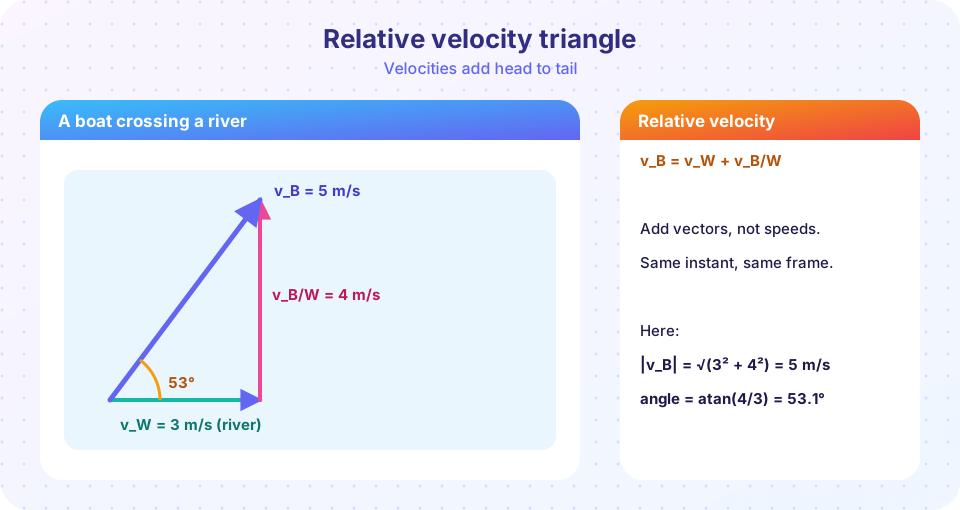
Worked example: a boat on a river. A river flows east at v_W = 3 m/s. A boat points north and moves at v_B/W = 4 m/s relative to the water. Then v_B = v_W + v_B/W = (3, 4) m/s, a speed of √(9 + 16) = 5 m/s at atan(4/3) = 53.1° north of east. Over a 200 m wide river, crossing takes 200/4 = 50 s, and the boat drifts 3 × 50 = 150 m downstream.
Cancelling the current
Suppose the boat can move at 5 m/s relative to the water and must go straight across. Aim upstream at angle φ from the north line so that the east-west components cancel: 5 sin φ = 3, φ = 36.9°. The crossing speed is 5 cos φ = 4 m/s, so a 200 m river takes 50 s with no drift. If the boat instead points straight across, it crosses in 200/5 = 40 s but drifts 3 × 40 = 120 m. Fastest crossing and straight crossing are different goals with different headings.
Aircraft and wind
An airplane has an airspeed of 200 km/h pointed north, with a wind of 50 km/h from the west (blowing east). Its ground velocity is (50, 200) km/h: speed √(2500 + 40000) = 206.2 km/h at atan(50/200) = 14.0° east of north. To fly due north the pilot must aim asin(50/200) = 14.5° west of north (the "crab angle"), which gives a ground speed of 200 cos 14.5° = 193.6 km/h.
Choosing a frame wisely
- Moving to the frame of one object can make it stationary and leave only the other moving, like two cars on a highway: in the frame of car A, car B just closes at the speed difference.
- For two bodies each moving at constant velocity, the closest approach is easiest in the relative frame: find
v_B/Aand the initial relative position, then find the shortest distance from the origin to the relative line.
Common misconceptions
"The speed relative to the water is the speed of the boat." The boat's ground speed is the vector sum; its speed through the water is only one leg of the triangle.
"Head straight at the target and you will get there." In a current you drift. You must aim upstream to cancel the drift.
"I can add speeds like scalars." Adding 3 and 4 gives 7 only if both are in the same direction.
Try it
First, an interactive river. Change the heading angle and see the ground path, the crossing time and the drift. Notice that the fastest crossing is at 0° (pointing straight across) but the straight crossing requires aiming upstream.
Second, solve the aircraft problem and the heading that cancels any crosswind.
Press Run (or Ctrl + Enter) to see the console output here.
No output.
Check your understanding
Quick check · 5 questions
of 5 answered You scored / 5 · perfect!
-
1. A boat moves 4 m/s north relative to water, in a river flowing 3 m/s east. Its speed over the ground is
The components are perpendicular, so the speed is √(3² + 4²) = 5 m/s. -
2. Two cars on a straight road: A at 25 m/s and B at 20 m/s, both east. The velocity of A relative to B is
v_A/B = v_A − v_B = 5 m/s east. -
3. To go straight across a river with a 3 m/s current using a boat of 5 m/s, you should aim
sin φ = 3/5 cancels the current. -
4. A coin is dropped inside a train moving at constant velocity. In the train's frame it falls
The train is an inertial frame; the horizontal velocities of train and coin are equal. -
5. Pointing straight across a river (no upstream angle), compared with the straight crossing, the crossing time is
All of the boat's speed goes across the river: 200/5 = 40 s instead of 50 s, at the price of a 120 m drift.
Summary
v_B = v_A + v_B/A: velocities add as vectors, andv_B/A = v_B − v_A.- Vector triangles solve river, wind and overtaking problems.
- Aiming to cancel a current costs speed; pointing straight across is quickest but drifts.
- The equation assumes the moving observer translates without rotating.
Next: Chapter 2 Review
Track your progress
Create a free account to tick off lessons and pick up where you left off on any device.
of Engineering Dynamics lessons completed