


















Lesson 7 of 47 · Kinematics of Particles
Rectilinear Motion
Solve straight-line motion problems: constant-acceleration equations, velocity-time graphs, and calculus methods for acceleration that depends on time or position.
The simplest motion is along a straight line: a train on a straight track, an elevator, a sprinter in the 100 m. One coordinate s is enough to say where the particle is. Even so, this case contains all the ideas of kinematics, and the equations you derive here show up everywhere else in the course.
What you will learn
- The three equations for constant acceleration and when each applies.
- How to read displacement and acceleration from a velocity-time graph.
- How to integrate when acceleration depends on time or on position.
- A reliable way to choose the right equation.
Key terms
Rectilinear motion: motion along a straight line.
Sign convention: a chosen positive direction; velocity and acceleration are positive or negative relative to it.
Uniform acceleration: acceleration constant in time.
Deceleration: acceleration opposite to the velocity (speed decreasing).
Constant acceleration
If a is constant, integrating a = dv/dt once gives v = v0 + a t, and integrating again gives s = s0 + v0 t + ½ a t². Eliminating t between them gives a third equation with no time in it:
| Equation | Missing quantity |
|---|---|
v = v0 + a t |
s |
s = s0 + v0 t + ½ a t² |
v |
v² = v0² + 2 a (s − s0) |
t |
Pick the equation that omits the quantity you neither know nor want. Write the knowns first, then the unknown, then choose.
Worked example. A car accelerates from 12 m/s to 28 m/s while covering 200 m. Find the acceleration and the time. The time is missing from the third equation, so a = (v² − v0²) / (2 Δs) = (784 − 144) / 400 = 1.6 m/s². Then t = (v − v0)/a = 16 / 1.6 = 10 s. Check: average speed 20 m/s over 10 s gives 200 m. ✓.
Reading a velocity-time graph
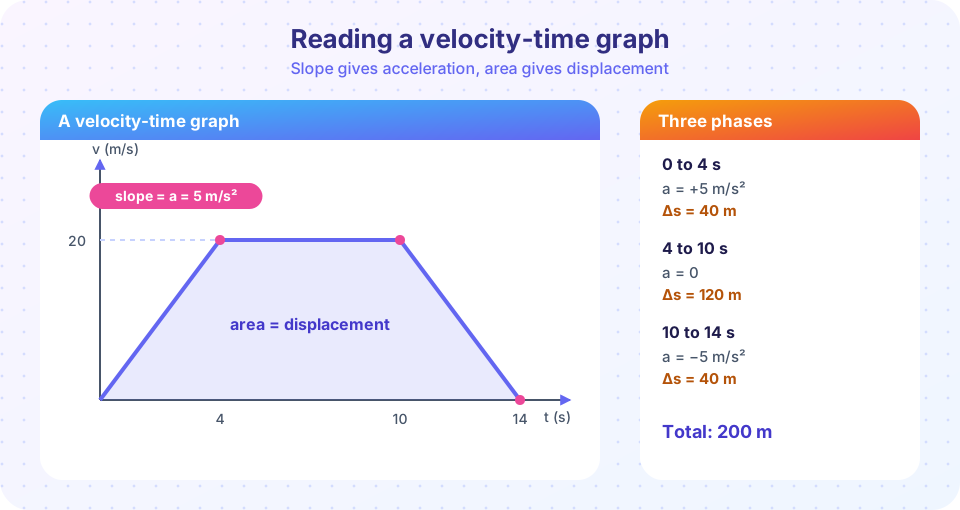
In the figure, the particle accelerates at 5 m/s² for 4 s (slope = 20/4), cruises at 20 m/s for 6 s, then slows at 5 m/s². The displacement is the area of the trapezoid: 40 + 120 + 40 = 200 m. Always count area below the time axis as negative displacement.
Variable acceleration
When acceleration is not constant, go back to the definitions.
Acceleration as a function of time, a(t). Integrate: v = v0 + ∫a dt, then s = s0 + ∫v dt.
Worked example. A particle starts at rest and has a = 6 − 0.6 t (m/s², t in s). Then v = 6 t − 0.3 t² and s = 3 t² − 0.1 t³. The acceleration is zero at t = 10 s, where v = 60 − 30 = 30 m/s (its maximum) and s = 300 − 100 = 200 m.
Acceleration as a function of position, a(s). Use the chain rule: a = v dv/ds, so v dv = a ds. For a spring-launched block with a = −k s / m, integrating v dv = a ds gives ½ v² = −(k/2m) s² + C, which is energy conservation in disguise (Chapter 4).
Acceleration as a function of velocity, a(v). Separate the variables: dt = dv / a(v). For drag-like a = −c v, you obtain exponential decay v = v0 e^(−c t).
Common misconceptions
"Deceleration means a negative acceleration." Only if the particle moves in the positive direction. A particle moving in −x and slowing down has a positive acceleration.
"The constant-acceleration equations always work." They fail the moment a changes, for instance when a car's driving force varies or drag grows with speed.
"Total distance equals the displacement." A ball thrown up and caught has a displacement of zero but traveled twice its maximum height.
Try it
First, a plot of the variable-acceleration example. The code integrates numerically and compares with the exact formulas.
Press Run (or Ctrl + Enter) to see the result here.
Program input · what you'd type while the program runs
Type the answers before you press Run, one per line. Each time the program reads a line (with input()), it gets the next line from this box.
Second, a constant-acceleration solver in JavaScript. Enter any combination that determines the motion and it prints all quantities.
Press Run (or Ctrl + Enter) to see the console output here.
No output.
Check your understanding
Quick check · 5 questions
of 5 answered You scored / 5 · perfect!
-
1. A car accelerates uniformly from rest at 3 m/s² for 8 s. How far does it travel?
s = ½ a t² = 0.5 × 3 × 64 = 96 m. -
2. Which equation should you use if you know v0, v and the distance, but not the time?
It is the equation without t. -
3. A particle has a(t) = 4 m/s² constant and starts from rest at s = 0. At t = 3 s its velocity and position are
v = 4 × 3 = 12 m/s, s = ½ × 4 × 9 = 18 m. -
4. The area under a velocity-time graph that lies below the time axis represents
Motion in the negative direction counts as negative displacement. -
5. If a = v dv/ds is integrated for a(s) = −2 s (SI), from v = 4 m/s at s = 0, the speed at s = 2 m is
v dv = −2 s ds gives ½ v² − 8 = −s², so v² = 16 − 2 s². At s = 2 m, v² = 8 and v = 2.83 m/s.
Summary
- For constant
a:v = v0 + a t,s = s0 + v0 t + ½ a t²,v² = v0² + 2 a Δs. - On a v-t graph, slope is acceleration and area is displacement.
- For variable
a, integrate the definitions:a(t)directly,a(s)throughv dv = a ds,a(v)by separating variables. - Choose the equation that omits the quantity you do not know and do not need.
Next: Projectile Motion
Track your progress
Create a free account to tick off lessons and pick up where you left off on any device.
of Engineering Dynamics lessons completed