


















Lesson 29 of 47 · Rigid Body Kinetics
Moment of inertia
Learn what moment of inertia means, how to derive it for a rod and a disk, use the parallel-axis theorem and radius of gyration, and handle composite bodies.
Mass tells you how hard it is to change the velocity of a body. The moment of inertia tells you how hard it is to change its spin. It depends on how much mass there is and, more strongly, on how far from the axis that mass lies. A bicycle wheel with its mass in the rim is harder to spin up than a solid disc of the same mass, which is exactly why flywheels have heavy rims and figure skaters pull in their arms to turn faster.
This lesson shows how to calculate I from its definition, how to use ready-made formulas, and how to move an axis or combine shapes.
What you will learn
- Define
I = ∫ r² dmand derive it for a thin rod and a disk. - Use standard formulas and the radius of gyration
k. - Apply the parallel-axis theorem
I = I_G + m d². - Compute
Iof composite bodies, including holes.
Key terms
Moment of inertia I: ∫ r² dm about a given axis, in kg·m².
Radius of gyration k: the distance at which all the mass would give the same I: I = m k².
Parallel-axis theorem: I = I_G + m d² for an axis parallel to the one through G.
Composite body: a body built from simple parts, possibly with removed parts (holes).
The definition
Divide a body into tiny pieces of mass dm, each at a distance r from the axis. The moment of inertia about that axis is
I = ∫ r² dm
The square makes distance far more important than amount. Moving a piece of mass from r to 2r makes its contribution four times larger. Notice also that I depends on the axis: the same body has a different I about different axes. Always say "about which axis".
Derivation: a thin rod about its center
A uniform rod of mass m and length L has mass per length m/L. A piece of length dx at position x (measured from the center) has dm = (m/L) dx, and r = x. Then
I_G = ∫ from −L/2 to L/2 of x² (m/L) dx = (m/L) · [x³/3] = (m/L)(L³/12) = m L² / 12
Derivation: a thin disk about its center axis
For a uniform disk of radius R and mass m, take a thin ring of radius r and width dr. Its mass is dm = (m/πR²)(2πr dr), and every point of it is at distance r:
I = ∫ from 0 to R of r² (2m/R²) r dr = (2m/R²)(R⁴/4) = ½ m R²
The ring is the simplest case: all its mass is at r = R, so I = m R². That is twice the disk's value, and the numbers explain the flywheel.
Common shapes
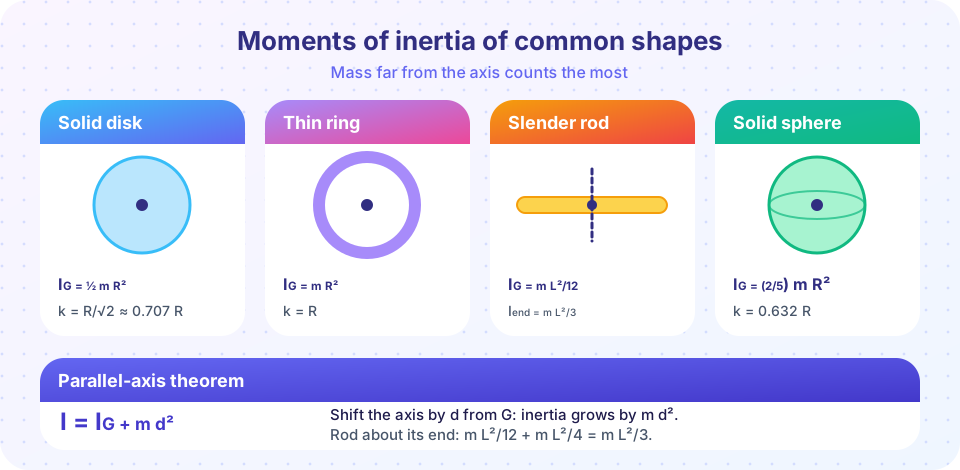
| Body | Axis | Moment of inertia |
|---|---|---|
| Thin ring (hoop) | Through center, perpendicular to plane | m R² |
| Solid disk or cylinder | Through center, along the axis | ½ m R² |
| Slender rod | Through center, perpendicular to rod | m L² / 12 |
| Slender rod | Through one end, perpendicular | m L² / 3 |
| Solid sphere | Through center | (2/5) m R² |
| Thin hollow sphere | Through center | (2/3) m R² |
Rectangular plate a × b |
Through center, perpendicular to plate | m (a² + b²) / 12 |
| Solid cone | Along its axis | (3/10) m R² |
Handbooks list many more. The three you will use most: disk (½mR²), rod (mL²/12) and the parallel-axis theorem.
The radius of gyration
It is often handy to write I = m k². For a solid disk, k = R/√2 ≈ 0.707 R. For a ring, k = R. Think of k as "the effective radius for rotation". Catalogs for motors and flywheels often give k instead of I.
The parallel-axis theorem
If you know I_G about an axis through the mass center, the moment about any parallel axis a distance d away is
I = I_G + m d²
The G axis always has the smallest I of all parallel axes. For the rod: I_end = m L²/12 + m (L/2)² = m L²/12 + m L²/4 = m L²/3. ✓ This agrees with the table.
Two cautions. First, the theorem links an axis through G with a parallel one; you cannot hop directly between two axes that both miss G (go through G in two steps). Second, do not add moments of inertia about different axes: only about the same axis.
Composite bodies
Split the body into pieces with known formulas. For each piece compute I_G,i about its own center, shift it to the common axis with m_i d_i², and add. Holes count as negative mass.
Worked example: a disk with a hole
A uniform disk of radius 0.30 m and mass 20 kg (before drilling) has a circular hole of radius 0.10 m with its center 0.15 m from the disk's center. Find I of the remaining plate about the center O of the original disk.
Full disk: I_full = ½ (20)(0.30)² = 0.900 kg·m².
The removed piece has mass proportional to area: m_hole = 20 (0.10/0.30)² = 2.222 kg. About its own center, I = ½ (2.222)(0.10)² = 0.01111 kg·m². Shift to O: + m d² = 2.222 × 0.15² = 0.05 kg·m². Total for the hole: 0.06111 kg·m².
Remaining plate: I = 0.900 − 0.06111 = 0.8389 kg·m², and its mass is 20 − 2.222 = 17.78 kg. The plate's mass center is no longer at O, but the number above is valid about O, which is what you need if the plate spins on a shaft there.
Common misconceptions
"Moment of inertia is a property of the body only." It also depends on the axis.
"A heavier body always has a larger I." Not if the mass is closer to the axis: a hollow tube can have a larger I than a heavier solid rod.
"Parallel-axis works between any two parallel axes." One of them must go through the mass center.
"Holes are ignored." Subtract their I, including the m d² term.
Try it
First, check the formulas numerically. The code fills each shape with many small equal masses and adds m r² for each, then compares with the formula. This is the definition of I, evaluated by brute force. The second plot shows how I of a rod grows as the axis moves away from the center.
Press Run (or Ctrl + Enter) to see the result here.
Program input · what you'd type while the program runs
Type the answers before you press Run, one per line. Each time the program reads a line (with input()), it gets the next line from this box.
The second calculator handles the plate with a hole from the worked example. Change the hole radius or offset and see how I and the mass change.
Press Run (or Ctrl + Enter) to see the result here.
Program input · what you'd type while the program runs
Type the answers before you press Run, one per line. Each time the program reads a line (with input()), it gets the next line from this box.
Check your understanding
Quick check · 5 questions
of 5 answered You scored / 5 · perfect!
-
1. A uniform rod has mass 3 kg and length 2 m. What is I about its center?
I = mL²/12 = 3 × 4/12 = 1 kg·m². -
2. Which has the larger moment of inertia: a thin ring or a solid disk with the same mass and radius?
Ring: mR². Disk: ½mR². All the ring's mass is at the full radius. -
3. The same rod (3 kg, 2 m) is spun about one end. I = ?
I = I_G + md² = 1 + 3 × 1² = 4 kg·m², which equals mL²/3. -
4. What does a radius of gyration of 0.2 m for a 10 kg wheel mean?
I = mk² = 10 × 0.04 = 0.4 kg·m². -
5. To compute I of a plate with a hole, what do you do with the hole?
Treat the hole as negative mass: subtract its contribution about the same axis.
Summary
I = ∫ r² dmdepends on the mass and on the axis; units kg·m².- Remember
½mR²(disk),mR²(ring),mL²/12(rod),(2/5)mR²(sphere). I = I_G + m d²moves the axis; theGaxis gives the minimum.- Build composite bodies by adding parts and subtracting holes, all about the same axis.
Track your progress
Create a free account to tick off lessons and pick up where you left off on any device.
of Engineering Dynamics lessons completed