


















Lesson 35 of 47 · Vibrations
Damped vibration
Learn underdamped, critically damped and overdamped responses, compute the damping ratio and damped frequency, and measure damping from a decay record.
Real vibrations die out. A struck bell rings for seconds, a car bounces once or twice after a bump, a door-closer lets the door settle without slamming. The mechanism that removes the energy is damping: friction, air drag, the fluid in a shock absorber, internal losses in a material.
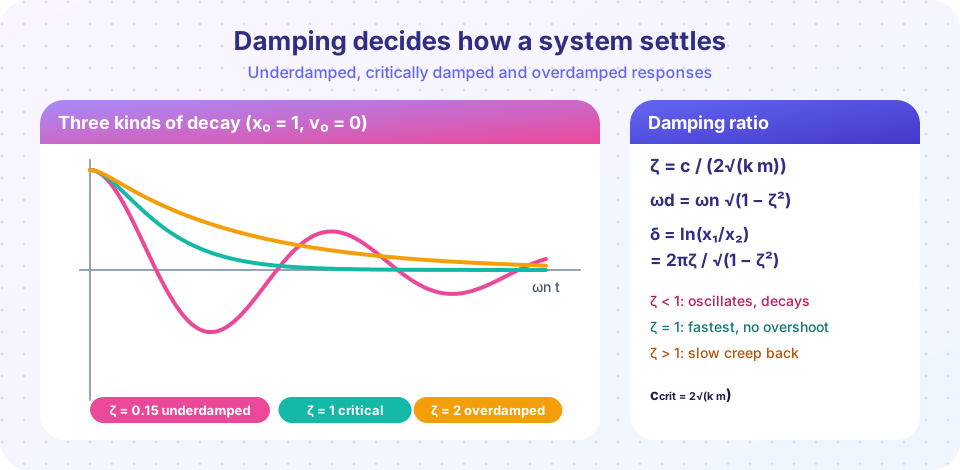
How fast the motion dies, and whether it overshoots, depends on a single dimensionless number, the damping ratio ζ. Learning to read and design it is the central skill of this lesson.
What you will learn
- Compute
ωn,ζandωdfromm,candk. - Recognize and write the three response types.
- Use the logarithmic decrement to measure damping.
- Estimate energy loss per cycle.
Key terms
Damping ratio ζ = c / (2√(k m)): damping relative to the critical value.
Critical damping c_cr = 2√(k m): the smallest damping at which the system does not oscillate.
Damped frequency ωd = ωn √(1 − ζ²): the frequency of the decaying oscillation.
Logarithmic decrement δ = ln(x₁/x₂): natural log of the ratio of successive peaks.
The equation
Divide m ẍ + c ẋ + k x = 0 by m:
ẍ + 2 ζ ωn ẋ + ωn² x = 0 with ωn = √(k/m), ζ = c / (2 √(k m))
Try x = e^(s t): the characteristic equation s² + 2ζωn s + ωn² = 0 has the roots s = −ζ ωn ± ωn √(ζ² − 1). Their nature sets the response.
Underdamped, ζ < 1. The roots are complex, the motion oscillates inside a decaying exponential envelope:
x(t) = e^(−ζ ωn t) [ x₀ cos ωd t + ((v₀ + ζ ωn x₀)/ωd) sin ωd t ]
The envelope is e^(−ζ ωn t); the oscillation frequency ωd is slightly below ωn. For ζ = 0.1 the reduction is only 0.5 %, so ωd ≈ ωn.
Critically damped, ζ = 1. A double root s = −ωn: x = (x₀ + (v₀ + ωn x₀) t) e^(−ωn t). It returns to equilibrium in the shortest time without crossing it (for a pull-and-release start). Door closers and gauge needles are designed near this value.
Overdamped, ζ > 1. Two real negative roots; the motion is a sum of two decaying exponentials and creeps back slowly. More damping makes the return slower, because the slow root approaches zero.
Worked example
A system has m = 2 kg, k = 800 N/m, c = 16 N·s/m. Then ωn = 20 rad/s, c_cr = 2√(800 × 2) = 80 N·s/m, so ζ = 16/80 = 0.2. The damped frequency is ωd = 20 √(1 − 0.04) = 19.60 rad/s, and T_d = 2π/ωd = 0.321 s. The amplitude shrinks by the factor e^(−ζ ωn T_d) = e^(−1.283) = 0.277 per cycle: about 28 % remains after one cycle, 8 % after two.
Logarithmic decrement
If you can record the vibration, you can find ζ without knowing c. The ratio of two peaks one period apart is
x₁ / x₂ = e^(ζ ωn T_d) → δ = ln(x₁/x₂) = 2π ζ / √(1 − ζ²)
Solving for ζ: ζ = δ / √(4π² + δ²). For small ζ, ζ ≈ δ/2π. Measuring over n cycles reduces noise: δ = (1/n) ln(x₀/x_n).
For example, suppose the peaks drop from 8.0 mm to 2.0 mm in 3 cycles. Then δ = ln(4)/3 = 0.462 and ζ = 0.462/√(39.48 + 0.21) = 0.073.
Energy lost per cycle
The energy is proportional to the amplitude squared, so the fraction lost in one cycle is 1 − e^(−2δ). With δ = 0.462 that is about 60 %: a lightly damped system can still lose most of its energy in a cycle.
Common misconceptions
"More damping always settles faster." Beyond critical damping, the response gets slower.
"Damping coefficient c alone tells you how damped it is." Compare it with c_cr: the same c is heavy for a small mass and light for a large one.
"The damped frequency equals the natural frequency." ωd = ωn √(1 − ζ²), always lower.
"The peaks fall linearly." They fall exponentially: a constant percentage per cycle.
Try it
Change the damping ratio and see the response. The black dashed curves are the exponential envelope.
The next program generates a synthetic decay record, finds the peaks, and recovers ζ from the logarithmic decrement, the way you would analyze a measured ring-down.
Press Run (or Ctrl + Enter) to see the result here.
Program input · what you'd type while the program runs
Type the answers before you press Run, one per line. Each time the program reads a line (with input()), it gets the next line from this box.
Check your understanding
Quick check · 5 questions
of 5 answered You scored / 5 · perfect!
-
1. A system has m = 10 kg, k = 1000 N/m and c = 100 N·s/m. What is ζ?
c_cr = 2√(1000 × 10) = 200 N·s/m, so ζ = 100/200 = 0.5. -
2. Which damping ratio gives the fastest return to equilibrium without overshoot?
Critical damping is the borderline: any less overshoots, any more is slower. -
3. With ζ = 0.6 and ωn = 10 rad/s, the damped frequency is:
ωd = 10 √(1 − 0.36) = 10 × 0.8 = 8 rad/s. -
4. Successive peaks are 10 mm and 5 mm. What is the logarithmic decrement?
δ = ln(10/5) = ln 2 = 0.693. -
5. Why is an overdamped system slow?
The root −ζωn + ωn√(ζ²−1) approaches zero as ζ grows.
Summary
ζ = c/(2√(km)); below 1 the system oscillates, at 1 it returns fastest, above 1 it creeps.ωd = ωn √(1 − ζ²); the envelope ise^(−ζ ωn t).δ = ln(x₁/x₂) = 2πζ/√(1 − ζ²)measures damping from a decay record.- More damping than critical makes the response slower, not faster.
Track your progress
Create a free account to tick off lessons and pick up where you left off on any device.
of Engineering Dynamics lessons completed