


















Lesson 2 of 47 · Getting Started
What Is Dynamics?
Learn what dynamics studies, how kinematics and kinetics differ, how Newton's three laws connect them, and work a braking-car example both ways.
Hold a ball at arm's length and let go. It falls, speeds up, hits the floor and bounces. Four centuries ago, that everyday scene stumped the best minds in Europe. Today we can predict the ball's path to a fraction of a millimeter. The subject that makes this possible is dynamics: the study of how forces change the motion of bodies.
In this lesson you meet the two halves of dynamics, Newton's three laws, and the central modeling choice behind everything that follows.
What you will learn
- The difference between kinematics and kinetics, and why both are needed.
- Newton's three laws in plain words and what each one lets you do.
- What an inertial reference frame is.
- How to solve one problem two ways, once using only motion and once using forces.
Key terms
Inertia: an object's tendency to keep its velocity; mass is its measure.
Net force: the vector sum of all forces acting on a body, written ΣF.
Acceleration: the rate of change of velocity, in m/s².
Inertial frame: a reference frame in which Newton's first law holds, one that is not itself accelerating.
Friction coefficient (μ): a number comparing the friction force with the normal force.
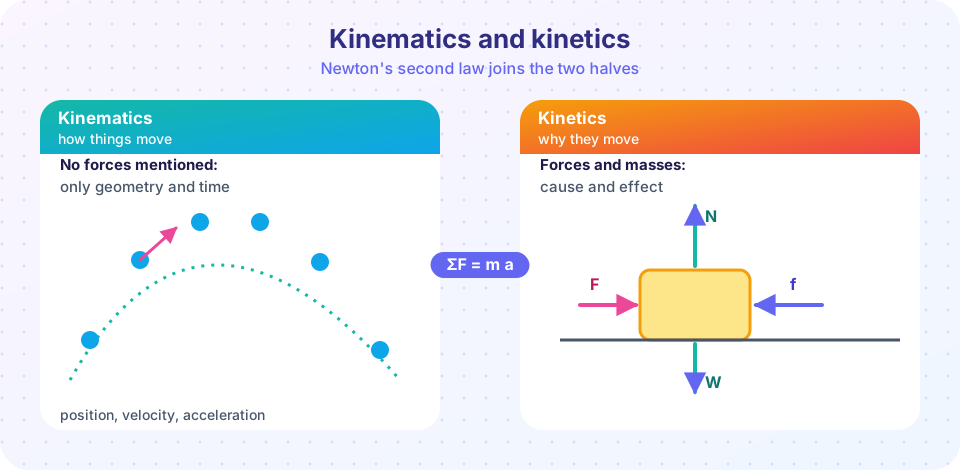
Two halves of one subject
Kinematics is geometry plus time. It describes where a body is, how fast it moves and how its speed changes, but it does not ask why. You can describe a car's trip perfectly using only a table of position against time.
Kinetics brings in the causes: forces and masses. It answers questions such as how hard a motor must push to reach 100 km/h in 8 seconds, or how much friction keeps a car on a bend.
You need both. Kinematics gives you the vocabulary and the equations that relate position, velocity and acceleration. Kinetics tells you what the acceleration actually is.
Newton's laws
Isaac Newton set out the foundations of mechanics in his Principia (1687), building on Galileo's experiments with falling bodies and rolling balls on ramps. The three laws, in modern words:
- First law (inertia). A body keeps its velocity (including rest) unless a net force acts on it.
- Second law. The net force on a body equals its mass times its acceleration:
ΣF = m a. Both sides are vectors. - Third law. When body A pushes on body B, B pushes back on A with an equal and opposite force. The two forces act on different bodies, so they never cancel in one free-body diagram.
The second law is the working equation of this course. Written out in components it becomes one scalar equation per axis: ΣFx = m ax and ΣFy = m ay.
Inertial frames
Newton's laws work in an inertial frame: a frame that is not accelerating or rotating. A laboratory fixed to the ground is, to a very good approximation, inertial for most engineering problems, even though the Earth rotates slowly. In a braking train, by contrast, a passenger feels thrown forward; that "force" is only the effect of using an accelerating frame. Unless we say otherwise, all motion in this course is measured from a ground frame.
One problem, two ways
A car travels at 25 m/s (90 km/h) and brakes hard until it stops.
Kinematic view. Suppose the car decelerates uniformly at 6.87 m/s². The stopping time is t = v / a = 25 / 6.87 = 3.64 s, and the distance is d = v² / (2a) = 625 / 13.74 = 45.5 m. We described the motion, but we do not know why the deceleration was 6.87.
Kinetic view. Dry asphalt gives tire friction with μ = 0.7. On a level road the friction force is at most μ m g, so the maximum deceleration is a = μ g = 0.7 × 9.81 = 6.87 m/s². The mass cancels, so a heavy truck and a small car with the same tire grip stop in the same distance. The kinetic view explained the number.
On a wet road with μ = 0.3, a = 2.94 m/s² and the same car needs d = 625 / 5.89 = 106 m. That is why wet roads demand longer gaps.
Common misconceptions
"The second law says force causes velocity." It says force causes acceleration. A constant velocity needs zero net force.
"Action and reaction cancel, so nothing can ever accelerate." They act on different bodies. Your shoe pushes back on the ground, and the ground pushes forward on you; only the second force acts on you.
"Heavier objects fall faster." Without air drag, all objects accelerate downward at the same rate near the Earth's surface (about 9.81 m/s²), because weight and inertia both scale with mass.
Try it
First, explore stopping distance. The formula d = v² / (2 μ g) has the speed squared, so doubling the speed quadruples the distance. The plot compares dry and wet roads.
Press Run (or Ctrl + Enter) to see the result here.
Program input · what you'd type while the program runs
Type the answers before you press Run, one per line. Each time the program reads a line (with input()), it gets the next line from this box.
Second, a console script that does the kinematic and kinetic calculations side by side. Change the friction coefficient to see the effect.
Press Run (or Ctrl + Enter) to see the console output here.
No output.
Check your understanding
Quick check · 5 questions
of 5 answered You scored / 5 · perfect!
-
1. Which statement is about kinematics rather than kinetics?
Kinematics describes motion (speeds and times) without referring to forces. -
2. A 1,000 kg car and a 2,000 kg truck have the same tire friction coefficient and start braking at the same speed on a level road. Compared with the car, the truck's stopping distance is
a = μg does not depend on mass, so the distance v²/(2μg) is the same. -
3. Which law explains why a rocket accelerates by throwing exhaust backward?
The rocket pushes the exhaust back; the exhaust pushes the rocket forward with an equal force on a different body, and ΣF = m a gives the resulting acceleration. -
4. A car doubles its speed from 15 to 30 m/s. With the same friction, its braking distance becomes
d = v²/(2μg), so doubling v multiplies d by 2² = 4. -
5. Why do the action and reaction forces in the third law not cancel?
Cancellation only happens between forces on the same body.
Summary
- Dynamics = kinematics (how it moves) + kinetics (why it moves).
- Newton's second law,
ΣF = m a, is a vector equation and the core tool of kinetics. - The laws hold in inertial frames; for most problems the ground is good enough.
- Stopping distance
d = v² / (2 μ g)is independent of mass and grows with the square of speed.
Track your progress
Create a free account to tick off lessons and pick up where you left off on any device.
of Engineering Dynamics lessons completed