


















Lesson 14 of 47 · Kinetics: Force and Acceleration
Circular Motion and Banked Curves
Write the normal-tangential equations of motion for flat and banked curves, conical pendulums, hills and vertical loops, with worked numbers and simulations.
Why does a car stay on a bend? Why do racetracks tilt at the corners? Why do you feel pushed to the side when a bus turns? In Chapter 2 you learned that moving along a curve means accelerating toward the center of curvature with a_n = v²/ρ. Newton's second law then says that something must push the object inward with a net force m v²/ρ. This lesson finds that something in each situation.
What you will learn
- The equations of motion in normal-tangential axes.
- How friction and banking supply the inward force on a curve.
- How to find the maximum safe speed on flat and banked curves.
- How to handle conical pendulums, hill crests and vertical circles.
Key terms
Centripetal force: the net inward force on an object moving in a circle, equal to m v²/r. It is a role played by real forces (friction, tension, gravity, the normal force), not an extra force.
Banking angle θ: the tilt of the road surface toward the center of the curve.
Conical pendulum: a mass on a string moving in a horizontal circle.
Apparent outward force: the "centrifugal" feeling, which is really inertia seen from the rotating frame.
Equations of motion in n-t axes
ΣF_t = m dv/dt and ΣF_n = m v²/ρ
The normal axis points toward the center. Any force component along it counts as positive. A free-body diagram does not change: draw the real forces; only the equations use m v²/ρ.
Flat curve
On a flat road the only horizontal force is friction. The most friction available is μs N = μs m g. So
μs m g ≥ m v²/r, giving v_max = √(μs g r).
For r = 100 m and μs = 0.7: v_max = √(0.7 × 9.81 × 100) = 26.2 m/s (94 km/h). The mass cancels. On a wet road with μs = 0.3, v_max = 17.2 m/s (62 km/h). Tires are rated for static friction here: a skidding tire has already lost grip.
Banked curve
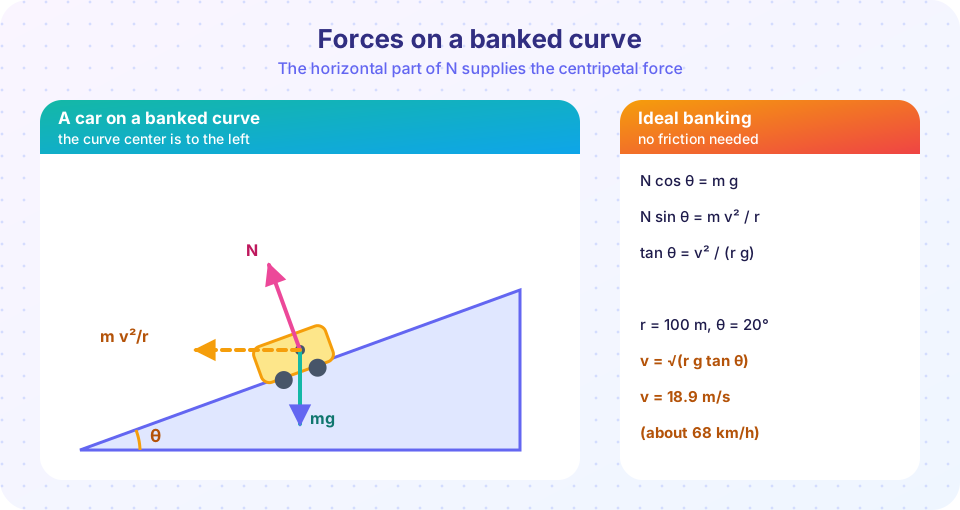
Tilt the road by θ. The normal force now has a horizontal component toward the center.
- Vertical:
N cos θ = m g - Horizontal (inward):
N sin θ = m v²/r
Dividing: tan θ = v²/(r g). This is the design speed: at v = √(r g tan θ) no friction is needed at all. For r = 100 m and θ = 20°, v = √(981 × 0.364) = 18.9 m/s (68 km/h).
With friction μ (limit of sliding up the bank):
v_max = √( r g (tan θ + μ) / (1 − μ tan θ) ).
With μ = 0.3: (0.364 + 0.3)/(1 − 0.109) = 0.745, so v_max = √(100 × 9.81 × 0.745) = 27.0 m/s (97 km/h). Banking raised the safe speed from 26.2 on the flat (with μ = 0.7) to 27.0 even though friction is lower. And on a banked road in ice, friction μ ≈ 0 still allows exactly v_design.
Other circular cases
Conical pendulum
A mass on a string of length L swings in a horizontal circle with the string at angle θ to the vertical. Vertical: T cos θ = m g. Inward: T sin θ = m ω² r, with r = L sin θ. So ω² = g/(L cos θ), and the period is 2π √(L cos θ / g). For L = 1 m and θ = 30°: ω = 3.37 rad/s, period = 1.87 s.
Crest of a hill
At the top of a hill of radius r, the weight points toward the center and the normal force away from it: m g − N = m v²/r, so N = m (g − v²/r). When v = √(g r) the normal force becomes zero: the car leaves the road. A hill of 50 m radius gives √(9.81 × 50) = 22.1 m/s. This is why bumps at speed make cars "fly".
Vertical circle
For a bucket or ball on a string swung in a vertical circle, at the top both weight and tension point inward: T + m g = m v²/r. The string goes slack when T = 0, so the minimum speed at the top is √(g r). For r = 5 m, that is 7.0 m/s.
Common misconceptions
"Centrifugal force pushes the car outward." In the ground frame there is no such force. The car's inertia wants to continue straight, and the road must supply the inward push. The outward feeling is inertia.
"If the string breaks, the ball flies off outward." It moves along the tangent, in a straight line, at the speed it had.
"Centripetal force must be added to the free-body diagram." It is the sum of the real forces along the inward axis.
Try it
First, the maximum speed on a banked curve for several friction values. The dashed line marks the frictionless design speed.
Press Run (or Ctrl + Enter) to see the result here.
Program input · what you'd type while the program runs
Type the answers before you press Run, one per line. Each time the program reads a line (with input()), it gets the next line from this box.
Second, a calculator for the conical pendulum, the hill crest and the vertical circle.
Press Run (or Ctrl + Enter) to see the console output here.
No output.
Check your understanding
Quick check · 5 questions
of 5 answered You scored / 5 · perfect!
-
1. A car takes a flat curve of radius 50 m with μs = 0.8. The maximum speed (g = 9.81 m/s²) is
v = √(μ g r) = √(0.8 × 9.81 × 50) = √392 = 19.8 m/s. -
2. On an icy banked road (friction ≈ 0), a car at exactly the design speed
At v = √(r g tan θ) the horizontal part of N alone supplies m v²/r. -
3. The normal force on a car crossing a hill crest at speed v (radius r) is
Weight inward minus N outward equals m v²/r. -
4. At what minimum speed must a ball at the top of a vertical circle of radius 2 m move so the string stays taut?
v = √(g r) = √19.62 = 4.43 m/s. -
5. Centripetal force is
It names the role played by the real forces.
Summary
- n-t equations:
ΣF_n = m v²/ρtoward the center,ΣF_t = m dv/dt. - Flat curve:
v_max = √(μs g r); banked:tan θ = v²/(r g)at the design speed. - Conical pendulum:
ω² = g/(L cos θ); hill crest:N = m (g − v²/r); vertical circle top:v ≥ √(g r). - Centripetal force is the net inward force, not a new kind of force.
Next: Drag and Variable Forces
Track your progress
Create a free account to tick off lessons and pick up where you left off on any device.
of Engineering Dynamics lessons completed