


















Lesson 34 of 47 · Vibrations
Free undamped vibration
Derive the natural frequency of a mass-spring system, solve for amplitude from initial conditions, and extend the result to pendulums and torsional systems.
Pull a mass on a spring and let go. It oscillates up and down, again and again. This is the simplest vibration: no damping, no outside force. It is also the foundation of everything else in this chapter, because every more complex case adds a term to this one.
The result is beautifully simple: the motion is a cosine, and its frequency depends only on the stiffness and the mass, not on how far you pulled. That independence from amplitude is what makes pendulum clocks and quartz watches possible.
What you will learn
- Derive
ωn = √(k/m)from Newton's law. - Find amplitude and phase from the initial displacement and velocity.
- Handle vertical springs, springs in series and parallel, and pendulums.
- Use energy to find
ωnquickly.
Key terms
Simple harmonic motion: motion x = A cos(ωn t − φ).
Amplitude A: the largest displacement from equilibrium.
Period T and frequency f: T = 1/f = 2π/ωn.
Static deflection δ_st = m g / k: the sag of a spring under a weight.
The equation and its solution
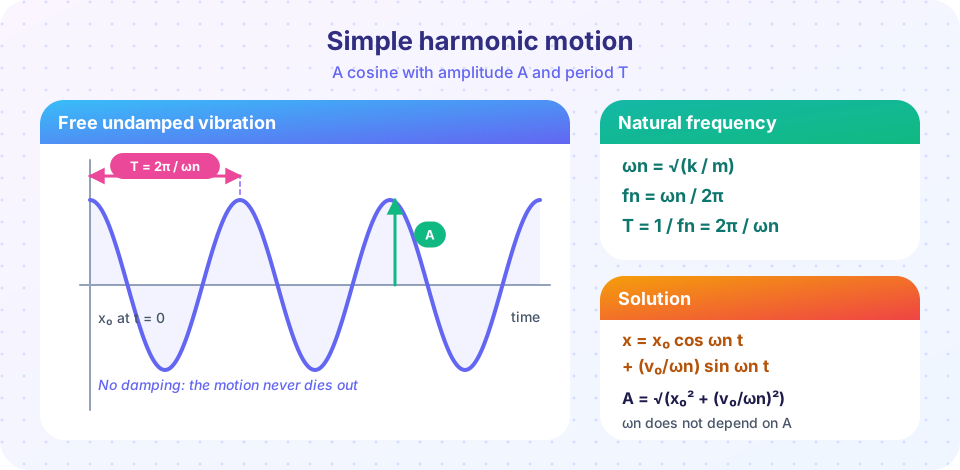
With no damping and no force, m ẍ + k x = 0, or ẍ + ωn² x = 0 with ωn = √(k/m). The general solution is
x(t) = x₀ cos ωn t + (v₀/ωn) sin ωn t
where x₀ and v₀ are the displacement and velocity at t = 0. The same motion can be written x = A cos(ωn t − φ) with
A = √(x₀² + (v₀/ωn)²) tan φ = v₀ / (ωn x₀)
The period is T = 2π/ωn and the frequency in hertz f_n = ωn/2π. Notice what is missing: ωn does not contain A. A big oscillation and a small one take the same time per cycle. A mass of 2 kg on k = 800 N/m has ωn = √400 = 20 rad/s, so f = 3.18 Hz and T = 0.314 s. If you pull it by x₀ = 0.05 m and push it with v₀ = 1 m/s, the amplitude is A = √(0.05² + (1/20)²) = 0.0707 m.
Where gravity went
Hang a mass on a vertical spring. At equilibrium the spring is stretched by δ_st = m g/k and the spring force balances the weight. Measure x from this equilibrium position. At displacement x the spring force is k(δ_st + x), and Newton's law is m ẍ = m g − k(δ_st + x) = −k x. The weight cancelled against the static stretch, so the equation is the same as for a horizontal spring. A neat consequence: because m/k = δ_st/g,
ωn = √(g / δ_st) fn ≈ 0.498 / √δ_st (δ_st in meters)
A system whose spring sags 10 mm under its own weight has fn ≈ 5 Hz; to get a 1 Hz natural frequency you need a static deflection of about 250 mm. You can measure fn with a ruler.
Springs in series and parallel
- Parallel (both springs stretch the same amount):
k = k₁ + k₂. - Series (springs share the force):
1/k = 1/k₁ + 1/k₂.
A beam, a rod and a rubber mount all act as springs. For a cantilever beam with a tip load, k = 3EI/L³. For a rod in tension, k = EA/L. For torsion of a shaft, k_t = GJ/L and the natural frequency is √(k_t/J_mass).
Pendulums and other rotating systems
For rotation the equation is I θ̈ + k_t θ = 0, and ωn = √(k_t/I).
A simple pendulum of length L has restoring moment m g L sin θ ≈ m g L θ for small angles, and I = m L², so ωn = √(g/L) and T = 2π √(L/g). For L = 1 m, T = 2.006 s.
A physical pendulum (any rigid body swinging about a pivot at distance d from G) has ωn = √(m g d / I_O). A uniform rod pivoted at one end has d = L/2 and I_O = mL²/3, so ωn = √(3g/(2L)). For L = 1 m this is 3.84 rad/s and T = 1.64 s, shorter than the simple pendulum of the same length because the mass is spread along the rod.
The energy method
An undamped system conserves energy: T_kin + V = constant. For a mass on a spring, ½ m ẋ² + ½ k x² = const. Differentiating gives the equation of motion. Better, for a complicated system you can find the maximum kinetic energy ½ m_eq v_max² and maximum potential energy ½ k_eq x_max², set them equal (Rayleigh's method) and with v_max = ωn x_max get ωn = √(k_eq/m_eq). This avoids drawing a free-body diagram. It is the standard way to estimate the frequency of a beam with a mass on it.
Common misconceptions
"A bigger pull makes the oscillation slower." For a linear spring the period is independent of amplitude.
"Gravity changes ωn of a vertical spring." It only moves the equilibrium position.
"The pendulum formula 2π√(L/g) holds for any angle." It is a small-angle result; larger swings take longer (see the demo below).
"Springs in series are stiffer." They are softer: k is smaller than either spring.
Try it
First see how energy moves between the spring and the mass. The total stays constant; the kinetic and potential energies trade places twice per period.
Press Run (or Ctrl + Enter) to see the result here.
Program input · what you'd type while the program runs
Type the answers before you press Run, one per line. Each time the program reads a line (with input()), it gets the next line from this box.
The small-angle formula for the pendulum is only an approximation. This calculation uses the exact period (via the complete elliptic integral K) to show how much the period grows with amplitude.
Press Run (or Ctrl + Enter) to see the result here.
Program input · what you'd type while the program runs
Type the answers before you press Run, one per line. Each time the program reads a line (with input()), it gets the next line from this box.
Check your understanding
Quick check · 5 questions
of 5 answered You scored / 5 · perfect!
-
1. A 0.5 kg mass on a spring of 50 N/m has period:
ωn = √(50/0.5) = 10 rad/s, T = 2π/10 = 0.628 s. -
2. A mass hung on a spring stretches it 4 mm at equilibrium. The natural frequency is about:
fn = 0.498/√0.004 ≈ 7.9 Hz. -
3. Two identical springs of stiffness k are connected in series. The combination has stiffness:
1/k_eq = 1/k + 1/k = 2/k, so k_eq = k/2. -
4. Initial conditions x₀ = 0 and v₀ = 2 m/s with ωn = 10 rad/s give amplitude:
A = v₀/ωn = 0.2 m. -
5. What happens to ωn if the pull distance doubles (linear spring)?
ωn = √(k/m) does not contain the amplitude.
Summary
m ẍ + k x = 0givesωn = √(k/m)andx = x₀ cos ωn t + (v₀/ωn) sin ωn t.A = √(x₀² + (v₀/ωn)²),T = 2π/ωn; amplitude does not change the period.- Gravity only shifts equilibrium:
ωn = √(g/δ_st). - Rotational systems and pendulums follow the same form with
Iandk_t.
Next: Damped vibration
Track your progress
Create a free account to tick off lessons and pick up where you left off on any device.
of Engineering Dynamics lessons completed