


















Lesson 23 of 47 · Rigid Body Kinematics
Chapter 5 overview: motion of rigid bodies
From points to bodies: see how translation, rotation about a fixed axis and general plane motion fit together before you learn the tools in chapter 5.
So far you have treated a moving object as a single point. That works for a ball in flight, but it fails for a wheel, a door, a connecting rod or a crane boom. These objects have a size and an orientation, and different points on them move differently. A point on the rim of a spinning wheel has a large velocity. A point near the axle hardly moves. Yet the wheel is one object.
The key idea of this chapter is the rigid body: an object whose points always stay the same distance from one another. Real objects deform a little, but for machines the deformation is tiny compared with the motion, so the rigid model is excellent. It turns a body with millions of moving points into one with just three numbers to track in a plane.
What you will learn
- Define a rigid body and count its degrees of freedom in a plane.
- Tell translation, fixed-axis rotation and general plane motion apart.
- See why general plane motion is "translation plus rotation".
- Know which tool solves which kind of problem in this chapter.
Key terms
Rigid body: an idealized object whose points keep fixed distances from each other.
Degrees of freedom: the number of independent coordinates needed to describe the position of a system.
Translation: motion in which every line in the body keeps its direction.
Rotation: motion in which the body turns; angle and angular velocity describe it.
Plane motion: all points move in parallel planes, so the motion can be drawn on a flat page.
Three numbers describe a body in a plane
A single particle in a plane needs two coordinates, x and y. A rigid body needs a third number, its orientation angle θ. Pick any reference point on the body, for example its mass center G. Then (x_G, y_G, θ) fixes where every other point is. Engineers say a rigid body in plane motion has three degrees of freedom. Each constraint, such as a pin or a wheel that must stay on the ground, removes one of them.
This counting is more useful than it looks. A wheel rolling without slipping has only one degree of freedom left: if you know how far it has turned, you know everything. That is why v = ωR will appear so often.
Three kinds of motion
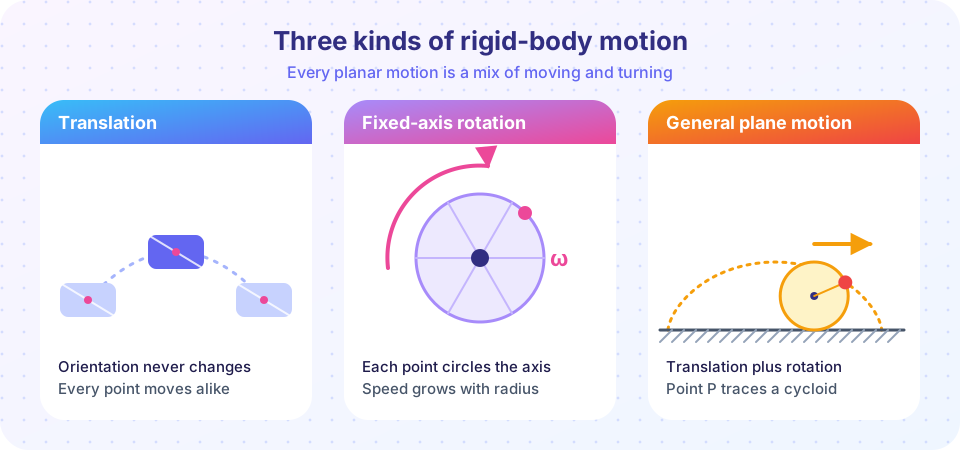
Translation. Every point has the same velocity and the same acceleration at every instant. The body does not turn. A car going around a flat bend is not in translation (it turns), but the seat of a Ferris wheel is: it moves along a circle, yet it never changes its orientation. That second case is called curvilinear translation. Straight-line motion is rectilinear translation.
Rotation about a fixed axis. One line in the body (the axis) stays still. Every other point moves on a circle around it. Ceiling fans, flywheels and the crank of a bicycle are examples. You will study this in rotation about a fixed axis.
General plane motion. The body both translates and rotates, with no fixed axis. A rolling wheel, a ladder sliding down a wall and a connecting rod in an engine are the standard examples. Chasles' theorem, named after the French mathematician Michel Chasles, says that any displacement of a rigid body in a plane can be built from one translation plus one rotation. You can pick the translation to follow any point you like. Engineers usually choose a point whose motion is easy, such as a pinned end or the mass center.
The tools of this chapter
| Situation | Tool | Lesson |
|---|---|---|
| One point stays fixed (a pin, an axle) | v = ωr, a_t = αr, a_n = ω²r |
Rotation about a fixed axis |
| You know the motion of one point and want another | Relative velocity: v_B = v_A + ω × r |
Relative velocity |
| You want a quick picture of the velocities, or the body rolls | Instant center of zero velocity and relative acceleration | Instant center and acceleration |
| You want to check what you learned | Summary and ten-question quiz | Chapter review |
Rigid means fixed shape
Three kinds of motion
Pick the right tool
Try it
The first demo lets you roll a wheel by dragging a slider. The red dot is a point on the rim. Its velocity arrow is the sum of the center's velocity and the spin. At the contact point the two cancel exactly.
The second demo plots the path of a rim point of a wheel with radius 0.3 m. This curve is a cycloid. Notice how it touches the ground with a sharp point: for an instant the point is at rest.
Press Run (or Ctrl + Enter) to see the result here.
Program input · what you'd type while the program runs
Type the answers before you press Run, one per line. Each time the program reads a line (with input()), it gets the next line from this box.
Common misconceptions
"A rigid body has one velocity." It has one velocity at each point. Only in pure translation are they all equal.
"Rotation needs an axle." A thrown baton rotates about its mass center with nothing holding it. The rotation is still described by one angular velocity for the whole body.
"Rolling means the top is moving at the speed of the center." The top moves at twice the center speed (when rolling without slipping), and the contact point is momentarily at rest.
Check your understanding
Quick check · 4 questions
of 4 answered You scored / 4 · perfect!
-
1. How many degrees of freedom does a rigid body have in plane motion?
Two coordinates for a reference point plus one orientation angle give three. -
2. A Ferris wheel seat stays upright while it circles the axle. What kind of motion is this?
The seat keeps its orientation, so it translates, but along a curved path. -
3. A wheel rolls without slipping at center speed v. How fast is the top point moving?
The top point has the center velocity plus the same amount from the spin, so 2v. -
4. Chasles' theorem says any plane displacement of a rigid body is equivalent to:
That decomposition is the basis of relative-velocity analysis.
Summary
- A rigid body keeps all point-to-point distances; in a plane it has three degrees of freedom.
- The three kinds of plane motion are translation, fixed-axis rotation and general plane motion.
- General plane motion is translation of a chosen point plus rotation about it.
- The rest of the chapter gives three tools: fixed-axis formulas, relative velocity and the instant center.
Track your progress
Create a free account to tick off lessons and pick up where you left off on any device.
of Engineering Dynamics lessons completed