


















Lesson 28 of 47 · Rigid Body Kinetics
Chapter 6 overview: forces and moments on rigid bodies
See the big picture of rigid body kinetics: why a force at an offset both pushes and spins a body, and how two equations govern plane motion.
Chapter 5 described how rigid bodies move. This chapter asks why. If you kick the center of a football, it flies straight. If you kick off-center, it flies off and spins. The force is the same; the motion is not. Kinetics gives a precise answer: forces decide where the mass center goes, and moments decide how the body turns.
The reward for learning this is large. With two equations and one new property, the moment of inertia, you can predict how fast a wheel accelerates, how hard a bearing is loaded, how a crane boom swings and how long a motor takes to spin up a rotor.
What you will learn
- State the two equations of plane motion and what each one controls.
- Explain why a force through the mass center only translates, and an offset force also rotates.
- Draw a free-body diagram and a kinetic diagram for a rigid body.
- Know what each lesson in this chapter adds.
Key terms
Kinetics: the study of how forces and moments cause motion.
Mass center (G): the point where the body's mass acts as if concentrated for translation.
Moment of inertia (I): a body's resistance to angular acceleration about a given axis, in kg·m².
Kinetic diagram: a sketch showing m a_G and I_G α on the right-hand side of the equations.
Two equations for plane motion
For a rigid body in plane motion, Newton's laws reduce to these:
ΣF_x = m (a_G)_x
ΣF_y = m (a_G)_y
ΣM_G = I_G α
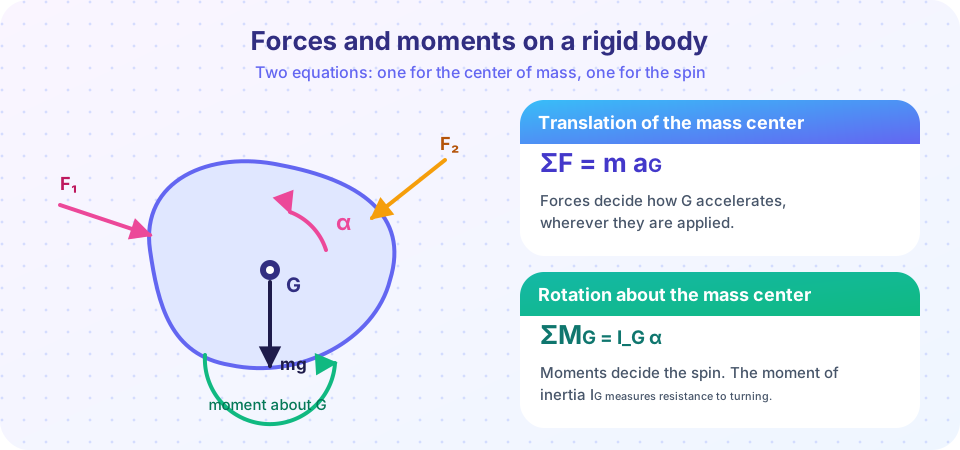
The first two are translation of the mass center: it moves as if all the mass sat at G and all the forces acted there, whatever the points of application are. The third is rotation about the mass center: only the moments of the forces about G matter, and I_G converts torque into angular acceleration, just as m converts force into acceleration. You can see the pattern: F ↔ M, m ↔ I, a ↔ α.
Two details save you from errors. Moments are added about G (or about a fixed pin, see planar equations of motion). And the sum on the left includes every force and couple: weight, contact forces, friction, spring and applied torques.
An example in words
A uniform bar of mass 2 kg and length 1 m lies on smooth ice. You push it with a 10 N force perpendicular to the bar. If the line of the force passes through G, then ΣM_G = 0, so α = 0 and the bar slides straight with a_G = 10/2 = 5 m/s². If the push is 0.25 m from G, the center still accelerates at 5 m/s² (the same force, the same mass), but now ΣM_G = 10 × 0.25 = 2.5 N·m and I_G = mL²/12 = 0.1667 kg·m², so α = 15 rad/s². The bar translates and spins at the same time. That the translation did not change is the key insight.
Free-body and kinetic diagrams
A reliable habit: draw two pictures side by side.
- The free-body diagram (FBD) shows the body alone with every external force and couple.
- The kinetic diagram shows the vectors
m a_G(atG) and the coupleI_G α. These are not forces; they are the "result" side of the equations.
The equations then say: FBD = kinetic diagram. Equate components for forces, and moments about any point. Taking moments about a clever point, for example where two unknown forces meet, removes unknowns from the equation.
Forces move the mass center
Moments spin the body
This chapter
What each lesson adds
| Lesson | New idea |
|---|---|
| Moment of inertia | How to calculate I for shapes, use the parallel-axis theorem and combine parts |
| Planar equations of motion | Solve problems with rolling, pulleys and pivoting bars |
| Energy and momentum | T = ½mv² + ½Iω², work of a couple, angular momentum and impulse |
| Chapter review | One-page summary and mixed quiz |
Common misconceptions
"A force away from G only rotates the body." It also accelerates G, exactly as much as a force through G.
"Angular momentum and torque need an axle." They are defined for any body; the equations about G hold for a free body.
"m a_G is a force." It is the kinetic side of the equation, not an extra force to draw on the FBD.
Try it
Push a bar with a force at any distance from its mass center. The animation shows the center rising with the same acceleration no matter where you push. Only the spin changes.
This script computes the same bar for several offsets and plots its angle over time. The mass-center acceleration is the same in all four cases.
Press Run (or Ctrl + Enter) to see the result here.
Program input · what you'd type while the program runs
Type the answers before you press Run, one per line. Each time the program reads a line (with input()), it gets the next line from this box.
Check your understanding
Quick check · 4 questions
of 4 answered You scored / 4 · perfect!
-
1. A force acts on a free body at a point away from G. What happens to the acceleration of G?
ΣF = m a_G does not contain the point of application. -
2. Which equation gives the angular acceleration of a free body?
The moments about G divided by I_G give α. -
3. A bar with I_G = 0.2 kg·m² has a net moment about G of 3 N·m. What is α?
α = ΣM_G / I_G = 3/0.2 = 15 rad/s². -
4. What is the kinetic diagram used for?
FBD = kinetic diagram is the central idea of the method.
Summary
ΣF = m a_Gcontrols the mass center;ΣM_G = I_G αcontrols the spin.- Where a force acts does not change
a_G, only the moment. - Draw an FBD and a kinetic diagram, then equate them.
- Next you need
I: how to compute it for real shapes.
Next: Moment of inertia
Track your progress
Create a free account to tick off lessons and pick up where you left off on any device.
of Engineering Dynamics lessons completed