


















Lesson 26 of 47 · Rigid Body Kinematics
Instant center and relative acceleration
Use the instantaneous center of zero velocity to read a body's motion at a glance, then learn the relative acceleration equation and why the IC has acceleration.
The relative velocity equation always works, but it takes algebra. There is a quicker way to see how a body is moving at one instant. For any plane motion with ω ≠ 0, there is exactly one point on the body (or on its extension) whose velocity is zero right now. Around that point, the body is turning as if it were hinged there. Every other point moves perpendicular to its line to that point, with a speed proportional to the distance.
That point is the instantaneous center of zero velocity, usually written IC. It is a tool for velocities only. This lesson then adds the second half of the story: accelerations of points on a rigid body, where the IC loses its magic.
What you will learn
- Locate the IC from two velocity directions and use
v = ω d. - Explain why a rolling wheel's contact point is its IC.
- Write the relative acceleration equation
a_B = a_A + α × r − ω² r. - Show that the IC has zero velocity but not zero acceleration.
Key terms
Instant center (IC): the point of a body (or its extension) with zero velocity at this instant.
Rolling without slipping: the contact point does not slide on the ground; its velocity equals the ground's.
Relative acceleration a_(B/A): acceleration of B relative to A in a non-rotating frame at A, made of a tangential and a normal part.
Finding the IC
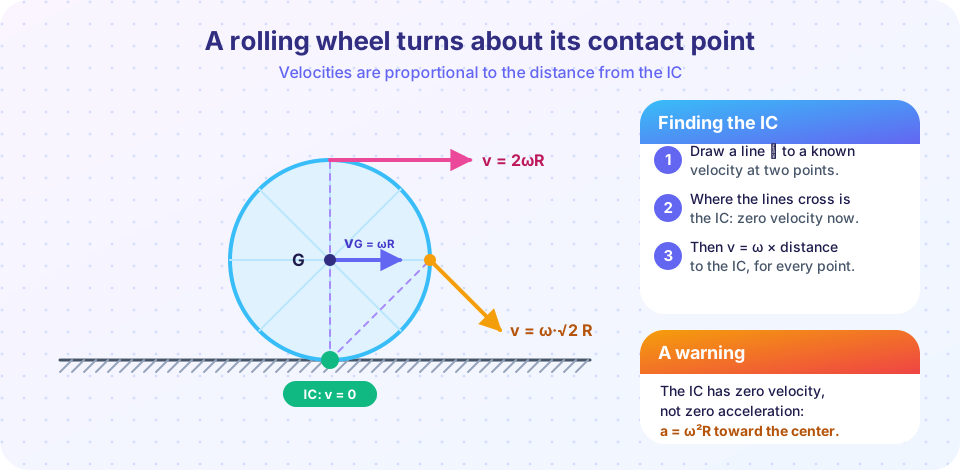
The velocity of a point is v = ω × (r from the IC), so it is perpendicular to the line from the IC. The reverse is the construction you use:
- Draw a line through a point with a known velocity direction, perpendicular to that velocity.
- Do the same at a second point.
- The two lines cross at the IC.
- If the velocity of one point is known,
ω = v/d, wheredis its distance to the IC. Then every other speed isωtimes its own distance.
If the perpendiculars are parallel and never meet, the IC is at infinity: that is instantaneous translation, as in the piston at the 90° position of the relative velocity lesson.
Worked example: the ladder again
The ladder from the previous lesson (L = 2.0 m, φ = 60°, v_A = 1.5 m/s) has the IC where the vertical through A meets the horizontal through B. That is directly above A at height 1.732 m. So d_A = 1.732 m and ω = 1.5/1.732 = 0.866 rad/s. The distance of B from the IC is 1.0 m, so v_B = 0.866 × 1.0 = 0.866 m/s. Same answer, no equations.
Even better, you now see directions at a glance: B must move in a direction perpendicular to the line from the IC, which is vertical, and since A moves right, B must move down.
Rolling wheels
If a wheel rolls on the ground without slipping, the contact point C has the same velocity as the ground, which is zero. So C is the IC. The center G is at distance R from it, so v_G = ωR. The top point is at 2R, so v_top = 2ωR = 2v_G. A point at the three o'clock position is at distance √2 R, so its speed is √2 ωR, directed perpendicular to its line to C.
Relative acceleration
Differentiate v_B = v_A + ω × r_(B/A) once more:
a_B = a_A + α × r_(B/A) + ω × (ω × r_(B/A))
For plane motion, ω × (ω × r) = −ω² r, so:
a_B = a_A + α × r_(B/A) − ω² r_(B/A)
The two relative terms have clear meanings:
α × r: the tangential part, magnitudeα · AB, perpendicular toAB.−ω² r: the normal part, magnitudeω² · AB, directed from B toward A.
Two things differ from the velocity case. The body now needs α too (an extra unknown), and a point that has zero velocity can still have acceleration. In components with r_(B/A) = (x, y): a_B = a_A + α(−y, x) − ω²(x, y).
Worked example: acceleration of rolling-wheel points
A wheel of radius R = 0.4 m rolls to the right without slipping, with v_G = 6 m/s and a_G = 2 m/s² (speeding up). Then ω = v_G/R = 15 rad/s clockwise and α = a_G/R = 5 rad/s² clockwise. Using counter-clockwise positive: ω = −15, α = −5.
For the contact point C, r_(C/G) = (0, −0.4):
α × r   = −5 × (0.4, 0)   = (−2.0, 0)
−ω² r   = −225 × (0, −0.4) = (0, 90)
a_C     = (2, 0) + (−2, 0) + (0, 90) = (0, 90) m/s²
The contact point accelerates at ω²R = 90 m/s² straight up, toward the center. That is nine times g. The point on the ground is not moving at this instant, but it is about to leave the ground and speed up. This is why acceleration analysis cannot be done "by IC".
For the top point, r = (0, 0.4): α × r = (2, 0) and −ω² r = (0, −90), so a_top = (2 + 2, −90) = (4, −90) m/s². The horizontal part is 2 a_G, matching the doubled velocity. The normal part again points to the center.
Common misconceptions
"The IC is a fixed point." It moves on the body and in space. For a rolling wheel it jumps from one contact point to the next.
"Zero velocity means zero acceleration." The IC of a rolling wheel accelerates at ω²R toward the center.
"I can use the IC to find accelerations." The IC works for velocities only. Use the relative acceleration equation for accelerations.
"The IC lies inside the body." It can lie outside, on the body's extension, as for the ladder.
Try it
Move a point around the wheel and watch its velocity vector: it is always perpendicular to the dashed line from the IC, and its length is proportional to that line.
This calculator applies the relative acceleration equation to every point on the rim of the rolling wheel from the worked example. The two named points confirm the results above.
Press Run (or Ctrl + Enter) to see the result here.
Program input · what you'd type while the program runs
Type the answers before you press Run, one per line. Each time the program reads a line (with input()), it gets the next line from this box.
Check your understanding
Quick check · 5 questions
of 5 answered You scored / 5 · perfect!
-
1. A wheel of radius 0.5 m rolls without slipping and its center moves at 4 m/s. How fast is the top point moving?
The top point is twice as far from the IC as the center is, so it moves at 2 × 4 = 8 m/s. -
2. How do you locate the IC when the directions of two velocities are known?
Each velocity is perpendicular to the line from the IC, so the IC lies on a perpendicular through each point. -
3. What is the acceleration of the contact point of a wheel rolling at constant speed v, radius R?
The contact point has a_n = ω²R = v²/R toward the center. -
4. Which term in a_B = a_A + α × r − ω² r points from B toward A?
−ω² r_(B/A) is directed opposite to r_(B/A), which points from A to B. -
5. The velocities of A and B are parallel and equal in magnitude. Where is the IC?
The perpendiculars to parallel velocities are parallel and never cross; ω = 0 at that instant.
Summary
- The IC is the point with zero velocity now; find it with perpendiculars to two velocities.
v = ω d, with the velocity perpendicular to the line from the IC.- A rolling wheel turns about its contact point:
v_top = 2v_G. a_B = a_A + α × r − ω² r. The IC is for velocities only: a rolling wheel's contact point accelerates atω²Rtoward the center.
Next: Chapter 5 review
Track your progress
Create a free account to tick off lessons and pick up where you left off on any device.
of Engineering Dynamics lessons completed