


















Lesson 31 of 47 · Rigid Body Kinetics
Energy and momentum of rigid bodies
Use kinetic energy of translation plus rotation, work of forces and couples, angular momentum and impulse to solve rolling, swinging and clutch problems.
Force-and-acceleration methods give you motion at one instant. When a problem asks for a speed after a certain distance or angle, or a final spin after a collision or clutch engagement, energy and momentum are faster: they skip the acceleration entirely.
For rigid bodies there is one new feature: kinetic energy has a translational part and a rotational part, and angular momentum joins linear momentum. This lesson shows how to use all of them.
What you will learn
- Write the kinetic energy of a rigid body in plane motion.
- Compute work of forces and of a couple, and apply conservation of energy.
- Use angular momentum
H_G = I_G ωand angular impulse. - Solve rolling, swinging-bar and disk-coupling problems.
Key terms
Kinetic energy T = ½ m v_G² + ½ I_G ω²: translation of G plus rotation about G.
Work of a couple U = ∫ M dθ: a torque times the angle turned (M θ for constant M).
Angular momentum H_G = I_G ω: the "amount of spin", in kg·m²/s.
Angular impulse: ∫ ΣM dt, equal to the change of angular momentum.
Kinetic energy of a rigid body
A body in plane motion has
T = ½ m v_G² + ½ I_G ω²
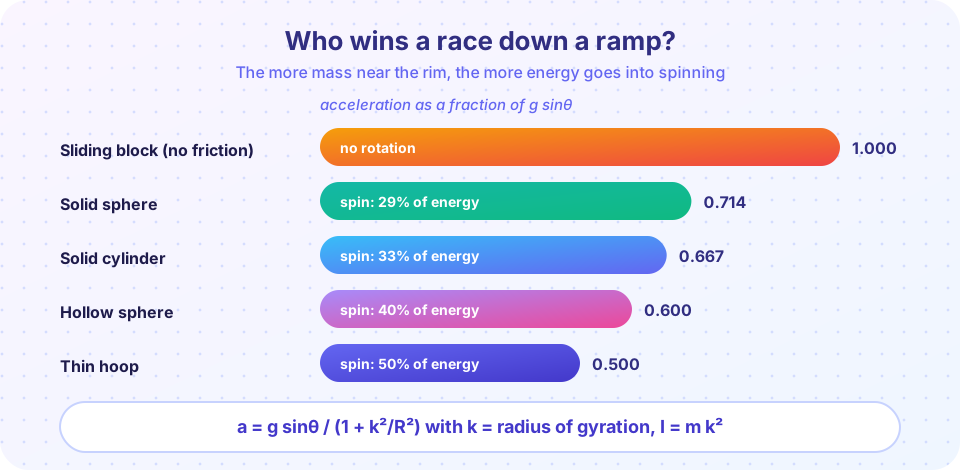
The first term is the energy of the mass moving with G; the second is the energy of spinning about G. If the body turns about a fixed axis O, the same energy is T = ½ I_O ω². The two forms agree because I_O = I_G + m d² and v_G = ω d. For a body rolling without slipping, substitute ω = v_G/R: T = ½ m v_G² (1 + k²/R²).
Work and conservation of energy
Work-energy: T₁ + ΣU₁₋₂ = T₂. Forces do work ∫ F · dr at their points of application; a couple does work M dθ. Three useful facts:
- Weight does work
m g Δhthrough the movement ofGonly. - Static friction on a body that rolls without slipping does no work: its point of application, the contact point, is instantaneously at rest.
- Pin and normal forces do no work when their points do not move along the force.
If only weight and spring forces do work, mechanical energy is conserved: T + V = constant.
Example 1: rolling from a height
A solid cylinder starts from rest at height h = 1.5 m and rolls to the bottom. Energy: m g h = ½ m v² + ½ (½ m R²)(v/R)² = ¾ m v², so
v = √(4 g h / 3) = √(19.62) = 4.43 m/s
A sliding block would reach √(2gh) = 5.42 m/s. For a solid sphere, v² = 10 g h / 7. In every case v depends on the shape (k/R) but not on the mass or radius. That is why the race in the picture above has the same winner for every size.
Example 2: a swinging bar
The bar of the previous lesson (m = 3 kg, L = 1.2 m) is released from the horizontal. At the vertical position G has dropped L/2: m g L/2 = ½ I_O ω² = ½ (m L²/3) ω², so
ω = √(3 g / L) = √24.5 = 4.95 rad/s
Using energy avoided solving the equation of motion. It does not, however, tell you the pin force: that still needs ΣF = m a_G with a_n = ω² L/2.
Power
Power of a force is F · v at its point; power of a torque is M ω. A motor that delivers M = 12 N·m at ω = 100 rad/s provides P = 1,200 W. Efficiency is output power divided by input power.
Linear and angular momentum
For a rigid body:
linear momentum:    L = m v_G
angular momentum:   H_G = I_G ω     (about the mass center)
about a fixed point O:   H_O = I_O ω
For a body whose center moves, the angular momentum about a point P is H_P = I_G ω + (r_(G/P) × m v_G). The principles of impulse and momentum are:
m v₁ + ∫ ΣF dt = m v₂
I_G ω₁ + ∫ ΣM_G dt = I_G ω₂
If the sum of moments about an axis is zero, angular momentum about that axis is conserved. A skater pulling in the arms reduces I and increases ω; a diver tucks to spin faster. A cat falling uses the same idea to turn over.
Example 3: two disks joined by a clutch
Disk 1 (I₁ = 0.50 kg·m²) spins at ω₁ = 20 rad/s. Disk 2 (I₂ = 0.30 kg·m²) is at rest on the same shaft. A friction clutch joins them. There is no external torque on the pair, so angular momentum is conserved:
I₁ ω₁ = (I₁ + I₂) ω₂ → ω₂ = 0.5 × 20 / 0.8 = 12.5 rad/s
Energy before = ½ (0.5)(20²) = 100 J; after = ½ (0.8)(12.5²) = 62.5 J. The missing 37.5 J is heat in the clutch. The calculation below shows that this loss does not depend on how hard the clutch squeezes.
Common misconceptions
"Rolling friction removes energy." Static friction in rolling without slipping does no work.
"Heavier bodies roll faster." Speed after a drop depends on k/R, not on mass.
"Angular momentum needs a pin." It is conserved whenever the net moment about the chosen point or axis is zero.
"Energy is conserved in every impact or coupling." Angular momentum can be conserved while energy is lost.
Try it
Race a hoop, a solid cylinder and a solid sphere down a 2 m ramp at 15°. The code computes each acceleration from energy and plots the position against time.
Press Run (or Ctrl + Enter) to see the result here.
Program input · what you'd type while the program runs
Type the answers before you press Run, one per line. Each time the program reads a line (with input()), it gets the next line from this box.
Now simulate the clutch. The torque Tc slows disk 1 and speeds up disk 2 until the speeds match. The final speed is always 12.5 rad/s, and the energy lost is always about 37.5 J, whatever the clutch torque.
Press Run (or Ctrl + Enter) to see the result here.
Program input · what you'd type while the program runs
Type the answers before you press Run, one per line. Each time the program reads a line (with input()), it gets the next line from this box.
Check your understanding
Quick check · 5 questions
of 5 answered You scored / 5 · perfect!
-
1. A wheel (m = 4 kg, I_G = 0.08 kg·m²) has v_G = 3 m/s and ω = 10 rad/s. What is T?
T = ½(4)(9) + ½(0.08)(100) = 18 + 4 = 22 J. -
2. A solid cylinder rolls from rest down a drop of 0.8 m. How fast is it at the bottom?
v = √(4gh/3) = √(10.46) = 3.24 m/s. -
3. Does static friction do work on a wheel that rolls without slipping?
Work is force times displacement of the point of application, which is zero for the contact point. -
4. A skater with I = 3 kg·m² and ω = 4 rad/s pulls in her arms to I = 2 kg·m². The new ω is:
Angular momentum is conserved: 3 × 4 = 2 × ω, so ω = 6 rad/s. -
5. In the clutch example, where did the missing energy go?
The clutch slips while the speeds differ, converting kinetic energy into heat.
Summary
T = ½ m v_G² + ½ I_G ω²; about a fixed pin,T = ½ I_O ω².- Couples do work
M dθ; rolling friction does none; weight doesm g Δh. - Angular momentum
H_G = I_G ωis conserved when the net moment is zero. - Rolling speed depends on
k/R, not on mass.
Next: Chapter 6 review
Track your progress
Create a free account to tick off lessons and pick up where you left off on any device.
of Engineering Dynamics lessons completed