


















Lesson 40 of 47 · Applications and Simulation
The slider-crank mechanism
Analyze the slider-crank used in engines and compressors: exact piston position, velocity and acceleration, dead centers and the inertia force on the piston.
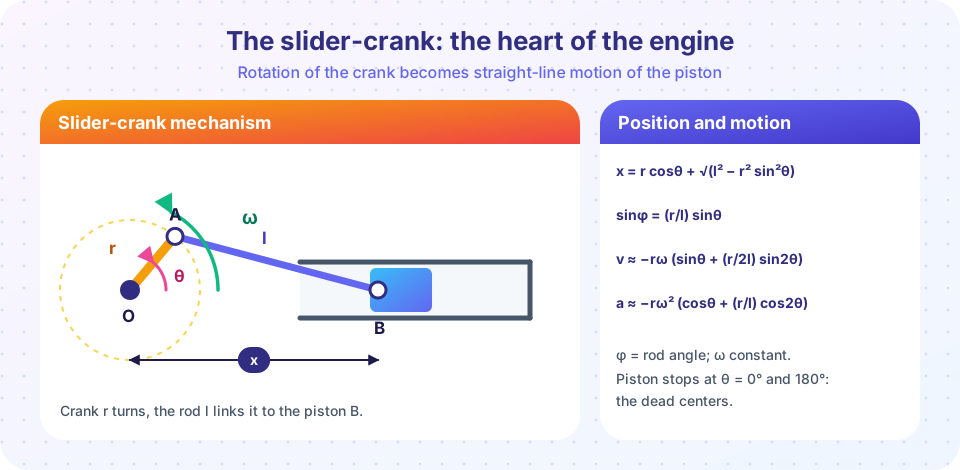
Almost every piston engine, air compressor and pump contains a slider-crank: a crank that turns, a connecting rod that links it to a piston, and a cylinder that makes the piston move in a straight line. It turns the rotation of a shaft into reciprocating motion, or the other way around.
It is a perfect case study for this course. The kinematics use the relative-velocity tools of chapter 5, the forces use the kinetics of chapter 6, and the numbers are easiest to explore with a short simulation.
What you will learn
- Derive the exact piston position
x(θ)and the rod angleφ. - Obtain velocity and acceleration, exactly and with the standard approximation.
- Find the maximum piston acceleration and the inertia force at the dead centers.
- Use a simulation to explore the effect of the ratio
l/r.
Key terms
Crank radius r: the distance from the crank axis to the crank pin.
Connecting rod length l: the distance between its two pins.
Rod ratio n = l/r: typically 3 to 4 in engines.
Dead center: the positions θ = 0 (top) and θ = 180° (bottom), where the piston stops and reverses.
Geometry
Put the crank axis O at the origin with the cylinder axis along x. The crank pin A is at (r cosθ, r sinθ). The rod of length l connects A to the piston pin B = (x, 0). The rod angle φ satisfies r sinθ = l sinφ. Then
x = r cosθ + l cosφ = r cosθ + √(l² − r² sin²θ)
At θ = 0, x = r + l (top dead center, TDC); at θ = 180°, x = l − r (bottom dead center, BDC). The stroke is 2r.
Velocity and acceleration
For a constant crank speed ω, differentiate with θ = ωt:
ẋ = −r ω sinθ − (r² ω sinθ cosθ) / √(l² − r² sin²θ)
Because r/l is small, it is common to use the series expansion, which is very accurate for l/r ≥ 3:
ẋ ≈ −r ω ( sinθ + (r/2l) sin 2θ )
ẍ ≈ −r ω² ( cosθ + (r/l) cos 2θ )
At the top dead center, θ = 0: ẍ = −r ω² (1 + r/l), pointing toward the crank and large. At the bottom dead center the magnitude is r ω² (1 − r/l): smaller. The piston accelerates harder near the top than the bottom. The cos 2θ term is a second harmonic: a vibration at twice the shaft speed that makes four-cylinder engines hum at twice crank frequency.
You can also get ẋ from the relative-velocity method: v_B = v_A + ω_AB × r_(B/A) with v_B horizontal. At the dead centers v_A is perpendicular to the cylinder axis and r_(B/A) lies along it, so v_B = 0, as the earlier relative velocity lesson showed. The rod's angular velocity is ω_AB = −(r ω cosθ)/(l cosφ).
Worked example
An engine has r = 0.05 m (stroke 100 mm), l = 0.15 m and runs at 3000 rpm, so ω = 314.16 rad/s. The mean piston speed is 2 × stroke × N = 2 × 0.1 × 50 = 10 m/s. The maximum acceleration at TDC is
r ω² (1 + r/l) = 0.05 × 98,696 × 1.333 = 6,580 m/s² ≈ 670 g
A piston of mass 0.4 kg then needs an inertia force of 0.4 × 6,580 = 2,630 N in each direction at the dead centers. These inertia loads are what the connecting rod, the crank and the bearings must withstand, and why racing engines are limited by piston speed and rod strength rather than only by combustion.
Forces
The gas pressure force p A_piston pushes the piston; the inertia force −m_p ẍ subtracts from it. At high speed the inertia term dominates at TDC on the exhaust stroke. The net piston force is passed through the rod: its component along the rod is F/cosφ, and the crank turns with torque F r sin(θ + φ)/cosφ. Because that torque fluctuates, engines carry a flywheel (see the moment of inertia lesson) to keep the speed steady.
Common misconceptions
"The piston moves as a pure cosine." The cos 2θ term makes it asymmetric; the piston spends more time in the lower half of its stroke.
"Acceleration is maximal in the middle of the stroke." Velocity is maximal near the middle; acceleration is maximal at the dead centers.
"A longer rod does nothing." It reduces the second harmonic (r/l) and the side thrust on the cylinder wall, at the cost of a taller engine.
"The piston moves at the same speed as the crank pin." The pin moves on a circle at the constant speed rω. The piston's speed changes continuously from zero at the dead centers to a peak of roughly rω, reached a little before mid-stroke.
Try it
Drag the crank angle and watch the piston. The readout shows the exact position and the velocity and acceleration from the approximate formulas, divided by r (or r ω²) so the numbers are dimensionless.
This script computes the engine from the worked example over a full turn, compares exact and approximate formulas, and plots position, velocity and acceleration of the piston.
Press Run (or Ctrl + Enter) to see the result here.
Program input · what you'd type while the program runs
Type the answers before you press Run, one per line. Each time the program reads a line (with input()), it gets the next line from this box.
Check your understanding
Quick check · 5 questions
of 5 answered You scored / 5 · perfect!
-
1. A slider-crank has r = 40 mm and l = 120 mm. What is the stroke?
The stroke is twice the crank radius. -
2. At which crank angles is the piston velocity zero?
At the dead centers the crank pin moves perpendicular to the cylinder axis and the rod only turns. -
3. r = 0.04 m, l = 0.12 m, ω = 200 rad/s. What is the piston acceleration magnitude at TDC?
rω²(1 + r/l) = 0.04 × 40,000 × (1 + 1/3) = 2,133 m/s². -
4. What does the cos 2θ term in the acceleration represent?
It comes from the finite rod length and produces a vibration at twice the shaft frequency. -
5. Where is the piston acceleration larger: at TDC or BDC?
At TDC the magnitude is rω²(1 + r/l); at BDC it is rω²(1 − r/l).
Summary
x = r cosθ + √(l² − r² sin²θ), withsinφ = (r/l) sinθ.ẋ ≈ −rω(sinθ + (r/2l) sin2θ)andẍ ≈ −rω²(cosθ + (r/l) cos2θ).- The piston stops at the dead centers and has maximum acceleration there:
rω²(1 ± r/l). - Inertia forces scale with
ω², which limits engine speed.
Next: Chapter 8 review
Track your progress
Create a free account to tick off lessons and pick up where you left off on any device.
of Engineering Dynamics lessons completed